Why Peptide Stacking Needs Structure
The central problem is not lack of information. It is lack of hierarchy.
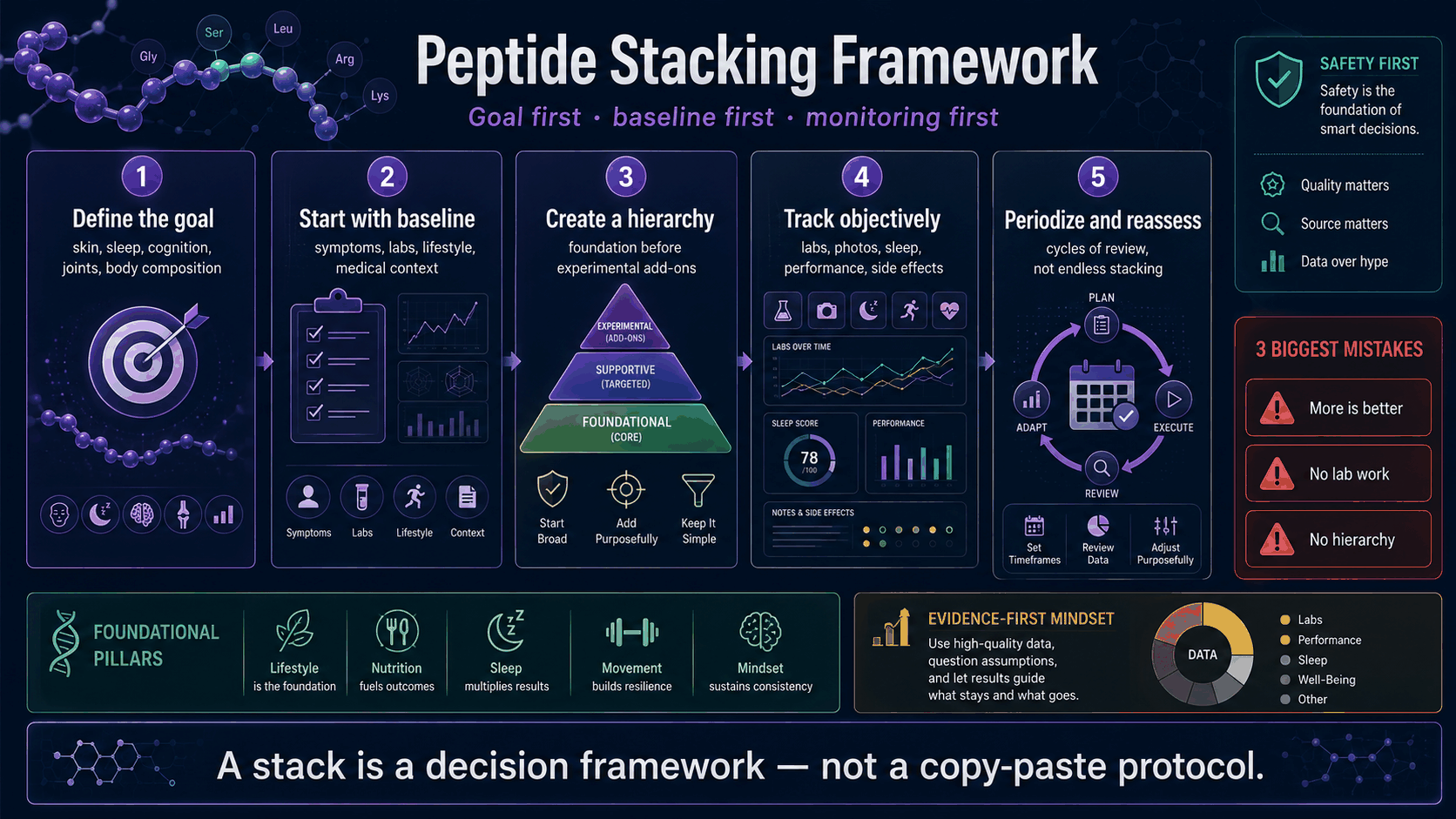
Peptide stacking becomes risky and inefficient when the stack is built from excitement instead of a goal. A useful protocol starts with one main outcome, confirms the baseline with labs, closes the foundational layer, then adds only the minimum number of agents needed to test the hypothesis.
The Three Biggest Stacking Mistakes
“More is better”
A large stack makes it harder to understand what works, what causes side effects, and which interaction matters. The script’s rule is to introduce no more than 1–2 new agents per month.
No lab work
Starting GH secretagogues without IGF-1, or hormone-related protocols without TSH and testosterone context, is described as building without a foundation.
No hierarchy
Peptides should not come before sleep, nutrition, recovery, and baseline nutraceutical support. The pyramid works from the bottom up.
Five Steps to Build a Personalized Protocol
 Sponsored / AffiliateUlta Lab Tests · Lab testing for hormones, inflammation, and wellness
Ready-Made Goal-Based Stack Frameworks
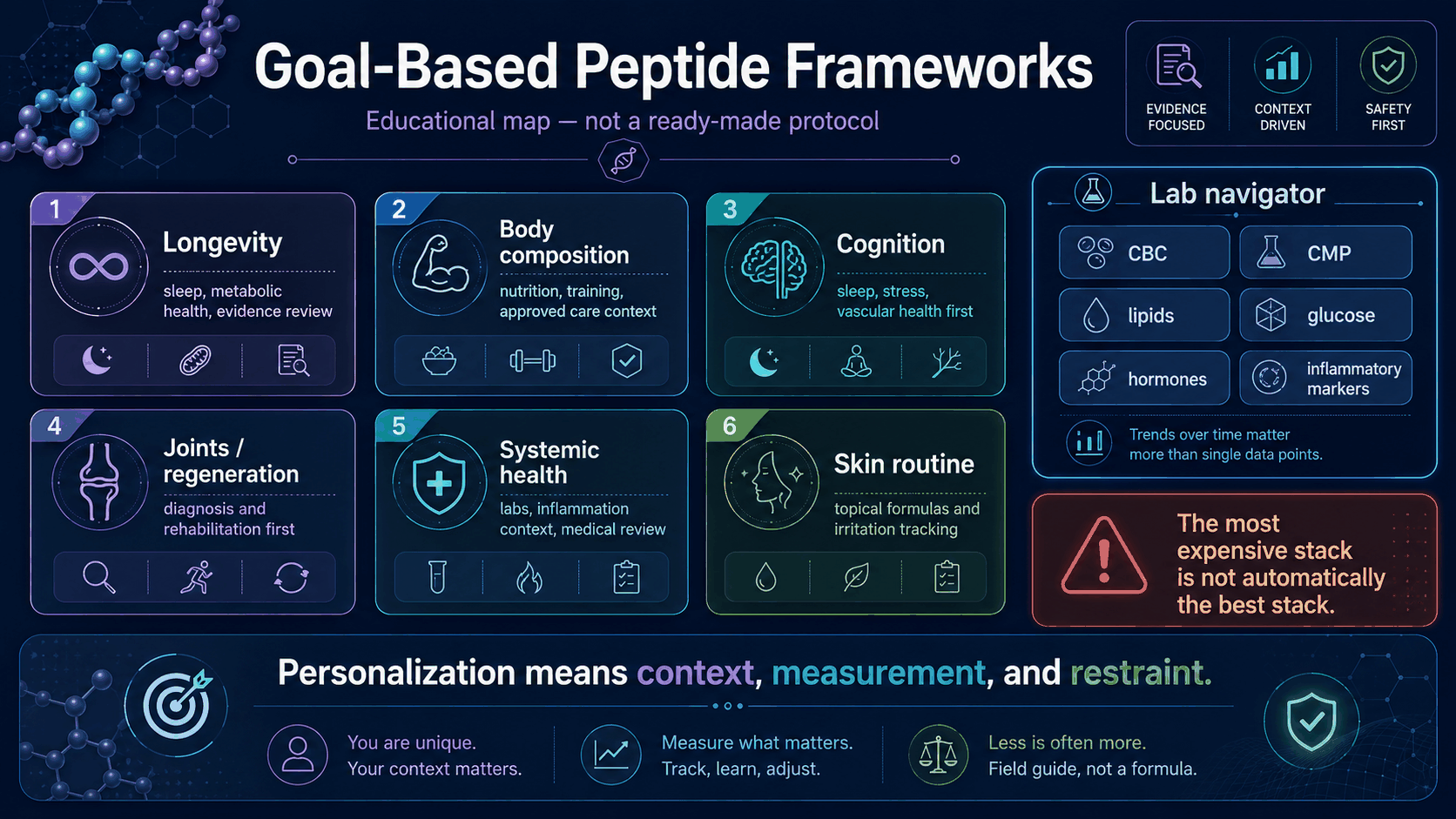
These frameworks are educational maps, not instructions to self-dose. They are meant to show hierarchy: anchor, support agents, foundation, and monitoring.
Anti-aging / Longevity
- Anchor: GHK-Cu topical + systemic context.
- Support: BPC-157, Epitalon, glycine, Semax context.
- Track: hs-CRP, IGF-1, biological-age tools.
Body Composition
- Anchor: CJC-1295 + Ipamorelin context.
- Support: BPC-157, glycine, magnesium, collagen.
- Track: IGF-1, E2, InBody every 6 weeks.
Cognition
- Anchor: Semax course context.
- Support: glycine, Selank during stress, Epitalon context.
- Track: cognitive tests and cortisol.
Joints / Regeneration
- Anchor: BPC-157 local discussion.
- Support: TB-500 context, collagen + vitamin C, UC-II.
- Track: VAS pain and functional testing.
Systemic Health
- Anchor: oral BPC-157 for barrier + NF-κB context.
- Support: GHK-Cu, Thymalin, ashwagandha context.
- Track: hs-CRP and IL-6.
Skin Routine
- Anchor: topical GHK-Cu context.
- Support: retinol, derma roller, niacinamide, SPF.
- Track: standardized photos after 12 weeks.
Periodization: The Main Principle
| Phase | Structure | Purpose |
|---|---|---|
| Weeks 1–2 | One anchor peptide | Observe response and establish tolerability. |
| Weeks 3–6 | Anchor + first support agent | Observe synergy and prepare control labs. |
| Weeks 7–10 | Full stack, max 3–4 agents | Peak protocol phase. |
| Weeks 11–14 | Pause or minimum maintenance | Restore sensitivity and avoid diminishing returns. |
Lab Work as the Navigator
Labs matter before starting, after 6–8 weeks, and after 3–6 months. They protect the protocol from guesswork.
hs-CRP, IGF-1, TSH, HbA1c, vitamin D 25-OH, testosterone/free testosterone, SHBG, E2 when relevant, and CBC.
No labs — no protocol. No doctor with hormonal changes — no GH secretagogues. No periodization — no reliable result.
Two Common Myths
Myth: The best stack is the one used by a famous blogger or athlete.
Fact: A stack only makes sense in the context of a person’s goals, labs, lifestyle, age, and baseline inflammation. Copying another person’s protocol is the most common error.
Myth: The most expensive stack gives the best result.
Fact: The quality of the result depends on the structure: goal, foundation, anchor, monitoring, and periodization — not how exotic the ingredients sound.
Frequently Asked Questions
What is peptide stacking?
It is the practice of combining peptide-related strategies or peptide-adjacent support layers around a specific goal. It should be structured, minimal, and monitored.
Should a stack start with many peptides?
No. The script recommends starting with one anchor and one support agent, then adjusting after observation and labs.
Why are labs so important?
Labs establish the baseline, catch silent problems, and help determine whether the protocol is moving markers in the right direction.
Is this a dosing protocol?
No. This is an educational framework and not medical advice, dosing guidance, or a self-treatment recommendation.
 Sponsored / AffiliateIntegrative Peptides · Practitioner-oriented peptide and wellness education
Key Takeaways
- Peptide stacking should start with one main goal.
- The three major mistakes are: too many agents, no labs, and no hierarchy.
- The five-step build is: goal → labs → foundation → anchor + support → retest and adjust.
- Ready-made stacks are frameworks for discussion, not self-treatment instructions.
- Periodization and pauses are part of the protocol.
- Labs are the navigation system for any serious protocol conversation.