One Episode Before the Finale: Looking Forward
After 99 episodes of mechanisms, studies, and practical frameworks, the question becomes: what comes next?
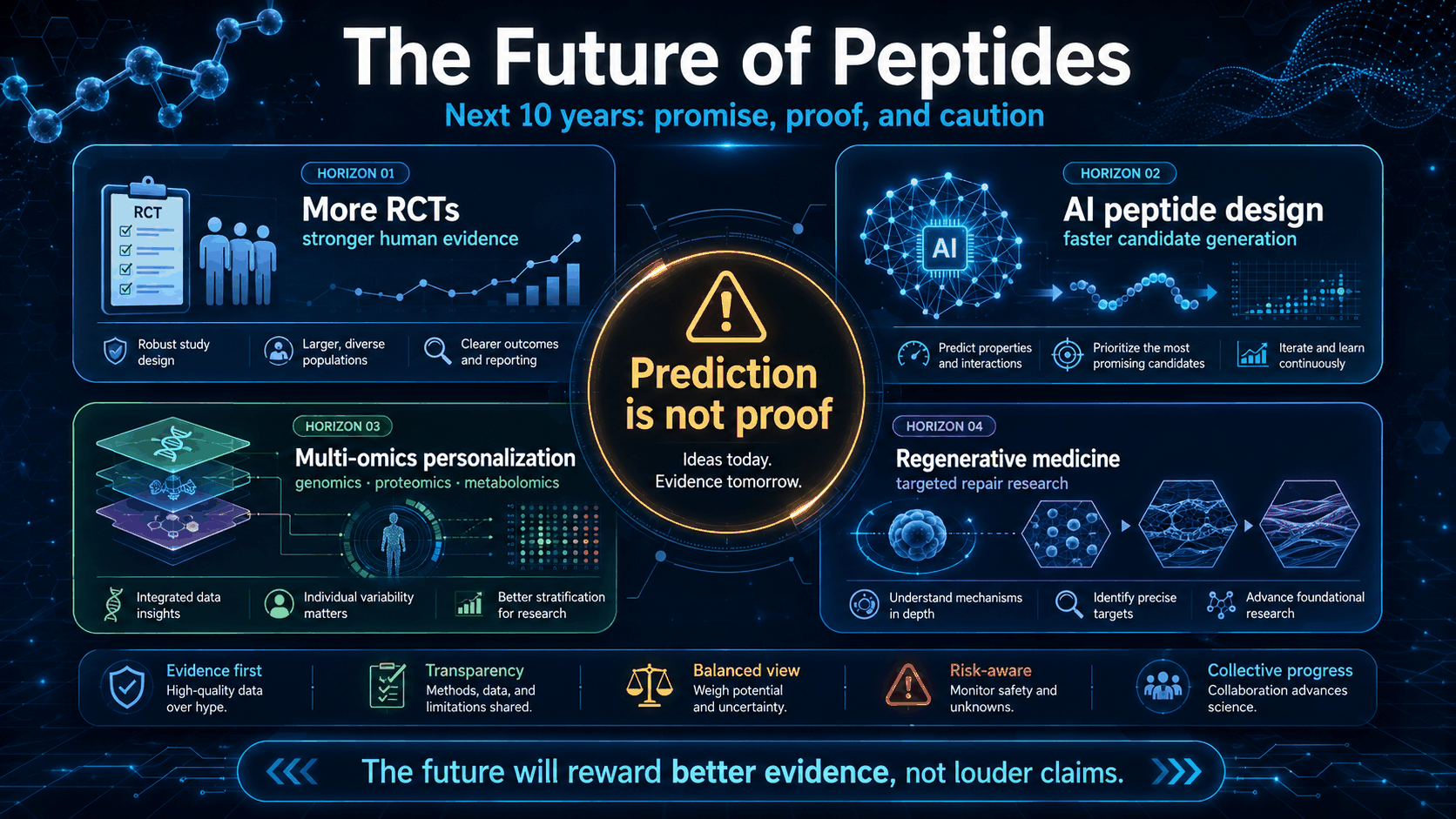
The future of peptide science is not only about new molecules. It is about better trials, stricter product quality, AI-assisted discovery, personal biochemical data, and a clearer understanding of where peptides fit in the wider system of health.
Four Horizons for Peptide Science
AI and Peptide Design
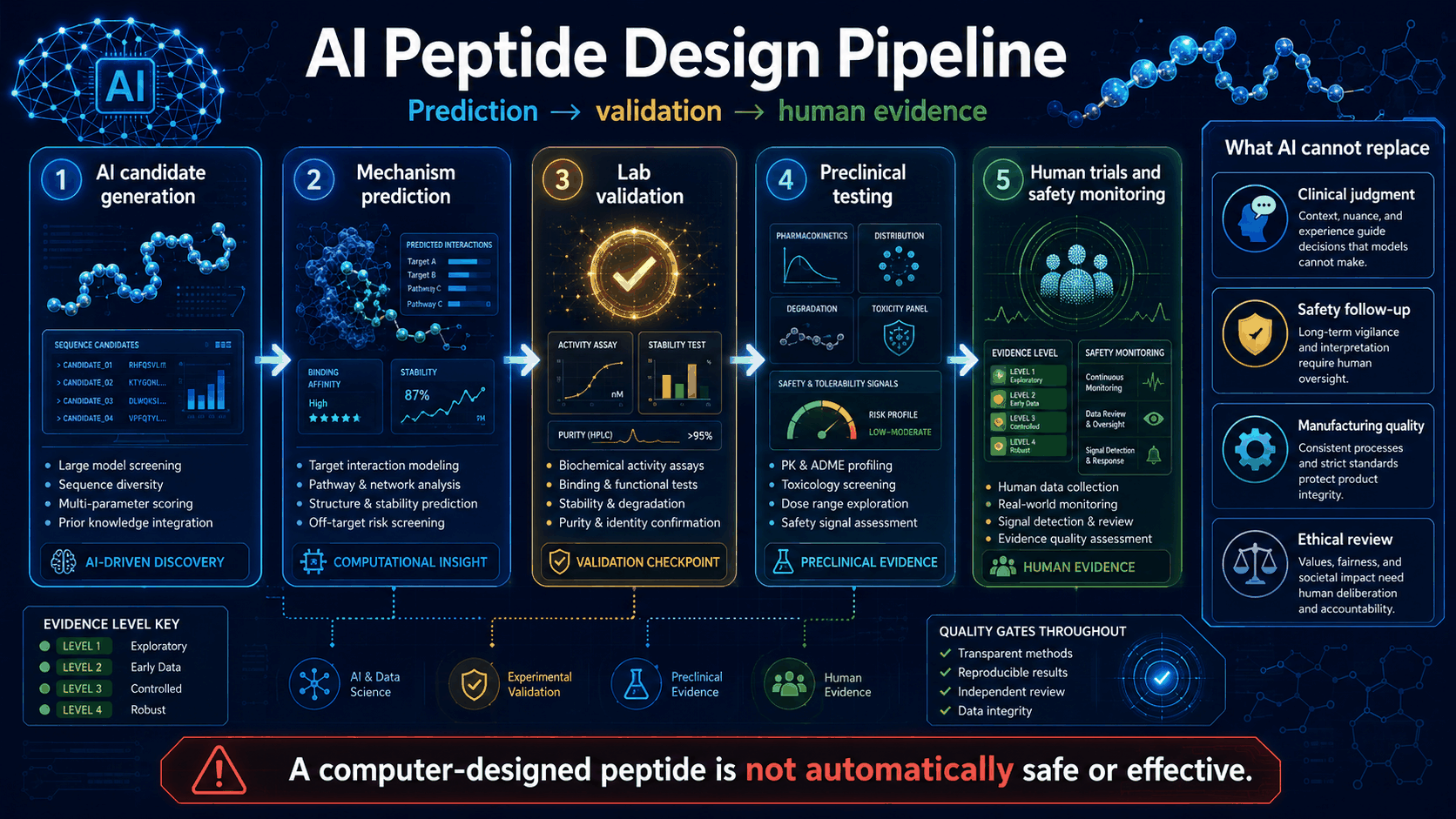
AI has already changed the way scientists think about protein structure. In the next phase, the key question becomes whether peptides can be designed for more specific targets, better pharmacokinetics, and fewer assumptions.
Faster candidate generation
Computational tools can test far more possible peptide structures than traditional trial-and-error discovery pipelines.
Targeted mechanisms
The promise is not “more peptides” alone. It is more specific receptor, pathway, and tissue-level hypotheses.
Prediction is not proof
AI can generate hypotheses, but clinical trials still determine whether an intervention is safe and effective in humans.
Beyond legacy peptides
The script frames GHK-Cu and BPC-157 as first-generation reference points; AI peptides may become the second generation.
 Sponsored / AffiliateDynamic Peptides · Research peptide catalog and product education resources
What Will Improve
More RCTs
The next decade may bring randomized trials for several peptides that currently sit between strong mechanism and incomplete human evidence.
Better standards
COA expectations, independent testing, and regulatory attention may improve product consistency as the market matures.
Individual profiles
Multi-omics plus AI could move protocols from “average response” to individualized biochemical patterns.
What Will Remain True
The most important part of the episode is not the forecast. It is the reminder that future tools do not cancel basic biology.
Chronic inflammation will still matter for aging and disease risk.
N3 sleep will remain one of the most powerful free longevity tools.
Aerobic exercise will still support BDNF, HDL, and lower inflammatory burden.
Biomarkers will remain more honest than subjective feelings.
A Letter to 2035
The script includes a reflective letter to the future: a hope that by 2035, BPC-157 has completed stronger trials, GHK-Cu has a clearer clinical role, and the audience has not only learned biochemistry but applied it.
Two Pre-Finale Myths
Myth: AI will replace doctors and make protocols automatic.
Fact: AI can improve pattern recognition and personalization, but clinical context, history, emotions, and judgment still matter. AI is an amplification tool, not a replacement.
Myth: One peptide will solve aging.
Fact: Aging is a system of parallel processes. Future strategy will likely be combined: peptides, senolytics, GLP-1 agonists, personalized nutraceuticals, and lifestyle.
Frequently Asked Questions
Is this a prediction or medical guidance?
It is a forward-looking educational prediction based on the supplied script, not clinical guidance.
What is the biggest future trend?
AI-assisted peptide design and multi-omics personalization are the two biggest forecasted shifts.
What should readers do now?
Focus on the foundations that will still matter in 10 years: sleep, movement, inflammation control, nutrition, and lab tracking.
Does AI prediction prove safety?
No. Prediction can help generate hypotheses, but human studies are still needed for safety and effectiveness.
 Sponsored / AffiliateiHerb · Supplements, wellness products, and daily health essentials
Key Takeaways
- Peptide science may move from observation toward stronger clinical evidence.
- AI-designed peptides could become a major discovery engine between 2027 and 2030.
- Multi-omics personalization may change how protocols are selected.
- Peptides may merge with regenerative medicine in the longer term.
- Future tools do not replace sleep, movement, inflammation control, nutrition, and lab work.