
Why BPC‑157 Became the Main Peptide of the Series
BPC‑157 appears again and again because its mechanisms intersect with multiple biological systems: gut barrier, vascular signaling, inflammation, tissue repair, neurochemistry, pain, and stress consequences.
The honest framing is important: BPC‑157 is mechanistically interesting and strongly represented in animal models, but large completed human randomized trials are still missing. This makes it a high-interest peptide, not a confirmed cure-all.
History: Sikiric and Three Decades of Research
The script frames Professor Predrag Sikiric’s work as the main research line behind BPC‑157: more than 100 peer-reviewed publications across many experimental models. The strength is consistency across animal systems; the limitation is that most of the evidence remains preclinical.
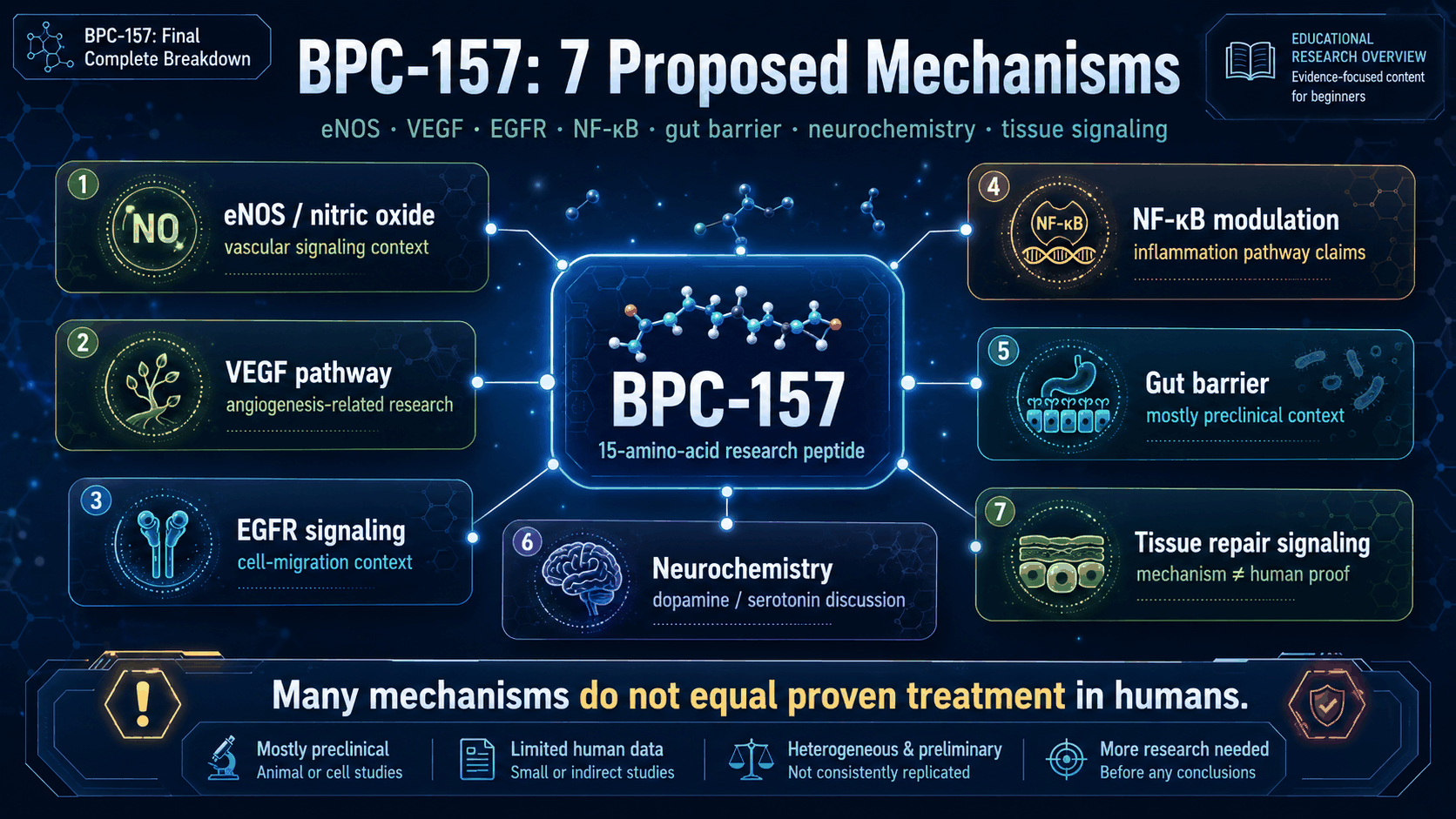
Seven Mechanisms
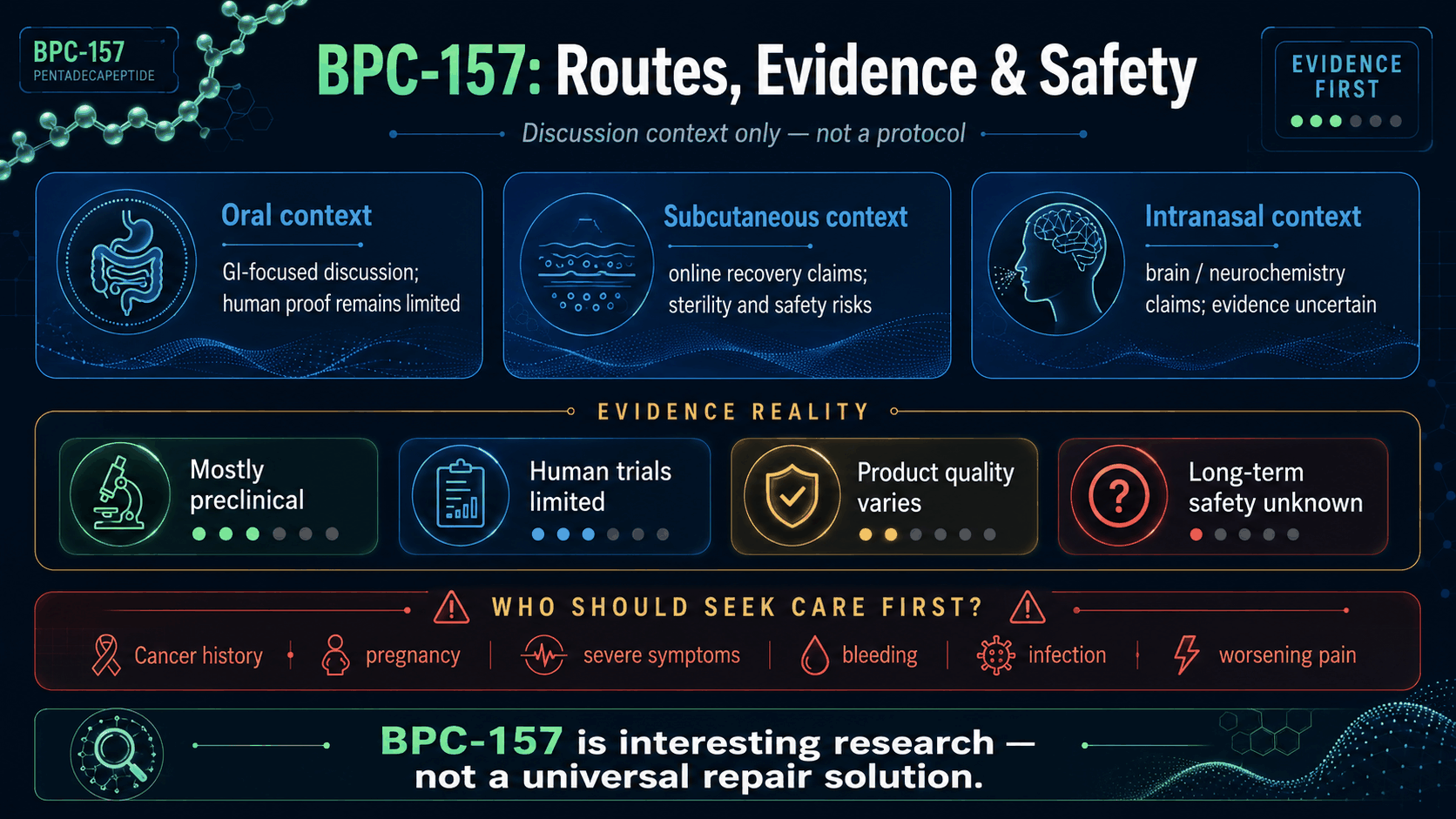
Formats: When Each Route Is Discussed
| Format | Main discussion context | Evidence boundary | Safety boundary |
|---|---|---|---|
| Subcutaneous | Systemic and local tissue-repair context; joints, tendons, ligaments, cardiovascular/immune contexts | Mostly animal/mechanistic; human protocols extrapolated | Clinician-guided only; sterile technique and legal status matter |
| Oral | GI barrier, IBD/IBS, gut-systemic switch, long-COVID gut reservoir discussion | Unique acid-stability logic; clinical confirmation still needed | Persistent GI symptoms require medical evaluation |
| Intranasal | CNS and neurochemistry context | Less data than oral/subcutaneous | Neurologic or psychiatric symptoms require qualified care |
| Eye drops | Cornea/conjunctivitis model context | Niche and limited data | Eye symptoms require ophthalmology care |
35+ Mentions Across the Series
Barrier and inflammation
IBD, IBS, LPS endotoxemia, gut-systemic switch, NF‑κB, TNF‑α, autoimmune caution.
VEGF and regeneration
Angiogenesis, tendons, ligaments, collagen context, synovitis context, peripheral inflammatory pain.
Neurochemistry and SHBG
Dopamine, serotonin, stress models, free testosterone context, erectile-function discussion via NO.
 Sponsored / AffiliateDT Peptides · Peptide research products and laboratory-focused resources
Final Frameworks by Goal
GI / gut-systemic
- Oral BPC‑157 discussion.
- Barrier-first logic.
- Probiotics and postbiotics in parallel context.
- Track symptoms and hs‑CRP trend with clinician context.
Joints / regeneration
- Local subcutaneous discussion.
- VEGF / angiogenesis context.
- Collagen + vitamin C with loading context.
- Injury diagnosis and rehab are essential.
Systemic inflammation
- NF‑κB downshift context.
- Omega‑3 / curcumin synergy discussion.
- hs‑CRP goal context.
- Do not skip medical workup.
Evidence-aware use
- Mechanisms are not proof.
- Animal data is not human proof.
- Phase II context is not approval.
- Legal/clinical guidance matters.
Evidence Limits and Honest Assessment
BPC‑157 is biologically plausible and mechanistically logical. It has a large body of preclinical data and a consistent research lineage, but the gold standard for clinical claims is completed human randomized controlled trials.
Two Common Myths
Myth: BPC‑157 is fully safe because it comes from the stomach.
Fact: BPC‑157 is a synthetic analogue of a peptide found in gastric juice. Origin does not prove safety; safety requires toxicology and human clinical evidence.
Myth: BPC‑157 cures everything because it affects many systems.
Fact: Broad mechanisms are not the same as disease treatment. BPC‑157 is discussed around support pathways, not as a cure for cancer, autoimmune disease, neurodegeneration, or injuries.
Frequently Asked Questions
What does BPC‑157 mean?
Body Protection Compound 157 — a synthetic analogue of a peptide found in human gastric juice.
Why is oral BPC‑157 discussed at all?
Because BPC‑157 is discussed as stable in gastric-acid conditions, unlike many peptides. That gives it a unique oral-use rationale, especially for gut-barrier contexts.
Is BPC‑157 proven in humans?
No broad clinical proof yet. The script mentions Phase II context for IBD, but completed human RCT results are still needed before strong clinical claims.
Is it safe to inject at home?
This article does not recommend self-injection. Injectable peptide use should be clinician-guided, sterile, and legally appropriate.
Who should seek medical care first?
Anyone with persistent GI symptoms, IBD, severe pain, injury, cardiovascular or neurologic symptoms, active infection, immune disease, cancer care, pregnancy, abnormal labs, or poor healing.
 Sponsored / AffiliateQuest Health · Personal lab testing and health marker tracking
Key Takeaways
- BPC‑157 is a 15-amino-acid gastric peptide analogue with broad mechanistic discussion.
- The seven core mechanisms are NO/eNOS, gut barrier, NF‑κB, VEGF, neurochemistry, SHBG context, and gastric stability.
- Oral, subcutaneous, intranasal, and ophthalmic routes have different evidence and safety boundaries.
- Most data is still animal/mechanistic; completed human RCT evidence is needed.
- BPC‑157 should not be framed as a cure-all or self-treatment tool.
- The page is mobile-responsive: TOC unsticks, grids collapse, mechanisms stack, images/ad blocks resize, tables scroll horizontally.