
Why GHK-Cu Deserves Its Own Episode
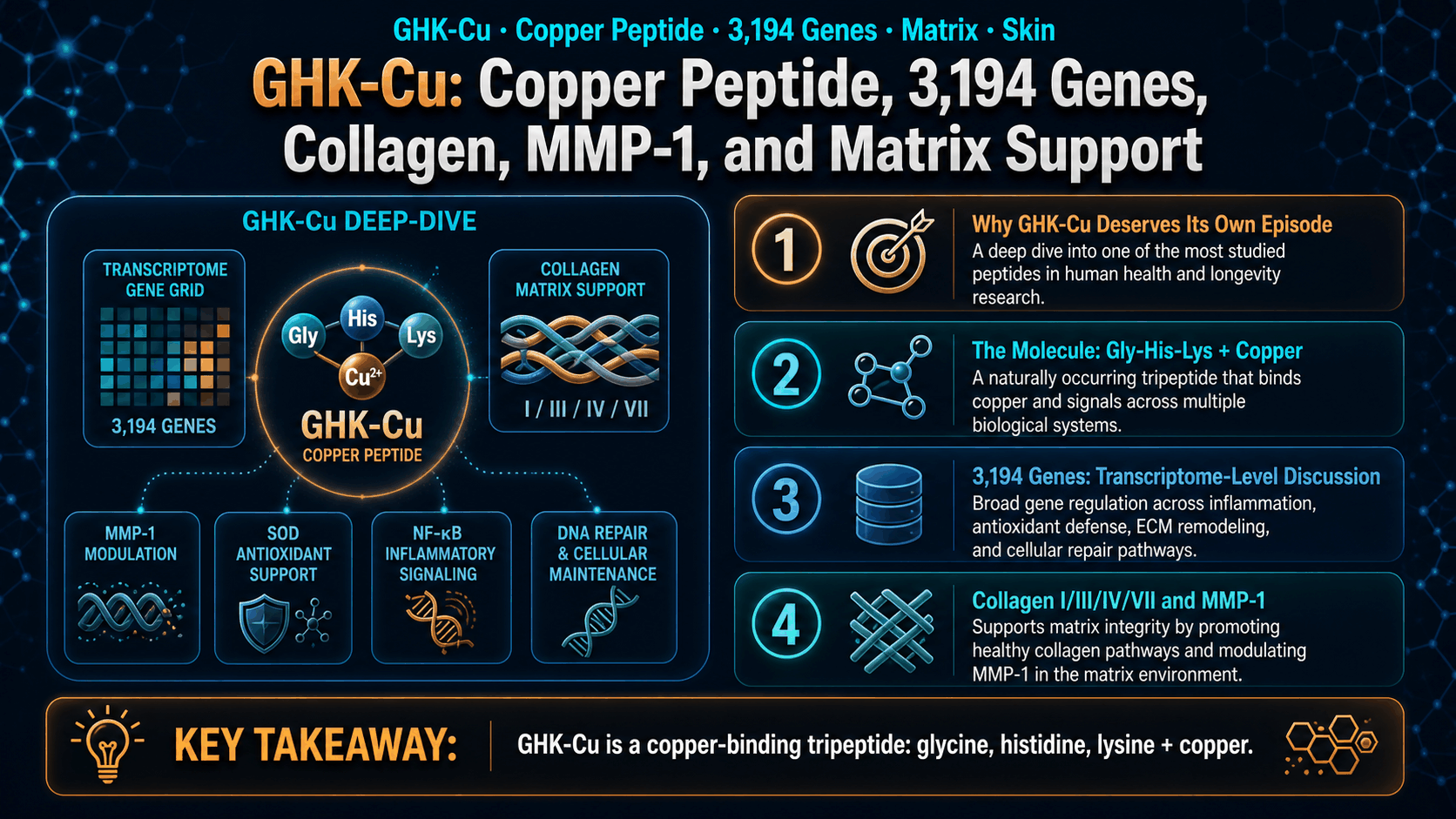
GHK-Cu is one of the most frequently recurring peptides in this series because it touches skin, collagen, matrix remodeling, inflammation, antioxidant defense, DNA-repair gene context, and biological-aging discussions.
It is not only a cosmetic ingredient. It is a small copper-binding peptide discussed as a signal molecule that can shift gene-expression patterns and support matrix biology. The key is to keep the claims honest: powerful transcriptomic context does not equal permanent genome rewriting or guaranteed clinical rejuvenation.
The Molecule: Gly-His-Lys + Copper
Three amino acids
GHK stands for glycine-histidine-lysine. Copper (Cu²⁺) coordinates with the peptide and changes its biological activity.
Copper as cofactor
Copper is required for enzymes such as Cu/Zn-SOD and lysyl oxidase, but abnormal copper metabolism or excessive exposure changes the safety context.
 Sponsored / AffiliatePeptide ReGenesis · Peptide education, protocols, and wellness-focused resources
3,194 Genes: Transcriptome-Level Discussion
Pickart and Margolina are often cited in the series for transcriptomic work showing that GHK-Cu changed expression of 3,194 genes in human fibroblast contexts. This is why the molecule is framed as broader than a simple collagen stimulant.
Collagen I/III/IV/VII and MMP‑1
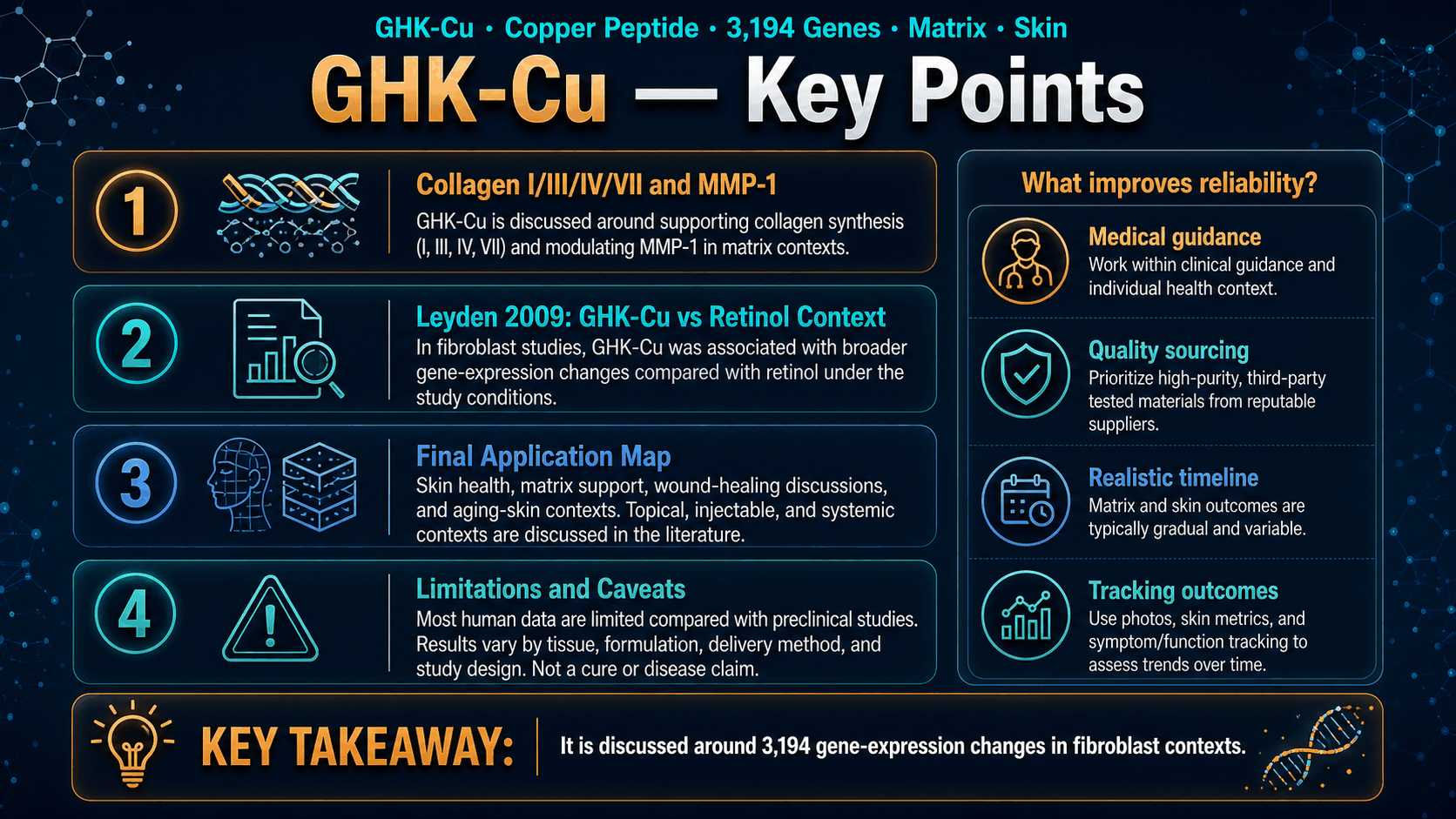
GHK-Cu is especially interesting because it is discussed as supporting collagen synthesis while also reducing collagen-degradation signaling through MMP‑1 context. This dual direction makes it different from tools that stimulate remodeling without clearly addressing breakdown.
Skin and connective tissue
Central to skin density, firmness, elasticity, and matrix architecture.
Basement membrane and junctions
Important for skin barrier architecture and dermal–epidermal structural integrity.
Collagenase pathway
Photoaging raises collagen breakdown via UV → AP‑1 → MMP‑1 context. GHK-Cu is discussed around downshifting this pathway.
Leyden 2009: GHK-Cu vs Retinol Context
The script highlights Leyden JJ et al. (2009), a double-blind randomized clinical study comparing topical GHK-Cu 1% with topical retinol 0.05% in photoaged skin. The key point: comparable improvement across several photoaging parameters with better tolerability in the GHK-Cu group in that study context.
| Topic | GHK-Cu context | Retinol context | Honest boundary |
|---|---|---|---|
| Photoaging | Skin density, wrinkles, pigmentation, tone support context | Strong photoaging evidence base | Leyden was one RCT, not a meta-analysis |
| Tolerability | Often gentler in the highlighted RCT context | More irritation/peeling context | Tolerance varies by skin type and formulation |
| Acne / keratinization | Not the strongest primary tool | Stronger evidence for keratinization and turnover | They can be synergistic, not simply competitors |
 Sponsored / AffiliateQuest Health · Personal lab testing and health marker tracking
Final Application Map
Skin-aging routine
- 0.5–1% cosmetic serum context.
- Works best around pH 5.5–7 context.
- Can pair with retinoids on compatible schedules.
- SPF remains essential.
Penetration support
- Can increase topical delivery in discussion.
- Technique and infection risks matter.
- Do not use on active infection or irritated skin.
- Professional guidance is safer.
Clinician-guided context
- Transcriptome-level tissue-support discussion.
- Systemic anti-aging RCT evidence is limited.
- Legal/regulatory status matters.
- Monitoring and medical context matter.
BPC‑157 / retinol context
- BPC‑157: acute repair context.
- GHK-Cu: deeper matrix-remodeling context.
- Retinol: receptor-driven turnover context.
- Different layers can complement each other.
Limitations and Caveats
pH and oxidation
Low pH may destabilize the copper chelate; oxidized/brown product should not be used.
More is not always better
0.5–1% is common cosmetic context; high concentrations may raise irritation/pro-oxidant concerns.
Two Common Myths
Myth: Copper means GHK-Cu is toxic on skin.
Fact: Cosmetic GHK-Cu uses chelated copper at low concentrations. Copper toxicity is a different context involving excessive exposure, poisoning, or copper-metabolism disorders.
Myth: GHK-Cu permanently rewrites the genome.
Fact: It changes gene expression — the transcriptome — which is epigenetic and expected to be reversible, not a permanent DNA-sequence change.
Frequently Asked Questions
What does GHK-Cu stand for?
GHK is glycine-histidine-lysine; Cu means copper. Together they form a copper-binding peptide complex.
Is GHK-Cu better than retinol?
Not universally. The highlighted RCT found comparable photoaging improvements with better tolerability, but retinoids have a stronger evidence base for acne and keratinization.
Can it be used with acids?
Low-pH AHA/BHA use can destabilize copper peptide formulations. Separate timing is usually safer in cosmetic routines.
Is systemic GHK-Cu proven for anti-aging?
No. Systemic use is mostly discussed through transcriptomic, animal, and mechanistic contexts; large clinical RCT evidence is limited.
Who needs medical guidance first?
Anyone with Wilson disease, copper metabolism issues, active cancer care, active infection, severe acne, poor wound healing, pregnancy, or unexplained skin lesions.
Key Takeaways
- GHK-Cu is a copper-binding tripeptide: glycine, histidine, lysine + copper.
- It is discussed around 3,194 gene-expression changes in fibroblast contexts.
- Key pathways include collagen I/III/IV/VII, MMP‑1, SOD, NF‑κB, and DNA-repair gene context.
- Leyden 2009 supports topical photoaging discussion but does not prove GHK-Cu is always better than retinol.
- Topical evidence is stronger than systemic anti-aging evidence.
- Systemic peptide use should be clinician-guided and legally appropriate.
- The page is mobile-responsive: grids, gene rows, cards, and tables adapt for small screens.