
Why Stress Matters for Every Protocol
Chronic stress can weaken the biological systems peptides are trying to support.
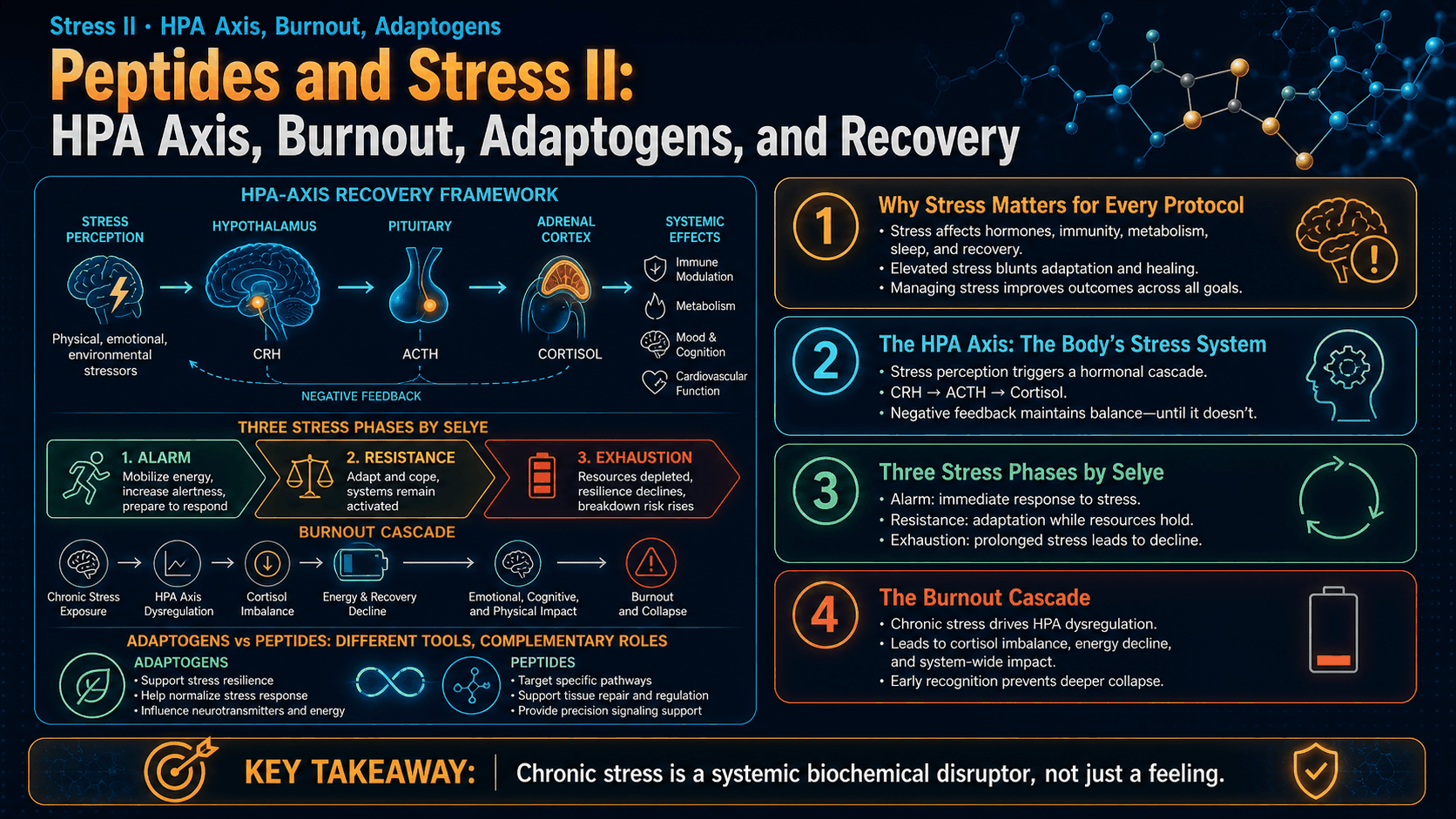
Cortisol and the HPA axis have appeared across many topics: sleep, immunity, testosterone, libido, gut health, collagen, BDNF, brain recovery, and viral reactivation. That is not a coincidence. Stress changes the biochemical environment in which every protocol operates.
The HPA Axis: The Body’s Stress System
The HPA axis means hypothalamic–pituitary–adrenal axis. It links the brain and adrenal glands through a stress-response chain: hypothalamus → CRH → pituitary → ACTH → adrenal glands → cortisol.
In normal physiology, cortisol is useful. It rises in the morning to help mobilize energy and activate the brain, then declines toward the evening to support relaxation and sleep. Chronic stress can flatten, distort, or mistime this rhythm.
 Sponsored / AffiliateApollo Peptide Sciences · Research-focused peptide science and molecular data
Three Stress Phases by Selye
Alarm
Acute stress. Cortisol, adrenaline, and noradrenaline rise to mobilize resources. This is adaptive when short-lived.
- Short-term activation.
- Useful survival response.
- Recovery should follow the event.
Resistance
Chronic stress. Cortisol may remain elevated, poorly timed, or difficult to regulate. Sleep, testosterone, libido, and recovery may suffer.
- Stress regulation becomes priority.
- Peptide strategies may underperform.
- Adaptogens and nervous-system tools may be discussed.
Exhaustion / burnout
Long-term depletion. Energy, mood, motivation, sleep, immune resilience, and performance may be impaired.
- Rest and workload reduction come first.
- Professional support may be necessary.
- Aggressive or stimulating protocols may backfire.
The Burnout Cascade
Chronic stress activates the HPA axis
Work pressure, conflict, financial stress, chronic pain, sleep disruption, inflammation, and oxidative stress can all keep the stress system active.
Recovery signaling weakens
Cortisol dysregulation can interfere with sleep depth and growth-hormone pulse context. GH-secretagogue strategies may underperform when stress is not addressed.
BDNF and neuroplasticity may suffer
Glucocorticoid burden is discussed in relation to hippocampal vulnerability and lower BDNF context. Stress management and Semax discussions may be synergistic.
Immune resilience can drop
Chronic stress may contribute to viral-reactivation contexts and immune dysregulation. Immune-support peptides do not solve the stress source by themselves.
Sleep and brain recovery decline
Stress can fragment sleep, reduce N3 quality, and weaken glymphatic-recovery context. Brain-focused strategies are undermined when sleep architecture is unstable.
 Sponsored / AffiliatePeptide ReGenesis · Peptide education, protocols, and wellness-focused resources
Adaptogens vs Peptides
Plant-based stress modulation
Ashwagandha, rhodiola, and eleuthero are discussed around stress resilience and HPA-axis modulation. They are usually cumulative tools rather than instant fixes.
- Best fit: chronic stress support.
- Effects may build over weeks.
- Ashwagandha is not universal; thyroid, liver, pregnancy, autoimmune disease, psychiatric medication, and sedatives require review.
Neurochemical and inflammation context
Selank is discussed around anxiety-context support, GABA modulation, and BDNF context. Semax is discussed around neurotrophic support. BPC‑157 is discussed around inflammation and gut-barrier context.
- Best fit: selected acute-stress or neurochemical discussions.
- Not a replacement for therapy or medication care.
- Use caution with psychiatric conditions and medications.
| Category | Examples | Best fit | Main caution |
|---|---|---|---|
| Adaptogens | Ashwagandha, rhodiola, eleuthero | Chronic stress resilience and HPA-axis context. | Interactions, thyroid/liver/autoimmune/pregnancy context. |
| Peptides | Selank, Semax, BPC‑157 | Neurochemical, BDNF, inflammation, and gut-brain-axis discussions. | Not a substitute for mental-health care; clinician guidance preferred. |
| Foundational tools | Sleep, workload changes, therapy, movement, breathing | Most important base layer. | Often skipped because they require behavior change. |
Phase-Based Anti-Stress Framework
Alarm
Acute stress support
- Breathing practices such as box breathing or 4-7-8 breathing.
- L-theanine with or without caffeine if tolerated.
- Selank discussion for acute anxiety/stress context.
- Magnesium and glycine context in the evening for recovery.
Resistance
System-level stress management
- Ashwagandha discussion as cumulative HPA-axis support.
- Selank discussion for GABA/neurochemical context.
- Magnesium glycinate for nighttime excitability context.
- Rhodiola discussion for mental-fatigue context if tolerated.
- Labs may include cortisol timing, DHEA-S, thyroid, glucose, and sex hormones when clinically relevant.
Burnout
Recovery-first approach
- Pause aggressive or stimulatory protocols.
- Rest, workload reduction, sleep restoration, and basic support come first.
- Psychotherapy, psychiatric care, or medical care may be necessary.
- Epitalon and thymic-support discussions belong only in careful, clinician-guided contexts.
- GH-secretagogues and stimulating strategies should wait until stabilization.
Two Common Myths
Myth: Peptides can compensate for chronic stress.
Fact: Peptides may support selected pathways, but they do not cancel biological limits. Chronic stress can still damage sleep, hormones, immune balance, and neuroplasticity.
Myth: Burnout is just fatigue.
Fact: Burnout can involve exhaustion, cynicism, reduced effectiveness, sleep disruption, mood symptoms, and long recovery. A couple of days off may not be enough.
Frequently Asked Questions
Can Selank replace anxiety treatment?
No. Selank is discussed as a support tool, not a replacement for therapy, psychiatric care, prescribed medication, or emergency care.
Is ashwagandha safe for everyone?
No. It may interact with thyroid status, sedatives, psychiatric medications, liver conditions, autoimmune disease, pregnancy, and other contexts. Medical review is wise.
What labs are useful for stress?
Clinicians may consider morning/evening cortisol, DHEA-S, thyroid markers, glucose, inflammatory markers, sex hormones, sleep evaluation, and medication review depending on symptoms.
When should someone seek urgent help?
Suicidal thoughts, severe panic, inability to function, chest pain, severe insomnia, psychosis, or major depression require urgent professional support.
What is the most important first step?
Reduce the stress load where possible, restore sleep, assess medical/mental-health factors, and build a realistic recovery plan before advanced protocols.
Key Takeaways
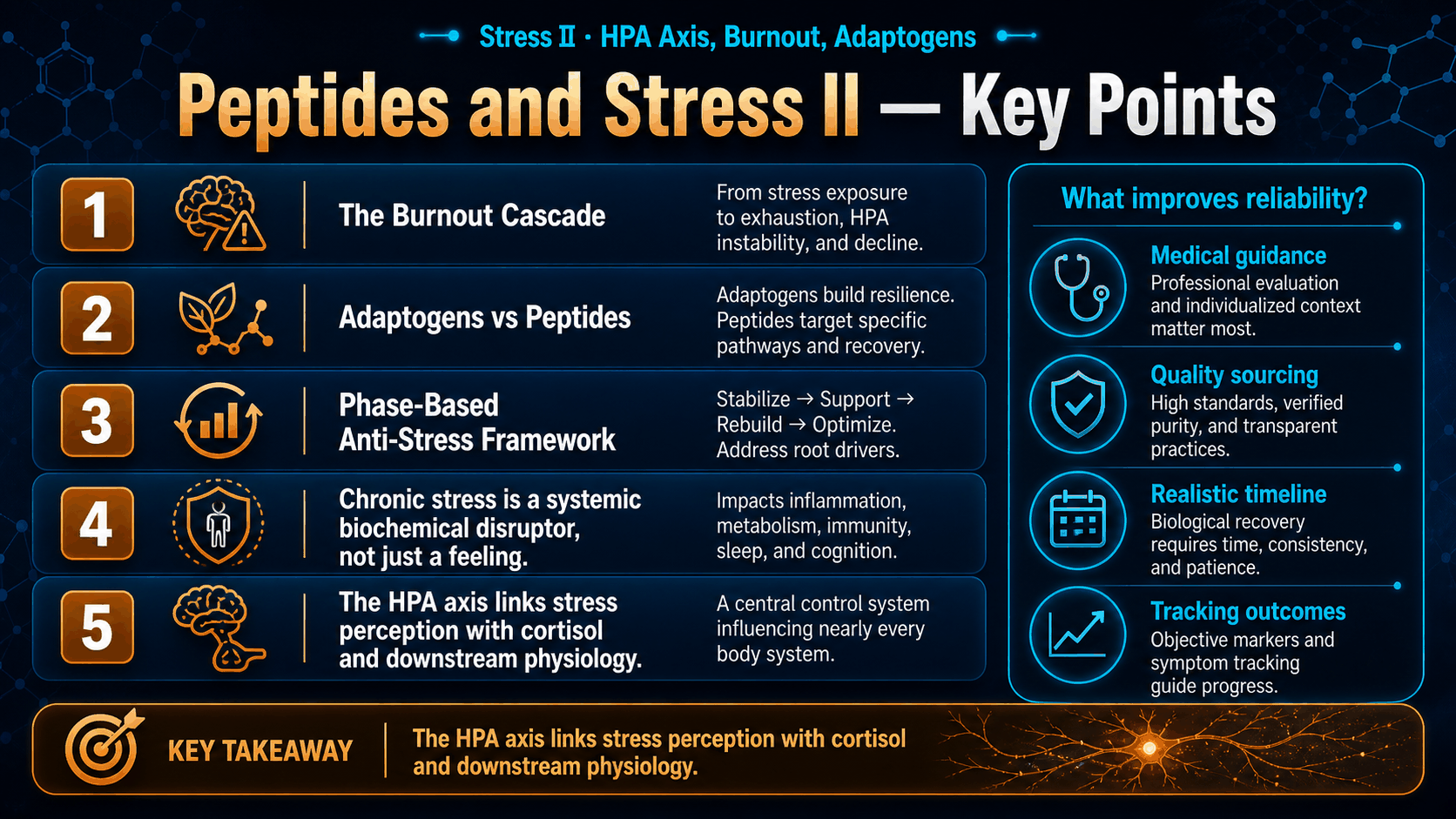
- Chronic stress is a systemic biochemical disruptor, not just a feeling.
- The HPA axis links stress perception with cortisol and downstream physiology.
- Stress can undermine sleep, testosterone, GH-pulse context, BDNF, immunity, and gut health.
- Adaptogens and peptides work on different layers and can complement each other.
- Burnout requires rest, workload change, sleep repair, and sometimes professional care.
- No peptide protocol fully compensates for unmanaged chronic stress.