
The Gut as a Systemic Organ
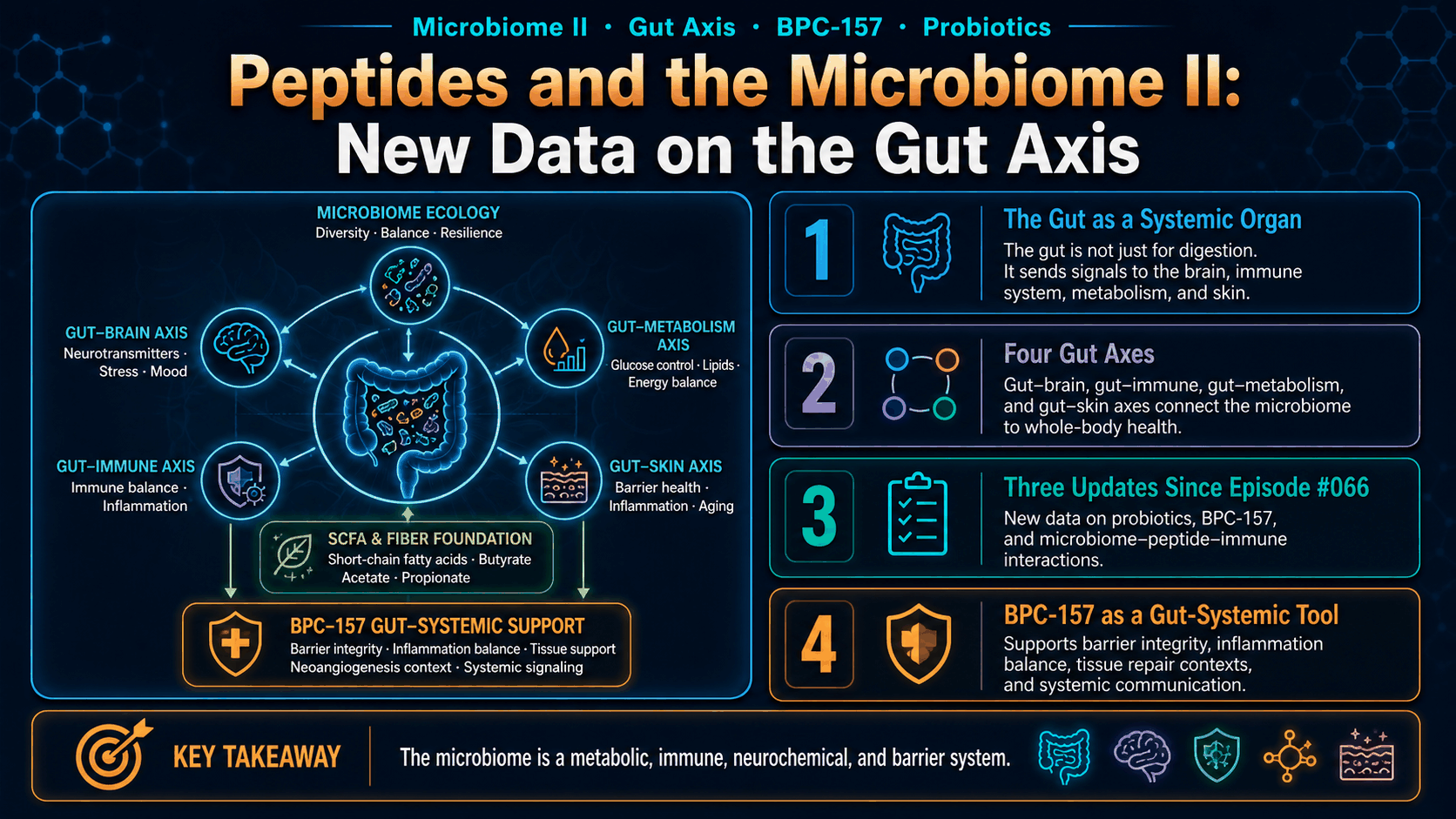
The gut is an immune center, neurochemical factory, metabolic regulator, and barrier between the external world and the body.
Microbiome research increasingly connects gut health with mood, cognition, immune balance, insulin sensitivity, skin inflammation, post-viral symptoms, and neurodegenerative-risk models. BPC‑157 appears throughout this series because many systemic discussions pass through the intestinal barrier.
Four Gut Axes
Gut–Brain
The vagus nerve, LPS endotoxemia, serotonin production, microbial metabolites, and neuroinflammation connect the gut to mood and cognition.
Gut–Immune
GALT, T-reg cells, SCFAs, and gut barrier function shape immune regulation and autoimmune-risk contexts.
Gut–Metabolism
SCFAs, GLP‑1, PYY, LPS, insulin resistance, appetite signaling, and adipokines connect the microbiome to metabolic health.
Gut–Skin
Gut dysbiosis can contribute to systemic inflammation that shows up in skin contexts such as acne, rosacea, and psoriasis.
 Sponsored / AffiliateQuest Health · Personal lab testing and health marker tracking
Three Updates Since Episode #066
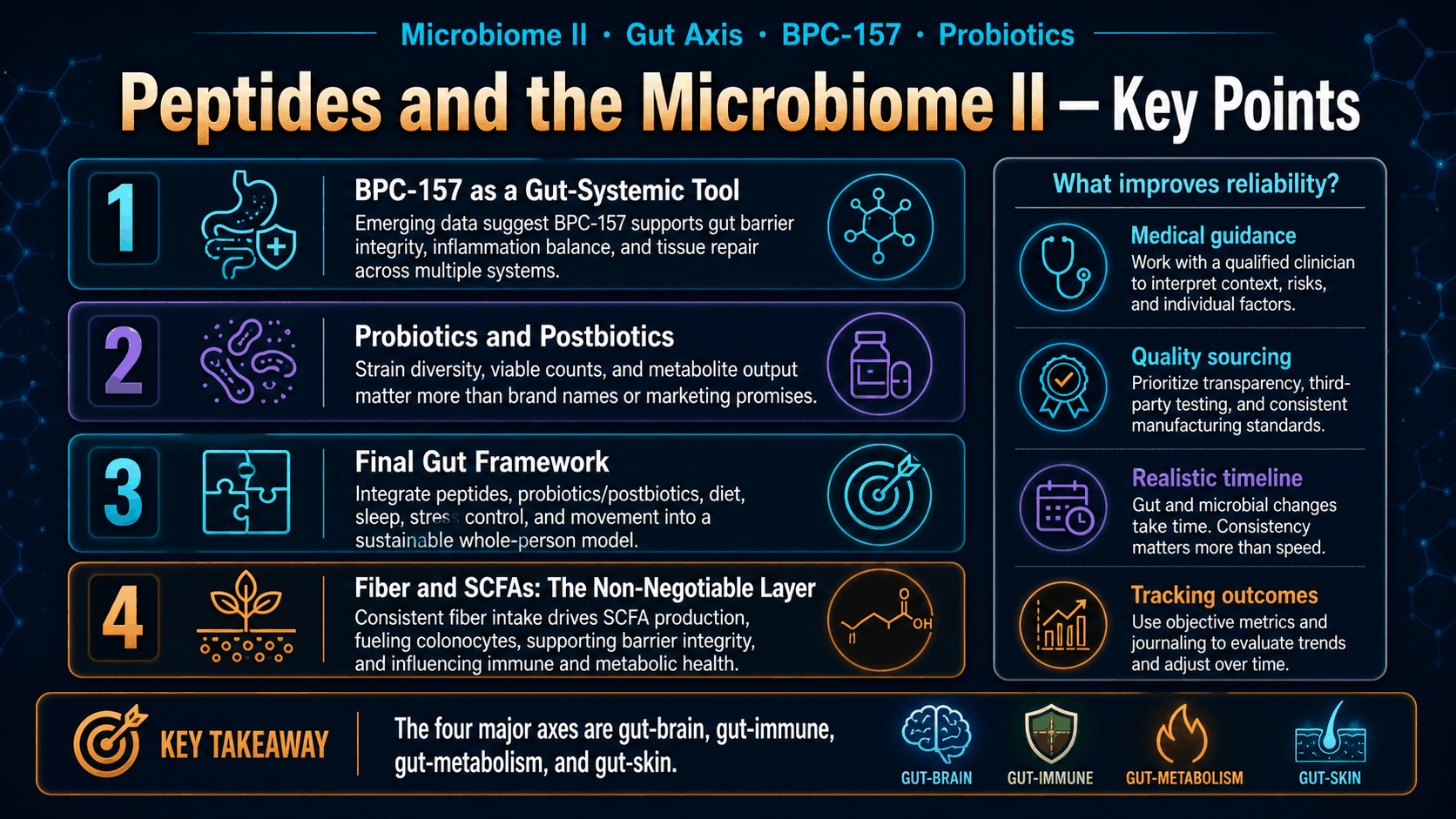
BPC‑157 as a Gut–Systemic Tool
Probiotics and Postbiotics
L. rhamnosus / B. longum
Discussed around stress reactivity, mood, and gut–brain communication. Effects are strain-specific.
L. plantarum / S. boulardii
Discussed around tight junctions, permeability, diarrhea contexts, IBD support discussion, and gut disruption.
Butyrate / urolithin A
Butyrate supports colonocytes and T-reg context. Urolithin A is discussed around mitophagy and aging biology.
 Sponsored / AffiliateMomentous · Performance nutrition and recovery supplements
Final Gut Framework
Food and fiber
- Fiber around 30 g/day when tolerated.
- Fermented foods regularly.
- Reduce ultra-processed foods.
- Reduce alcohol where dysbiosis is a concern.
BPC‑157 context
- Oral BPC‑157 is discussed around gut-barrier support.
- IBD and long-COVID contexts require clinician guidance.
- Barrier support can come before probiotic targeting.
- This is educational, not dosing advice.
Probiotics
- Multi-strain Lactobacillus + Bifidobacterium context.
- S. boulardii for disruption/travel/antibiotic-associated diarrhea discussions.
- Strain specificity matters more than generic claims.
- Rotate strains for diversity context.
Postbiotics
- Butyrate / tributyrin for barrier and T-reg context.
- Urolithin A for mitophagy context.
- SCFAs require fiber substrate.
- Function matters more than simply “more bacteria.”
Fiber and SCFAs: The Non-Negotiable Layer
Fiber is the substrate for short-chain fatty acids such as butyrate, acetate, and propionate. Butyrate supports colonocyte energy, tight-junction proteins, and T-reg context. No probiotic replaces adequate fiber and dietary diversity.
Two Common Myths
Myth: Probiotics alone restore the microbiome.
Fact: Probiotics are often temporary guests. Without fiber, diet change, and barrier support, their long-term effect may be limited.
Myth: A microbiome test tells exactly what to take.
Fact: Commercial tests can describe composition, but personalized strain recommendations still have limited evidence. Dietary diversity is often more reliable.
Frequently Asked Questions
Is oral BPC‑157 better than injection for gut goals?
For gut-epithelium discussions, oral BPC‑157 is often framed as more directly relevant. This is not medical advice or a treatment claim.
What is the gut–brain axis?
It is the communication network between gut microbes, metabolites, the vagus nerve, immune signaling, and brain function.
Why does fiber matter more than probiotics?
Fiber feeds microbial metabolism and SCFA production. Without substrate, probiotics have less functional support.
Are postbiotics better than probiotics?
Not necessarily. They are different: probiotics are organisms; postbiotics are metabolites or microbial products with functional effects.
When should a doctor be involved?
Blood in stool, severe pain, chronic diarrhea, IBD, unexplained weight loss, immunosuppression, long COVID, or neurologic symptoms require medical evaluation.
Key Takeaways
- The microbiome is a metabolic, immune, neurochemical, and barrier system.
- The four major axes are gut–brain, gut–immune, gut–metabolism, and gut–skin.
- BPC‑157 is discussed as a gut-barrier and gut-systemic support tool.
- Fiber and dietary diversity are the foundation of microbiome function.
- Probiotics are strain-specific and usually work best with adequate prebiotic substrate.
- Postbiotics such as butyrate and urolithin A are functional metabolite discussions.
- The page is mobile-responsive: grids collapse, update/strategy rows stack, sticky TOC becomes normal, and tables scroll horizontally if added.