The Molecule That Holds Us Together
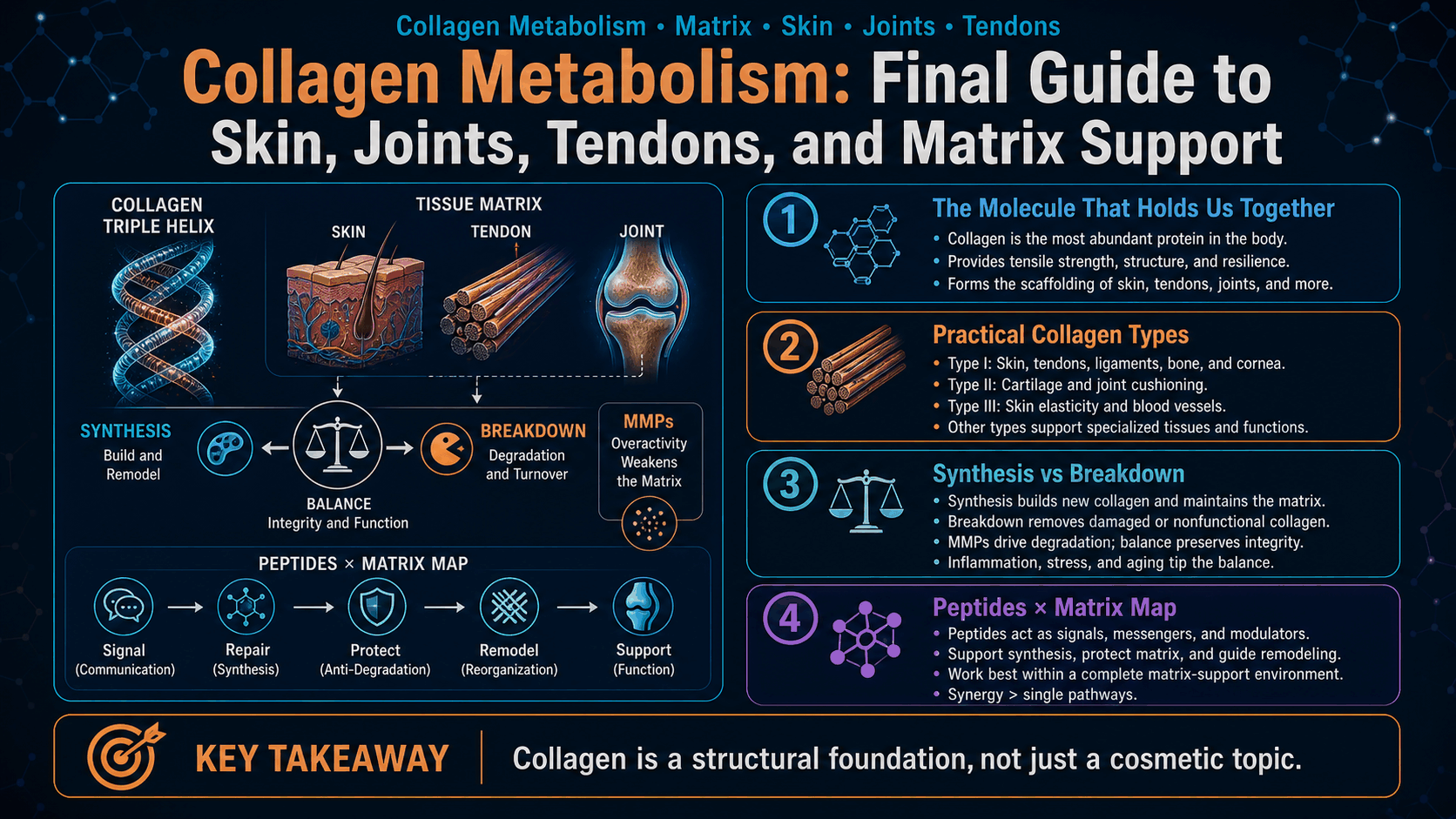
Collagen makes up a large share of body protein and forms the structural base of many tissues.
Skin firmness, tendon strength, ligament resilience, cartilage integrity, basement membranes, blood-vessel structure, gut lining, and bone matrix all depend on collagen architecture. Supporting collagen means supporting tissue structure — not just improving surface appearance.
Practical Collagen Types
Skin, bone, tendons
The most abundant collagen type. It provides tensile strength and is central to skin firmness, tendon structure, ligaments, and bone matrix.
Cartilage and cornea
Specialized for compression. UC-II is discussed through oral tolerance and cartilage-support context rather than generic collagen supplementation.
Skin, vessels, intestine
More elastic and often synthesized early during regeneration. The I/III balance affects skin elasticity and connective tissue repair context.
Basement membranes
Forms network-like structures, not fibers. Important for skin, vessels, kidneys, and barrier architecture.
Dermal–epidermal junction
Anchoring fibrils that help connect epidermis and dermis. Discussed in relation to skin structural integrity and GHK-Cu context.
Match type to goal
I/III for skin and tendons, type II/UC-II for cartilage, GHK-Cu for multi-type matrix signaling, and loading for tendon adaptation.
 Sponsored / AffiliateIntegrative Peptides · Practitioner-oriented peptide and wellness education
Synthesis vs Breakdown
What collagen needs
- Vitamin C for proline hydroxylation.
- Glycine, proline, lysine as amino-acid building blocks.
- Zinc, copper, manganese as enzyme cofactors.
- Mechanical loading as a tissue-specific signal.
- IGF‑1/GH context as systemic anabolic signaling.
What damages collagen
- UV radiation and photoaging through MMPs.
- Chronic inflammation and TNF‑α context.
- High cortisol and chronic stress.
- Glycation and AGE-related stiffening.
- Smoking and oxidative stress.
Peptides × Matrix Map
Matrix regulator
Discussed around collagen I/III/IV/VII, elastin support, and reduced MMP‑1 activity — a dual synthesis/protection context.
Repair-context signal
Discussed around EGFR, fibroblast proliferation, VEGF, angiogenesis, NO-system context, and acute repair settings.
Remodeling context
Discussed around cell migration, tenocyte context, progenitor-cell biology, matrix remodeling, and chronic tendinopathy frameworks.
Complete Collagen-Stimulation Matrix
| Tool | Mechanism | Target | Timing / context |
|---|---|---|---|
| Hydrolyzed collagen I+III | Hyp-Pro / Pro-Hyp dipeptides → fibroblast stimulation context | Skin · Tendons · Ligaments | Collagen + vitamin C before loading |
| UC-II | Oral tolerance → reduced immune cartilage-degradation context | Cartilage · OA context | Low-dose daily discussion |
| Topical GHK-Cu | ↑ collagen I/III/IV/VII · ↓ MMP‑1 · elastin context | Skin · Vessels | Topical cosmetic use; pH/irritation matter |
| BPC‑157 | EGFR / VEGF / NO-system repair context | Acute repair · Gut context | Clinician-guided only |
| TB‑500 | Cell migration / progenitor-cell context | Tendinopathy · scar context | Clinician-guided only |
| GH secretagogues | IGF‑1 context → fibroblast stimulation | Systemic matrix context | Medical monitoring required |
| Retinol / retinoids | RAR/RXR → collagen gene expression · MMP context | Skin | Slow titration and sun protection |
| Vitamin C | Cofactor for collagen triple-helix formation | All collagen synthesis | Supportive nutritional layer |
 Sponsored / AffiliateDT Peptides · Peptide research products and laboratory-focused resources
Final Collagen Framework
Morning / topical layer
- SPF is the strongest collagen-preservation tool.
- Stable vitamin C supports collagen synthesis context.
- Topical GHK-Cu may support matrix signaling.
- Retinoids are evening tools, introduced gradually.
Loading + substrate
- Collagen I/III + vitamin C context before loading.
- Mechanical loading is part of the signal.
- Eccentric work matters for chronic tendinopathy.
- Rehab guidance is essential after injury.
Type II logic
- UC-II is more cartilage-specific than generic I/III collagen.
- Oral tolerance is the key discussion mechanism.
- Osteoarthritis requires clinical evaluation.
- Weight, inflammation, and strength support matter.
By goal and supervision
- GHK-Cu for skin/matrix context.
- BPC‑157 for repair-context discussion.
- TB‑500 for remodeling-context discussion.
- GH-axis tools only with clinician monitoring.
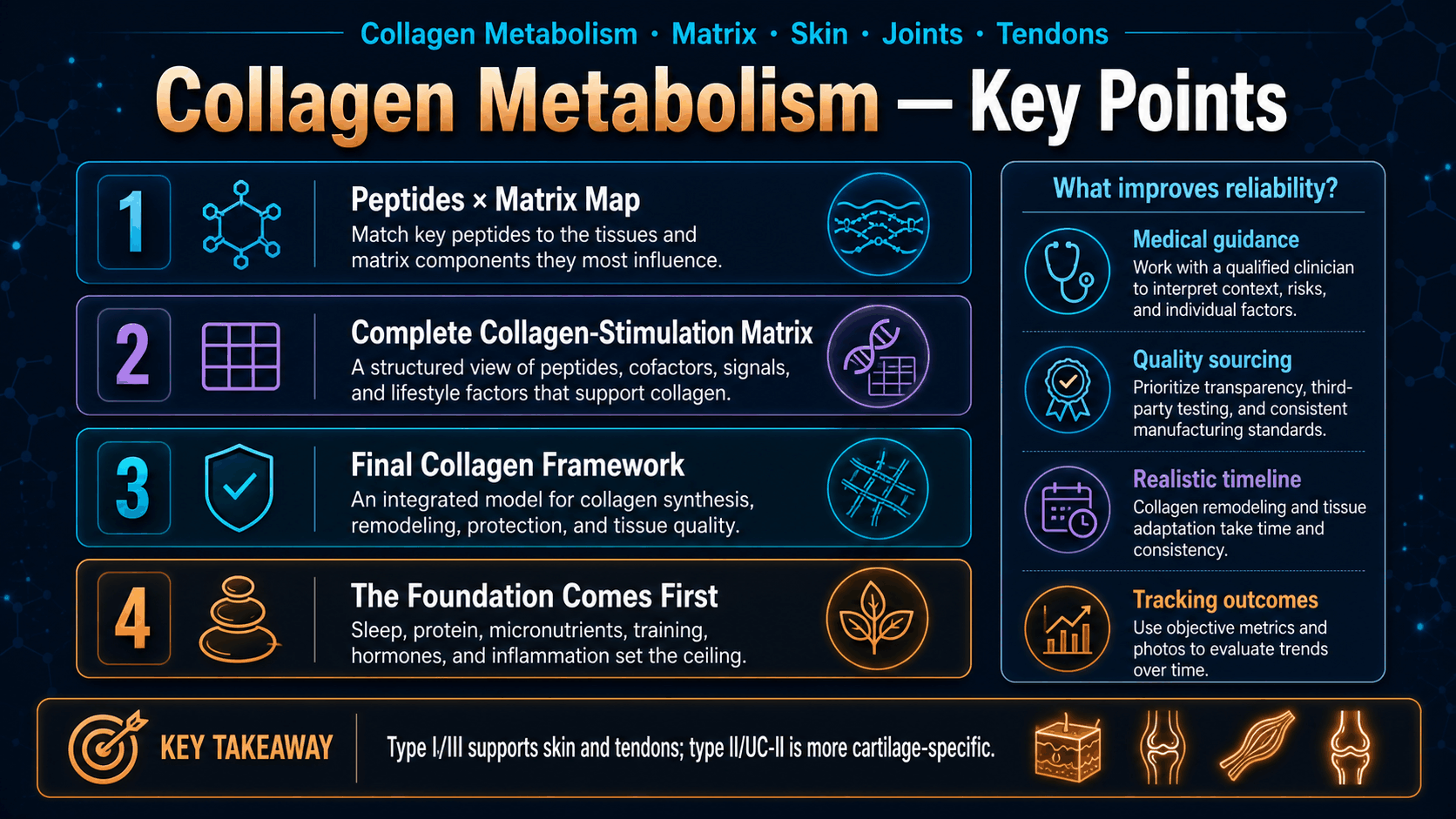
The Foundation Comes First
Collagen support is not just supplementation. It is the combination of adequate protein, vitamin C, micronutrients, sunlight protection, resistance training, tendon loading, inflammation control, glucose control, sleep, and medical care when injury or disease exists.
Two Common Myths
Myth: One collagen works for everything.
Fact: Skin/tendons, cartilage, basement membranes, and matrix remodeling require different collagen types and different support strategies.
Myth: Drinking collagen is pointless because it is destroyed in the stomach.
Fact: Hydrolyzed collagen can produce bioactive dipeptides such as Pro-Hyp and Hyp-Gly, which are discussed as matrix-related signals, especially when timed with loading.
Frequently Asked Questions
Is collagen only for skin?
No. Collagen is central to tendons, ligaments, cartilage, vessels, bone, gut, and basement membranes.
What is the difference between collagen I/III and UC-II?
I/III is more relevant to skin and tendons; UC-II is undenatured type II collagen discussed for cartilage through oral tolerance.
Why does vitamin C matter?
Vitamin C is required for collagen triple-helix stability through proline hydroxylation.
Where does GHK-Cu fit?
GHK-Cu is discussed as a matrix regulator involving multiple collagen types, elastin, and MMP modulation.
When should a doctor be involved?
Severe joint pain, tendon rupture, swelling, wounds, infection, inflammatory arthritis, unexplained pain, or systemic peptide use requires medical guidance.
Key Takeaways
- Collagen is a structural foundation, not just a cosmetic topic.
- Type I/III supports skin and tendons; type II/UC-II is more cartilage-specific.
- GHK-Cu is discussed around collagen I/III/IV/VII and MMP‑1 context.
- BPC‑157 and TB‑500 are repair/remodeling discussions, not self-treatment instructions.
- Vitamin C, minerals, protein, loading, sleep, and UV protection are foundational.
- Timing and mechanical loading matter for tendon/ligament collagen frameworks.
- The page is mobile-responsive: grids collapse, sticky TOC becomes normal, and matrix tables scroll horizontally.