
The Organ That Ages Early
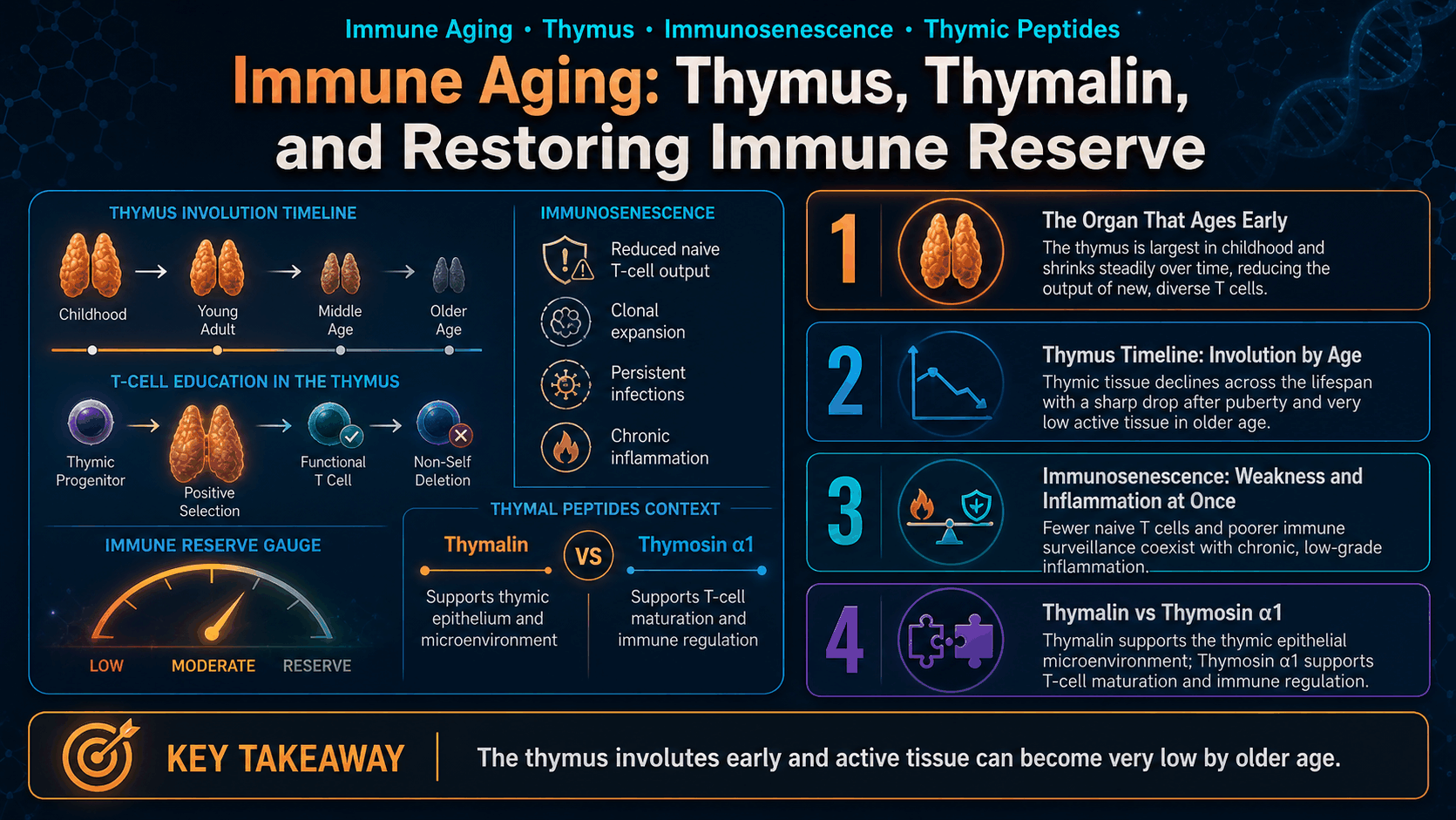
The thymus begins to involute early in life, and by midlife active thymic tissue can be dramatically reduced.
The thymus is where naive T lymphocytes are trained to distinguish self from non-self and become part of a functional adaptive immune repertoire. With age, thymic tissue is gradually replaced by fat tissue. The result is fewer new naive T cells, a narrower immune repertoire, weaker response to new antigens, and a higher inflammatory baseline.
Thymus Timeline: Involution by Age
 Sponsored / AffiliateDT Peptides · Peptide research products and laboratory-focused resources
Immunosenescence: Weakness and Inflammation at Once
Fewer naive T cells
A narrower repertoire means the immune system has fewer fresh options for new pathogens and immune challenges.
Higher chronic inflammation
Innate immune aging can raise baseline inflammatory signaling even while adaptive immunity weakens.
Occupied immune space
CMV-specific T cells can occupy a large share of the T-cell pool in older adults.
Reduced response quality
Immune aging may reduce vaccine responsiveness, making timely vaccination and medical review more important.
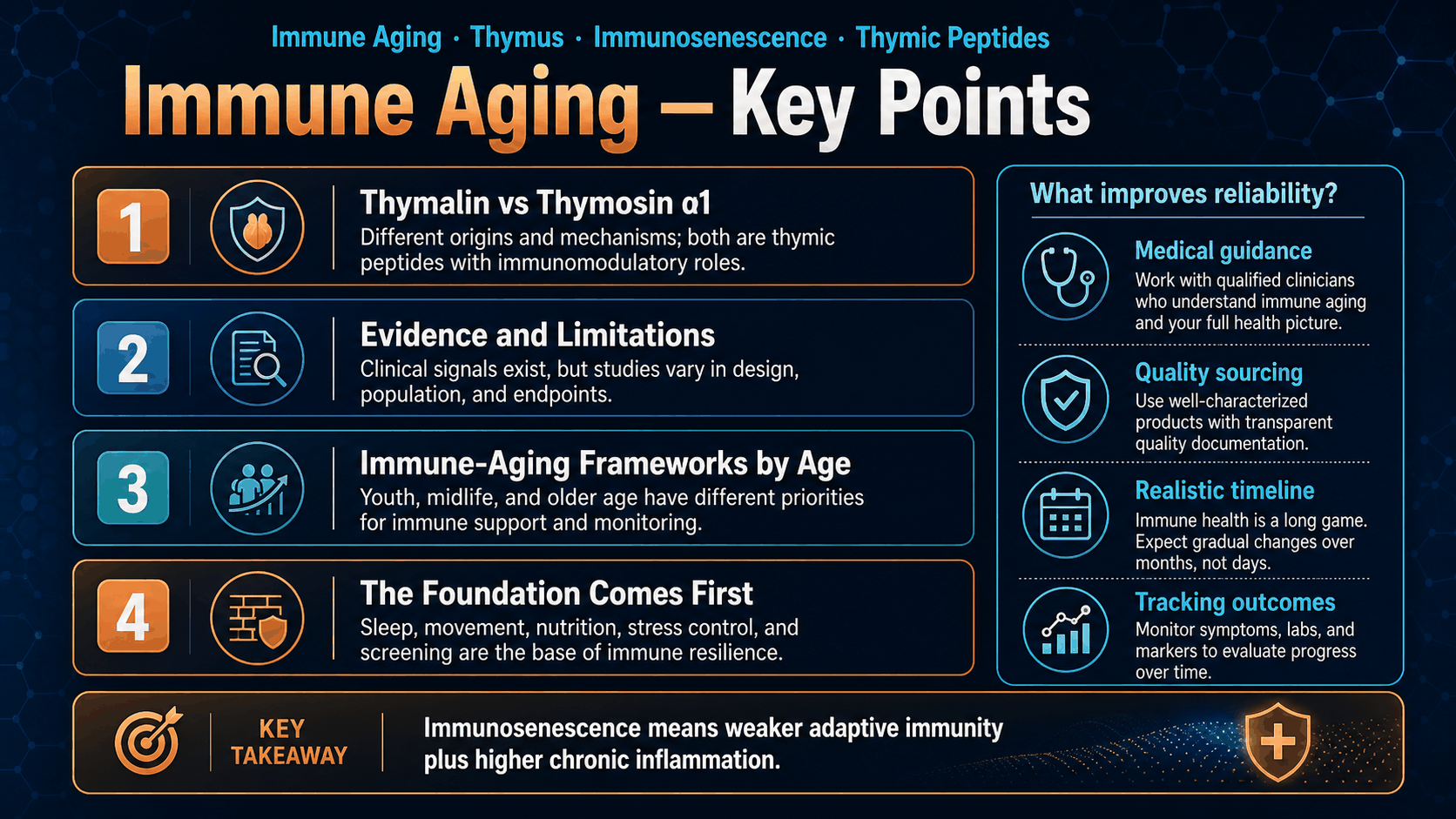
Thymalin vs Thymosin α1
Thymic peptide extract
Thymalin is an extract-based mixture of thymic peptides, used in some regions as an immunomodulatory product. It is discussed around T-cell differentiation, CD4/CD8 ratio, and NK-cell context.
- Broad thymic-signal mixture.
- Regional clinical experience.
- Less specific composition.
- Should be clinician-guided.
Synthetic thymic peptide
Thymosin α1 is a 28-amino-acid synthetic peptide with a more precise composition and broader international clinical study context.
- More specific molecule.
- Studied in viral and immune contexts.
- Explored in oncology-immunotherapy support.
- Special caution in autoimmunity.
Evidence and Limitations
| Topic | Evidence context | Limitations |
|---|---|---|
| Thymosin α1 | More internationally studied; clinical trial contexts exist in hepatitis and immune-support areas. | Not a universal immune-aging cure; use depends on indication and clinician review. |
| Thymalin | Long regional clinical use, especially in Russia and gerontology traditions. | Large modern international double-blind RCTs are limited. |
| TRICOM | GH + DHEA + metformin study reported thymic changes and epigenetic-age reduction. | Small study; recombinant GH protocol is medical and not equivalent to peptide self-use. |
| GH-axis tools | Theoretical thymopoietic discussion through GH biology. | Not proven thymus-regeneration protocols; require screening and medical oversight. |
 Sponsored / AffiliateIntegrative Peptides · Practitioner-oriented peptide and wellness education
Immune-Aging Frameworks by Age
Prevention support
- Vitamin D and zinc status when indicated.
- Omega‑3 inflammation-resolution context.
- Aerobic exercise and N3 sleep.
- Thymalin only when clinically appropriate.
Active support
- Immune markers if infections are frequent.
- CMV discussion when immune exhaustion is suspected.
- Thymosin α1 only with documented need and clinician guidance.
- Vaccination review: flu, pneumococcal, shingles when appropriate.
Geroprotection
- Immunologist evaluation for recurrent or unusual infections.
- Stay current on vaccines.
- Physical activity for NK-cell and immune-aging support.
- Any thymic peptide discussion should be marker-guided and supervised.
The Foundation Comes First
Sleep, exercise, nutrition
N3 sleep, aerobic training, adequate protein, and whole-food nutrition shape immune resilience before peptide discussions begin.
Vaccines and evaluation
Vaccination, immune workup, medication review, cancer care, infection treatment, and specialist guidance remain the primary layer.
Two Common Myths
Myth: Thymalin is a general immune booster.
Fact: Thymalin is better framed around thymic signaling and T-cell composition, especially in immune aging or immune deficiency contexts.
Myth: After 40, the thymus is gone and nothing can be done.
Fact: Thymic involution is gradual. Full youthful restoration is unrealistic, but immune-reserve support may still be possible under clinical guidance.
Frequently Asked Questions
Can thymic peptides reverse immune aging?
No. They may be discussed as immune-reserve support, but they do not reverse aging or replace medical care.
What is the difference between immune boosting and immune regulation?
Boosting suggests indiscriminate stimulation. Regulation means supporting balanced immune function, reducing chronic inflammation, and preserving adaptive capacity.
Who should not self-direct thymic peptides?
Anyone with autoimmune disease, cancer, transplant history, immunosuppressive medication use, chronic viral infection, or unusual/recurrent infections.
Why does zinc matter?
Zinc is required for thymulin, a zinc-dependent thymic peptide, and is important for thymic and T-cell function.
What is CMV inflation?
It is the expansion of CMV-specific T cells over time, which may occupy immune space and reduce repertoire flexibility in older age.
Key Takeaways
- The thymus involutes early and active tissue can become very low by older age.
- Immunosenescence means weaker adaptive immunity plus higher chronic inflammation.
- CMV inflation may occupy a large share of T-cell space in older adults.
- Thymalin is a broad extract-based thymic peptide mixture.
- Thymosin α1 is synthetic, more specific, and more internationally studied.
- Vaccines, medical evaluation, sleep, exercise, zinc, vitamin D status, and inflammation control come first.
- The page is mobile-responsive: grids collapse, timeline rows stack, sticky TOC becomes normal, and tables scroll horizontally.