
Sleep Is Free Biochemistry
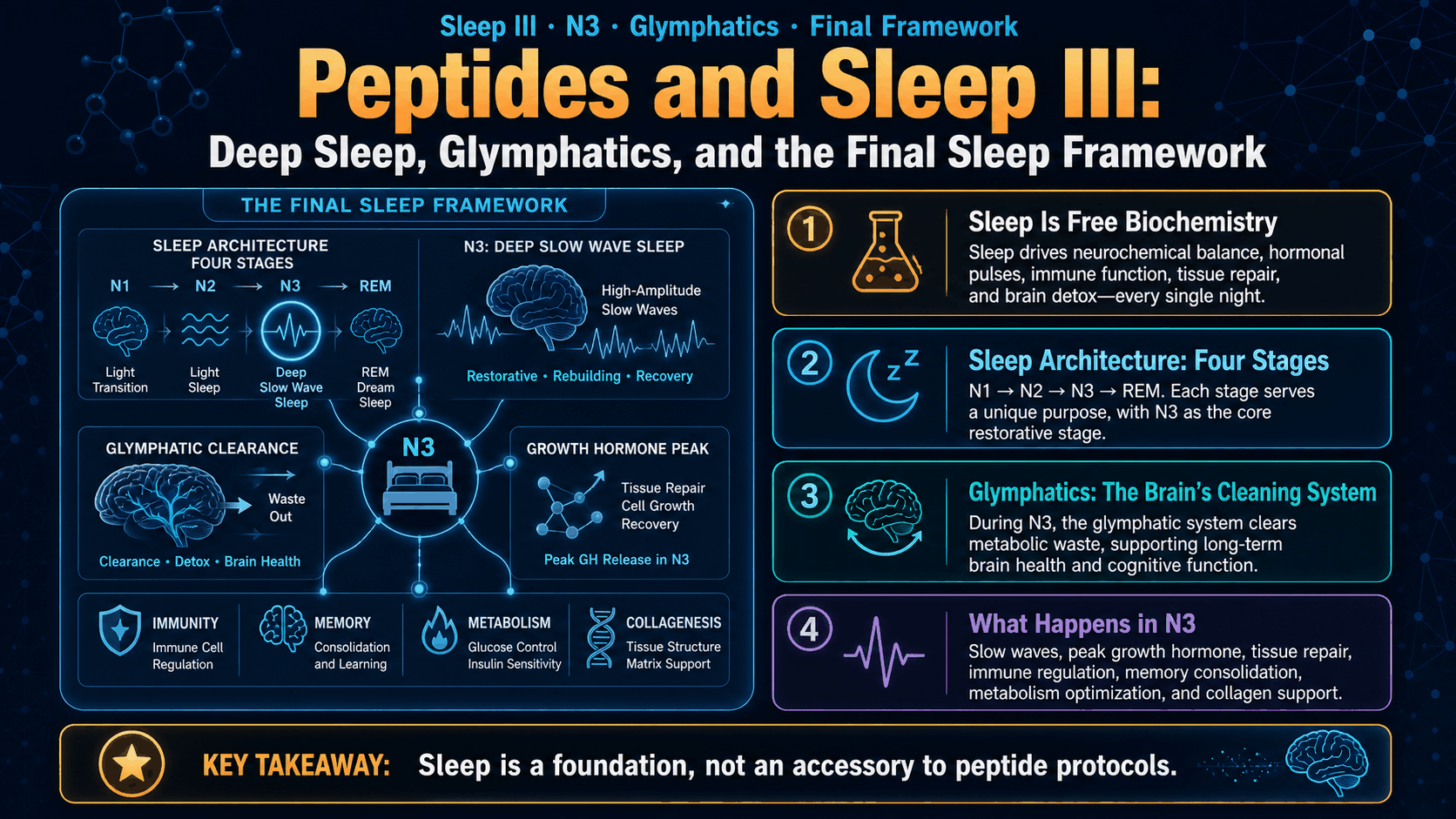
Across the peptide series, one pattern appears again and again: poor N3 sleep weakens almost every regeneration, hormone, immune, and cognition-support framework.
Growth-hormone secretagogues depend on physiologic sleep architecture. Neuroplasticity needs consolidation. Gut barrier and immune signaling change overnight. Collagenesis and tissue repair are deeply tied to sleep quality. This makes sleep the foundation — not a bonus.
Sleep Architecture: Four Stages
Sleep onset
Transition from wakefulness into sleep. Easy to wake from. Minimal restorative value.
Light sleep
Sleep spindles and K-complexes. Motor-memory consolidation and body-temperature drop.
Deep delta sleep
The most restorative stage: growth-hormone peak, immune cytokines, glymphatic clearance, and tissue repair.
Rapid-eye-movement sleep
Emotional processing, dreaming, creativity, memory integration. Suppressed by alcohol and many sedatives.
 Sponsored / AffiliateDynamic Peptides · Research peptide catalog and product education resources
Glymphatics: The Brain’s Cleaning System
During deep sleep, cerebrospinal fluid movement through the brain increases, helping clear metabolic waste including β‑amyloid and tau-related proteins. Chronic N3 deficiency is therefore a brain-health issue, not just a “feeling tired” issue.
Clearance window
N3 is the phase most associated with restoration and glymphatic function.
Side sleeping context
Lateral sleeping positions are often discussed as more favorable for glymphatic flow than sleeping supine.
What Happens in N3
Peptides and Nutraceuticals: N3 Tools
| Tool | Discussion mechanism | Boundary |
|---|---|---|
| Glycine | Lower core body temperature, glycinergic signaling, N3-support context | Nutraceutical, not insomnia treatment |
| Magnesium glycinate | GABAergic calm-down pathways, lower evening CNS excitability | Caution with kidney disease/medications |
| Epitalon | Pineal/melatonin rhythm and sleep-architecture context | Peptide discussion; clinician/legal context matters |
| Ipamorelin | Amplifies GH peak discussion when N3 exists | Clinician-guided; does not replace sleep |
| Melatonin | Circadian timing and jet-lag context | Not default nightly solution for everyone |
| CBT-I | Behavioral treatment for chronic insomnia | Evidence-based first-line insomnia care |
 Sponsored / AffiliateTeleWellnessMD · Telehealth wellness consultations and health optimization support
Final Sleep Framework
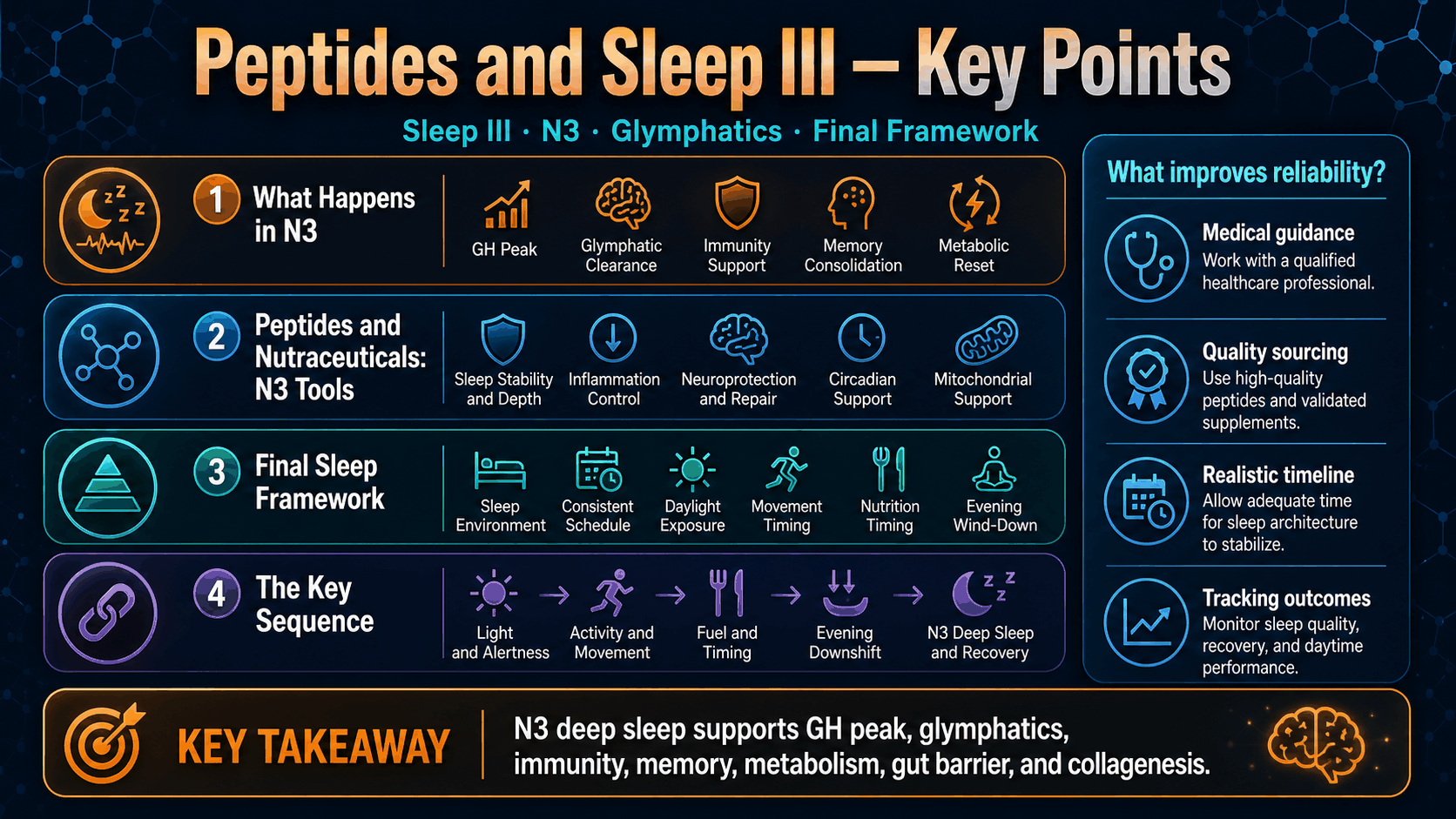
The Key Sequence
Improve N3 first
- Consistent bedtime.
- Cool, dark room.
- Glycine + magnesium context.
- Reduce late caffeine and blue light.
Stabilize rhythm
- Morning light.
- Melatonin only for timing issues.
- Epitalon discussion in 50+ contexts.
- Avoid chronic sedative-style thinking.
Then peptide layer
- Ipamorelin only if N3 quality exists.
- Clinical monitoring matters.
- Do not use peptide tools to compensate for bad sleep.
- Medical screening for sleep disorders first.
Measure and adjust
- Track sleep timing and daytime function.
- Watch for snoring, apneas, daytime sleepiness.
- Consider CBT‑I for chronic insomnia.
- Seek sleep-medicine evaluation when needed.
Two Common Myths
Myth: Sleeping pills create better sleep.
Fact: Sedation is not the same as physiological sleep. Some sedatives can suppress N3 and REM. For chronic insomnia, CBT‑I has stronger long-term evidence.
Myth: Ipamorelin raises GH even if sleep is poor.
Fact: Ipamorelin is discussed as amplifying a physiologic GH peak that depends on N3. It does not replace deep sleep.
Frequently Asked Questions
Why is N3 so important?
N3 is the deep sleep stage linked to growth-hormone peak, glymphatic clearance, immune timing, memory consolidation, and tissue repair.
Is glycine a sleeping pill?
No. Glycine is discussed as a nutraceutical that may support deep sleep through body-temperature and glycinergic mechanisms.
Can Ipamorelin fix bad sleep?
No. It may support GH-pulse discussion when sleep architecture is already good, but it does not replace N3 sleep.
When should I see a sleep specialist?
Chronic insomnia, loud snoring, breathing pauses, severe sleepiness, parasomnias, restless legs, shift-work disorder, or long-term sedative use deserve clinical evaluation.
What is the first practical step?
Regular bedtime, morning light, lower late caffeine, cool/dark room, and tracking daytime function.
Key Takeaways
- Sleep is a foundation, not an accessory to peptide protocols.
- N3 deep sleep supports GH peak, glymphatics, immunity, memory, metabolism, gut barrier, and collagenesis.
- Glycine and magnesium form a basic N3-support discussion.
- Epitalon is discussed around melatonin rhythm and architecture, especially in 50+ contexts.
- Ipamorelin is meaningful only if N3 quality exists and should be clinician-guided.
- Sedation is not the same as physiological sleep.
- The page is mobile-responsive: grids collapse, N3 rows stack, timeline rows stack, sticky TOC becomes normal, and tables scroll horizontally.