10-minute read · Responsive dark-blue guide
Episode #098 · Questions & answers · 2 episodes before the finale

Peptide Q&A: 97 Episodes, 12 Honest Answers

This guide turns the penultimate episode into a clear Q&A article: BPC-157 and GH secretagogues, lab work, long-term safety, oncology caution, evidence limits, lifestyle foundations, and what changed after 97 episodes.

12 questionsEvidence-awareLab-guidedLifestyle-first
Safety disclaimer: This article is educational and does not diagnose, treat, prevent, or cure any condition. It is not dosing guidance, peptide-use instruction, or a substitute for clinician-led care. Cancer history, active cancer care, hormonal changes, pregnancy, chronic disease, severe symptoms, abnormal labs, or injectable/medication-adjacent decisions require qualified medical supervision.

The Penultimate Episode: A Conversation With the Audience

After 97 episodes, the series becomes a dialogue.

The most important questions are not only technical. They are about safety, uncertainty, evidence quality, personal responsibility, and how to turn biochemical knowledge into real-life decisions without overconfidence.

Best framing: honest, educational, evidence-aware, and clear about what is known, what is plausible, and what remains uncertain.

Questions 1–4: The Most Common Ones

Can BPC-157 and GH secretagogues be used at the same time?
They work through different mechanisms: BPC-157 is discussed around inflammation, the NO system, and gut barrier; GH secretagogues work through the GH/IGF-1 axis. The script frames the combination as mechanistically compatible, with monitoring of IGF-1, hs-CRP, and body composition.
Why do labs matter if someone feels good?
Because silent problems can exist for years. The episode uses hs-CRP and TSH as examples: feelings can adapt, while biomarkers show the biochemical terrain more honestly.
How safe are peptides long-term?
The honest answer is uncertainty. Many peptides lack 10–20 year human data. Animal toxicology and physiological mechanisms may be reassuring, but they are not the same as long-term outcome certainty.
Which peptide is most important?
BPC-157 for versatility, GHK-Cu for genomic depth, glycine for evidence/cost/safety ratio — but the strongest principle is that lifestyle matters more than any peptide.
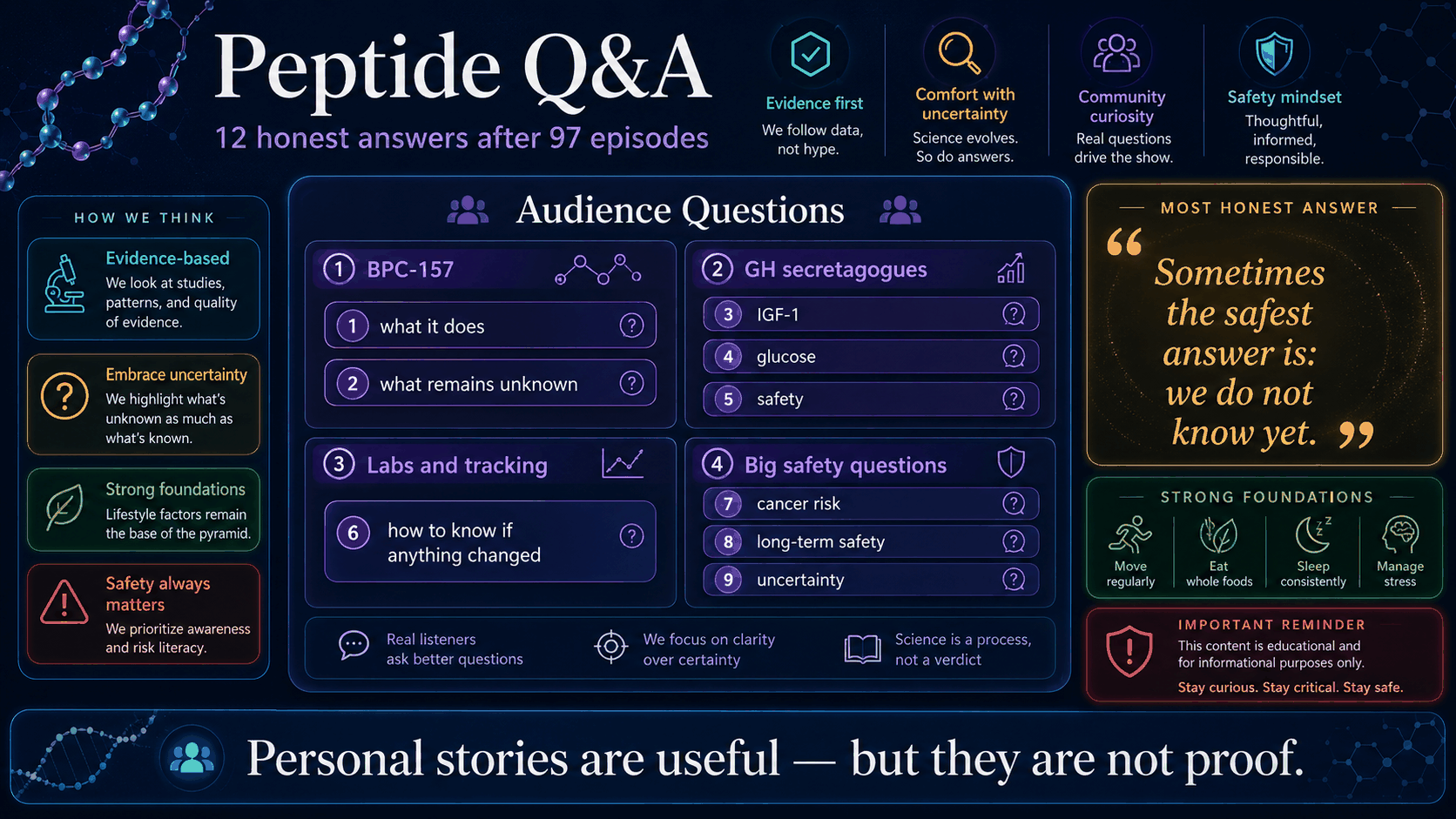
Peptide Q&A infographic with six major questions from the series
Q&A map: safety, labs, long-term uncertainty, oncology caution, and lifestyle-first framing.

Questions 5–8: Technical and Biological

Oncology

Can peptides cause cancer?

The episode is careful: growth-related pathways such as IGF-1 or VEGF raise theoretical concerns when tumor cells already exist. Cancer history or active oncology care requires specialist involvement.

Effectiveness

How do you know it works?

Use objective markers: hs-CRP, IGF-1, body composition, and goal-specific outcomes. The timeline depends on the peptide and goal.

Schedule

Every day or skipped days?

It depends on half-life, mechanism, and course structure. Missing one day is less important than repeated inconsistency and lack of monitoring.

Women

GH secretagogues and masculinization

GH secretagogues act through the GH/IGF-1 axis, not through androgens. In PCOS or hyperandrogenism, clinician guidance is especially important.
TeleWellnessMD banner: telehealth wellness consultations and optimization supportSponsored / AffiliateTeleWellnessMD · Telehealth wellness consultations and health optimization support

Questions 9–12: Personal and Philosophical

Do you personally use what you talk about?
The script answers yes, while emphasizing personal experience, clinician discussion, and monitoring rather than “just take this” recommendations.
How did the view change over 97 episodes?
Two shifts: more caution about the evidence base, and stronger conviction that lifestyle is the highest-value foundation.
Why no ads for specific suppliers?
Because the peptide market is described as under-regulated, and supplier recommendations can create conflict of interest. The focus is on evaluation principles such as COA, HPLC, and independent testing.
Advice for someone starting from episode one?
Start with labs, not peptides. Treat lifestyle as the main protocol. Do not rush. Depth of understanding matters more than speed of consumption.

An Honest View: What Remains Unknown

The episode’s strongest section is its refusal to overstate certainty. It says clearly that long-term human outcomes for many peptides remain unknown, that individual variability is real, and that average effects do not guarantee personal results.

Important distinction: biologically plausible is not the same as proven in completed human randomized controlled trials. Mechanism is the beginning of the conversation, not the end.
Known strongly

Lifestyle, sleep, exercise, nutrition, and stress management have the strongest evidence base.

Known cautiously

Some peptide mechanisms are biologically plausible and supported by preclinical or limited clinical context.

Unknown

Long-term 10–20 year human outcomes are still missing for many peptide strategies.
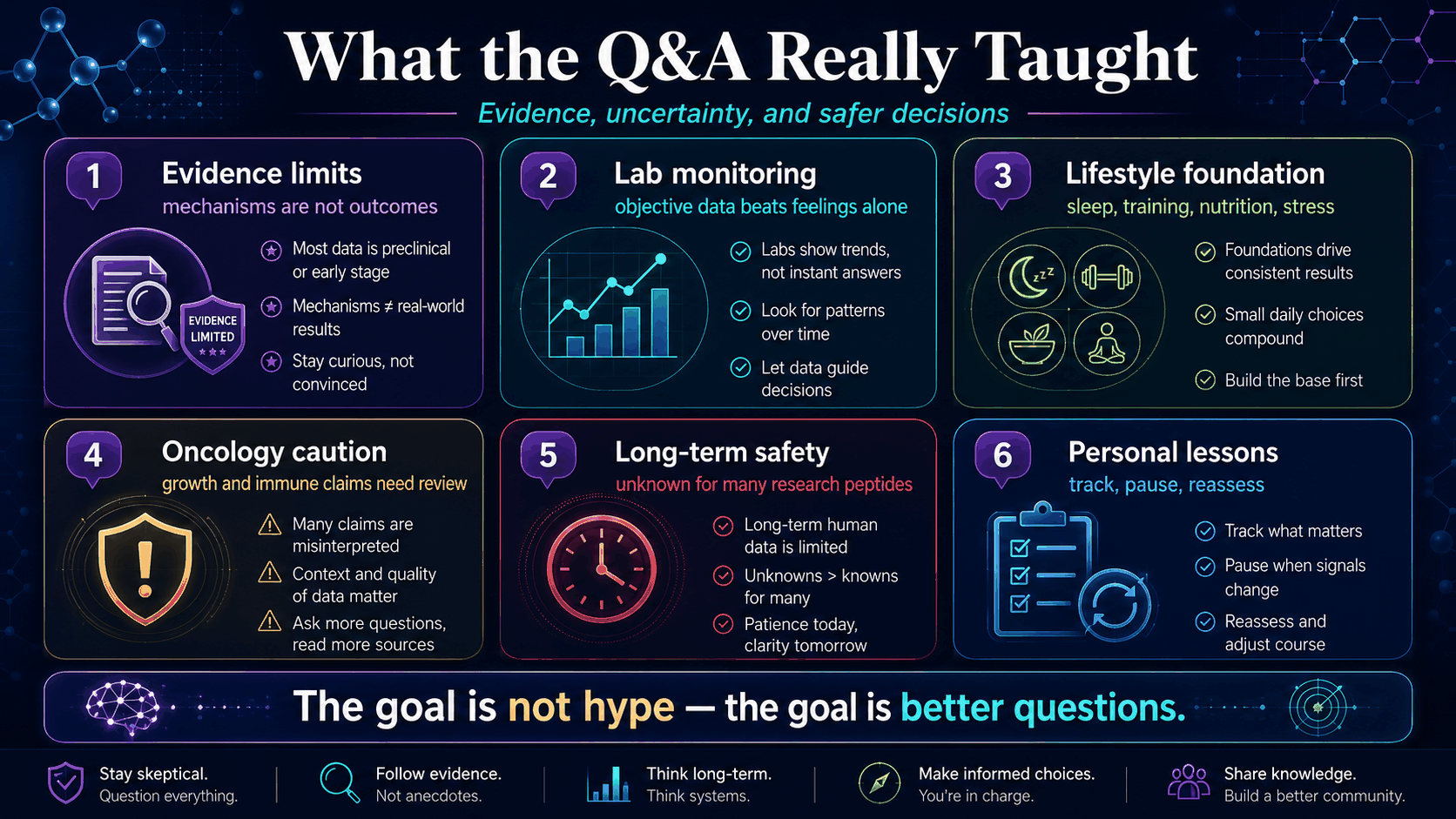
Honest evidence framework after 98 episodes showing lifestyle, labs, peptides, and evidence limits
The honest framework: lifestyle foundation, lab navigation, peptide context, and evidence limits.

Gratitude Before the Finale

The episode closes by thanking the audience: viewers who watched from the beginning, new viewers who brought a fresh perspective, and people who disagreed respectfully. The message is that disagreement is thinking — and thinking improves the series.

The final episode is positioned as a manifesto: how to apply knowledge about the biochemistry of life to real life.

Frequently Asked Questions

Is this article medical advice?

No. It is an educational summary and Q&A-style guide based on the supplied script.

What is the main safety theme?

Do not copy protocols. Use labs, clinician context, and realistic evidence boundaries.

What is the biggest lesson from the episode?

Lifestyle and biomarkers matter more than peptide enthusiasm.

Why mention uncertainty so often?

Because honest uncertainty is safer than confident but unsupported claims, especially in peptide content.
Ulta Lab Tests banner: track health markers with lab testing for hormones inflammation and wellnessSponsored / AffiliateUlta Lab Tests · Lab testing for hormones, inflammation, and wellness

Key Takeaways

  • The episode answers 12 audience questions from the full series.
  • BPC-157 and GH secretagogues are discussed as mechanistically different, with lab monitoring.
  • Long-term human safety data remain limited for many peptides.
  • Oncology-related contexts require special caution and medical supervision.
  • Labs are more honest than subjective feelings.
  • Lifestyle remains the first layer; peptides are the third layer.
Next article #099The Future of Peptides: What the Next 10 Years May Bring