
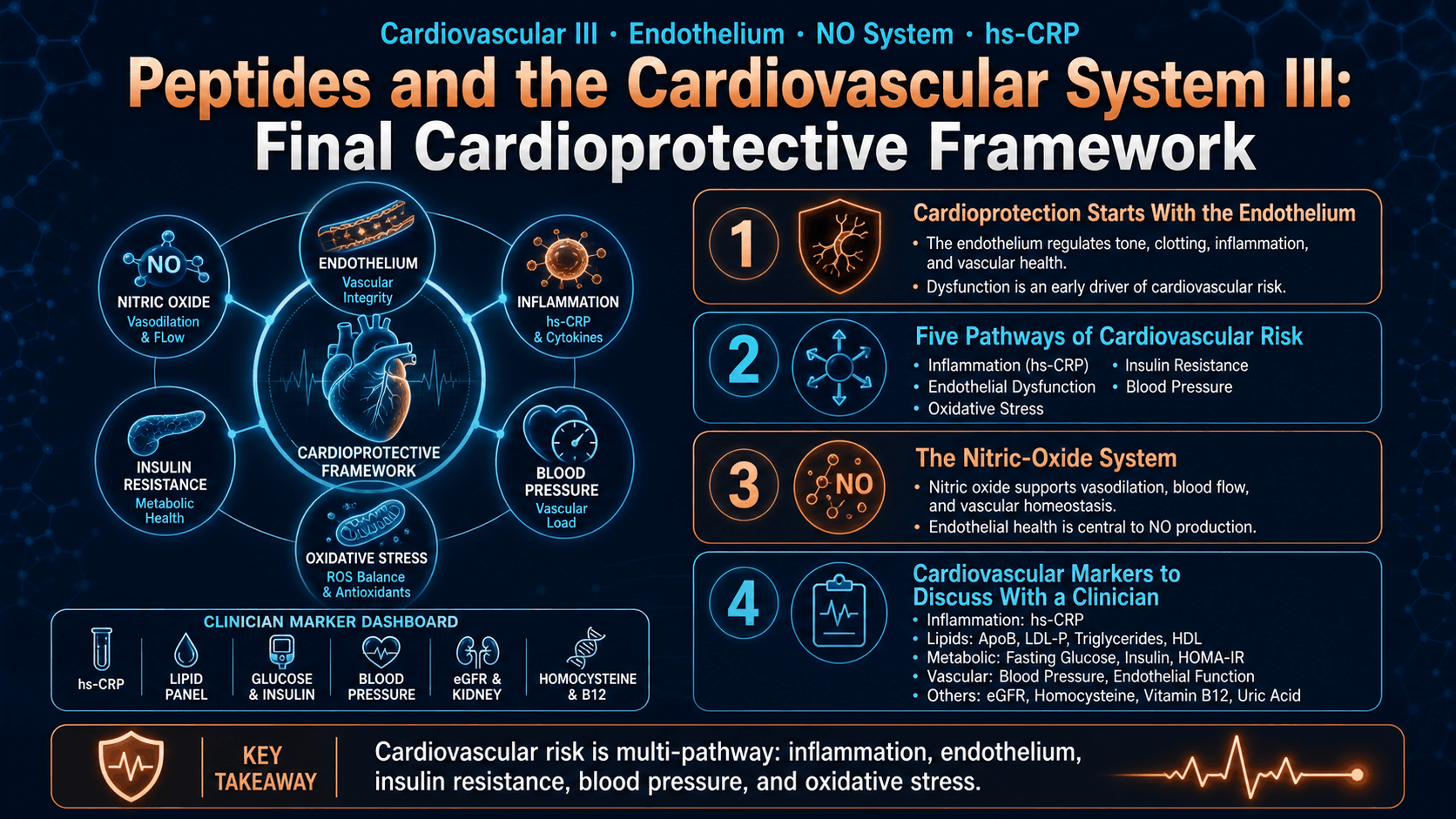
Cardioprotection Starts With the Endothelium
Atherosclerosis often begins long before a visible event, with changes in endothelial function and inflammatory signaling.
The endothelium is a single-cell-thick vascular layer that helps regulate vascular tone, clotting, inflammation, and nitric oxide availability. When endothelial function declines, vasoconstriction, platelet adhesion, inflammation, and plaque biology become easier.
Five Pathways of Cardiovascular Risk
 Sponsored / AffiliatePeptide University · Peptide learning resources and educational programs
The Nitric-Oxide System
Nitric oxide is a major endothelial vasodilator and anti-thrombotic signal. It supports vascular relaxation, platelet regulation, and anti-atherogenic signaling.
eNOS / NO pathway
BPC‑157 is discussed around EGF-receptor and PI3K/Akt pathway context, eNOS activation, and NO availability.
L‑citrulline and nitrate foods
L‑citrulline, beetroot, spinach, and nitrate–nitrite–NO pathways are often discussed around NO support.
Aerobic exercise
Aerobic training is one of the strongest non-peptide ways to support endothelial function and eNOS expression.
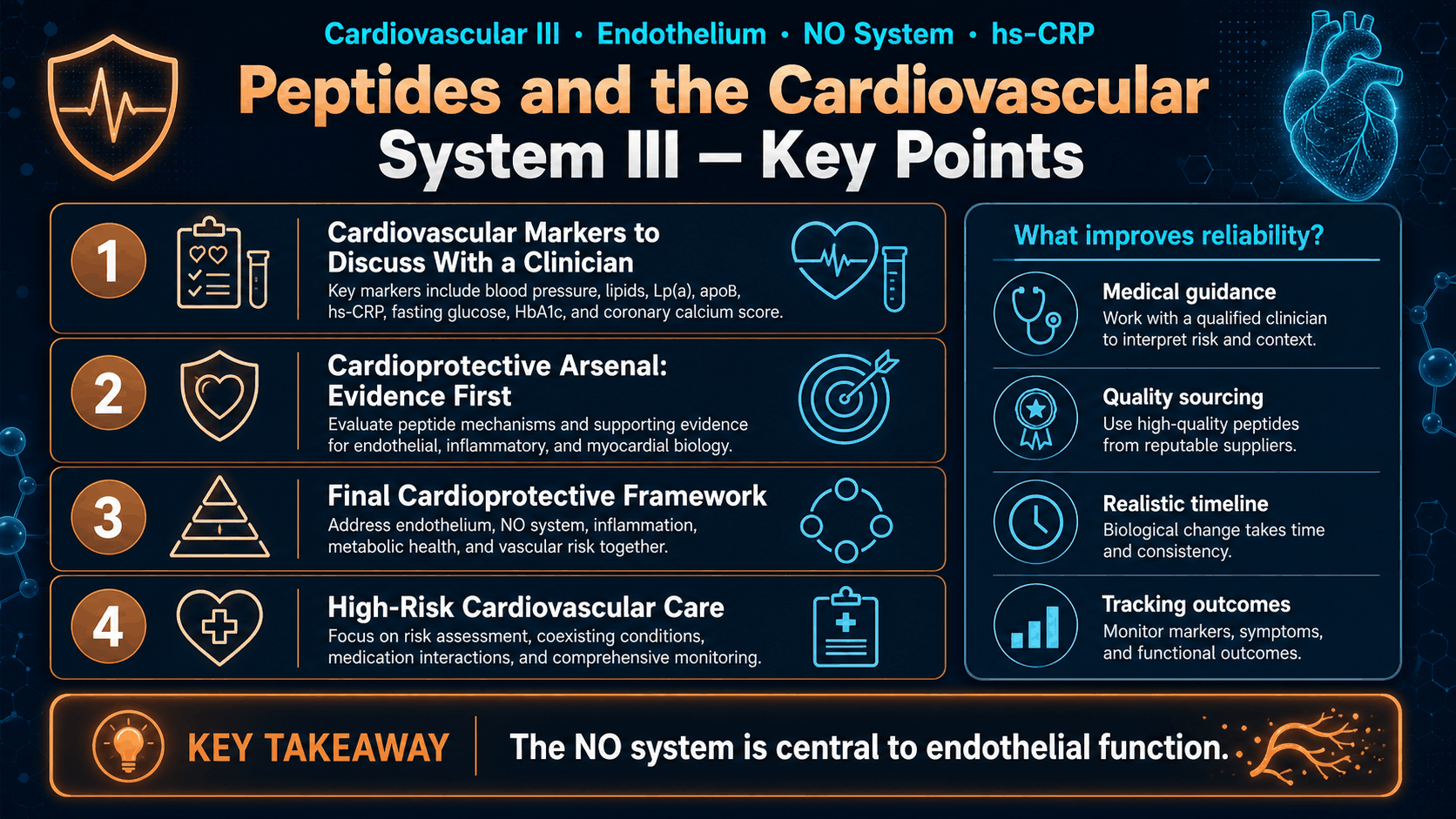
Cardiovascular Markers to Discuss With a Clinician
| Marker | What it measures | Interpretation | Framework relevance |
|---|---|---|---|
| hs‑CRP | Systemic inflammation | Lower levels are generally preferable | Inflammation monitoring |
| Lp(a) | Genetically influenced risk factor | Needs clinician interpretation | Not meaningfully lowered by peptides |
| ApoB / LDL | Atherogenic particle burden | Lower ApoB is generally better in risk contexts | Medical lipid management first |
| HDL | Reverse cholesterol transport context | Context-dependent | Aerobic/metabolic health context |
| Triglycerides | Metabolic syndrome and insulin resistance | Lower is generally better | Omega‑3/metabolic context |
| HbA1c | Average glycemia | Individualized target | Metabolic health context |
| Homocysteine | Endothelial stress / methylation context | Clinician/lab dependent | B-vitamin context, not primarily peptides |
| NT‑proBNP | Cardiac wall stress | Elevated values require evaluation | Diagnostic, not a peptide target |
Cardioprotective Arsenal: Evidence First
Aerobic exercise
Zone-2 style aerobic work, walking, cycling, swimming, and consistent cardiovascular training have strong evidence for risk reduction.
Omega‑3, magnesium, berberine
Omega‑3, magnesium, vitamin D when indicated, berberine in metabolic contexts, and curcumin are discussed as supportive layers.
BPC‑157, GHK‑Cu
BPC‑157 is discussed around NO/inflammation context. GHK‑Cu is discussed around antioxidant enzyme and vascular-stress context.
Proven therapy
Statins, blood-pressure medications, antiplatelet/anticoagulant therapy, diabetes treatment, imaging, and rehab come first when indicated.
 Sponsored / AffiliateQuest Health · Personal lab testing and health marker tracking
Final Cardioprotective Framework
Adults 35+
- Aerobic exercise and blood-pressure awareness.
- Omega‑3 and magnesium discussion where appropriate.
- Vitamin D/K2 only when indicated.
- Annual discussion of hs‑CRP, ApoB, triglycerides, HDL, HbA1c, Lp(a), homocysteine, and blood pressure.
hs‑CRP context
- BPC‑157 as adjunctive inflammation/eNOS discussion only.
- Berberine only with medication-interaction review.
- L‑citrulline and curcumin context.
- Recheck markers with clinician guidance.
Cardiologist first
- Evidence-based therapy is primary.
- Peptides only after cardiologist discussion.
- Extra caution with stents, anticoagulants, antiplatelets, heart failure, or recent events.
- Rehab and monitoring are essential.
High-Risk Cardiovascular Care
High-risk or post-event care is not a wellness-protocol situation. It belongs in medical care.
Two Common Myths
Myth: BPC‑157 is more natural and better than statins.
Fact: Statins have extensive human cardiovascular-outcome evidence in appropriate risk groups. BPC‑157 is mechanistically interesting but does not replace proven therapy.
Myth: Normal hs‑CRP means the heart is safe.
Fact: hs‑CRP is useful, but ApoB, Lp(a), blood pressure, glycemia, smoking, kidney function, family history, imaging, and symptoms also matter.
Frequently Asked Questions
Can peptides prevent heart disease?
No peptide should be presented as proven to prevent cardiovascular events. Some are discussed around mechanisms, but prevention requires evidence-based risk management.
What is the most important cardiovascular foundation?
Blood-pressure control, lipid management, exercise, metabolic health, smoking avoidance, sleep, nutrition, and clinician-guided screening.
Why is hs‑CRP important?
It gives information about systemic inflammation, but it is only one part of a full risk assessment.
Where does BPC‑157 fit?
As an adjunctive mechanistic discussion around inflammation and the NO/eNOS pathway, not as a replacement for cardiology care.
Who should avoid self-directed cardiovascular protocols?
Anyone with symptoms, diagnosed CVD, high blood pressure, diabetes, kidney disease, stents, anticoagulants, antiplatelets, arrhythmias, or heart failure.
Key Takeaways
- Cardiovascular risk is multi-pathway: inflammation, endothelium, insulin resistance, blood pressure, and oxidative stress.
- The NO system is central to endothelial function.
- hs‑CRP is important, but not enough alone.
- ApoB, Lp(a), triglycerides, HbA1c, blood pressure, and symptoms also matter.
- BPC‑157 and GHK‑Cu are adjunctive mechanistic discussions, not cardiology replacements.
- Established cardiovascular disease requires cardiologist-directed care first.
- The page is mobile-responsive: grids collapse, risk rows stack, sticky TOC becomes normal, and marker tables scroll horizontally.