
Longevity Is Architecture, Not Hacks
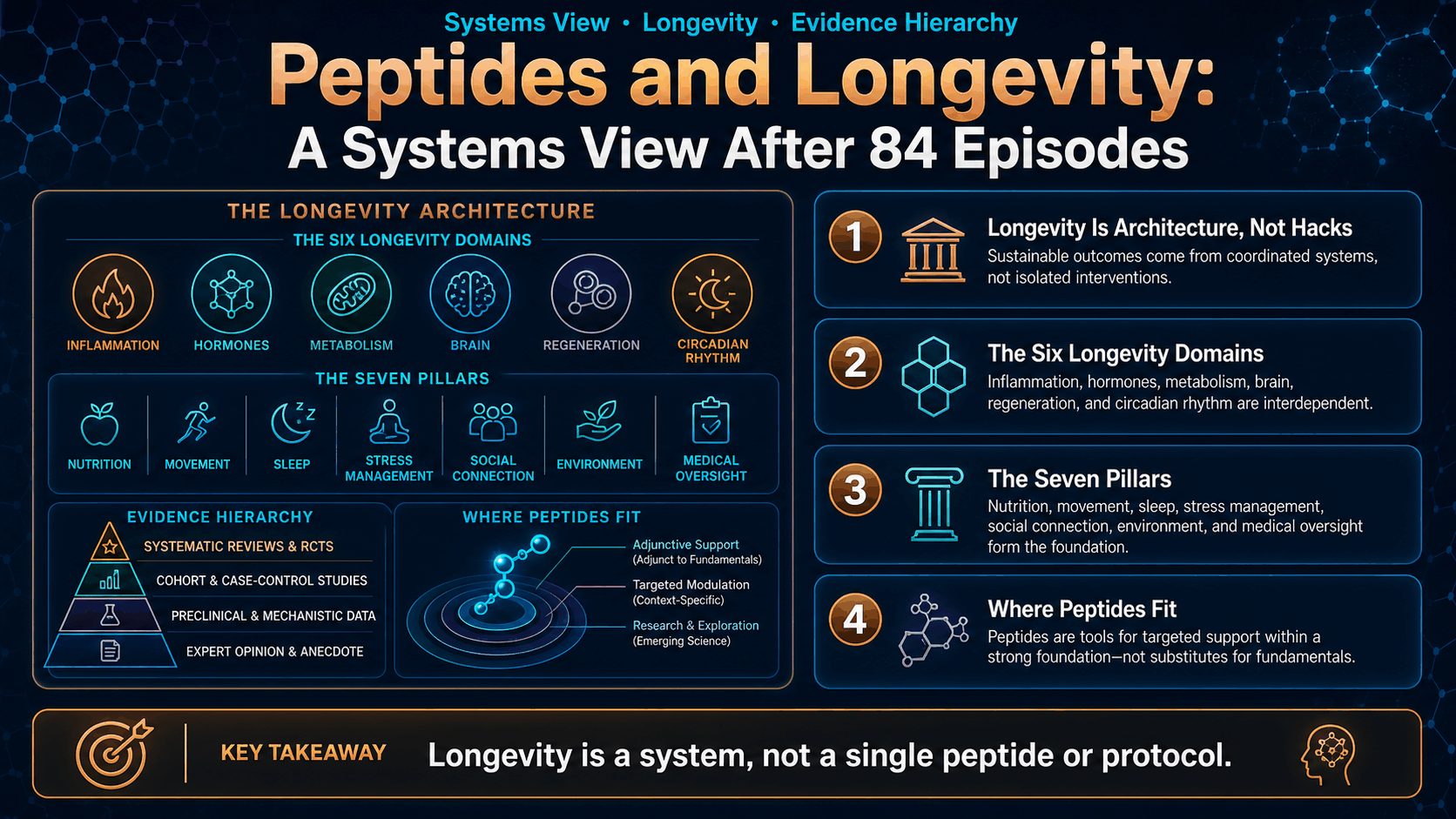
After 84 episodes, the main conclusion is simple: longevity is a system.
Peptides matter, but they do not sit at the bottom of the pyramid. The base is lifestyle: movement, sleep, nutrition, inflammation control, stress management, and medical screening. Nutraceuticals are the second layer. Peptides are the third layer — potentially powerful, but only when the lower layers exist.
The Six Longevity Domains
Inflammation and immunity
Inflammaging, TNF‑α, IL‑6, NF‑κB, and SASP from senescent cells connect aging with chronic disease and reduced recovery capacity.
Hormonal axis
GH/IGF‑1, testosterone, estrogen, thyroid, cortisol, and DHEA‑S shape metabolism, body composition, sleep, and resilience.
Metabolic health
Insulin resistance, adipokines, glycemia, visceral fat, and liver metabolism connect nearly every other longevity domain.
Neurocognitive health
BDNF, neuroinflammation, glymphatic clearance, sleep, and neuroplasticity determine long-term brain performance.
Tissue regeneration
Collagen, extracellular matrix, progenitor-cell context, and repair biology determine how the body maintains structure.
Circadian rhythm and sleep
N3 sleep, melatonin, glymphatic clearance, and the natural GH pulse make sleep a central repair process.
 Sponsored / AffiliateMomentous · Performance nutrition and recovery supplements
The Seven Pillars
Where Peptides Fit
Gut-system and inflammation context
Discussed around TNF‑α, gut-barrier integrity, eNOS, and tissue-repair environment. Evidence is still emerging.
Gene-expression and matrix context
Often discussed around skin, matrix remodeling, collagen, and transcriptional pattern support.
Circadian and neurotrophic context
Epitalon is discussed around circadian aging; Semax around BDNF and neurocognitive contexts.
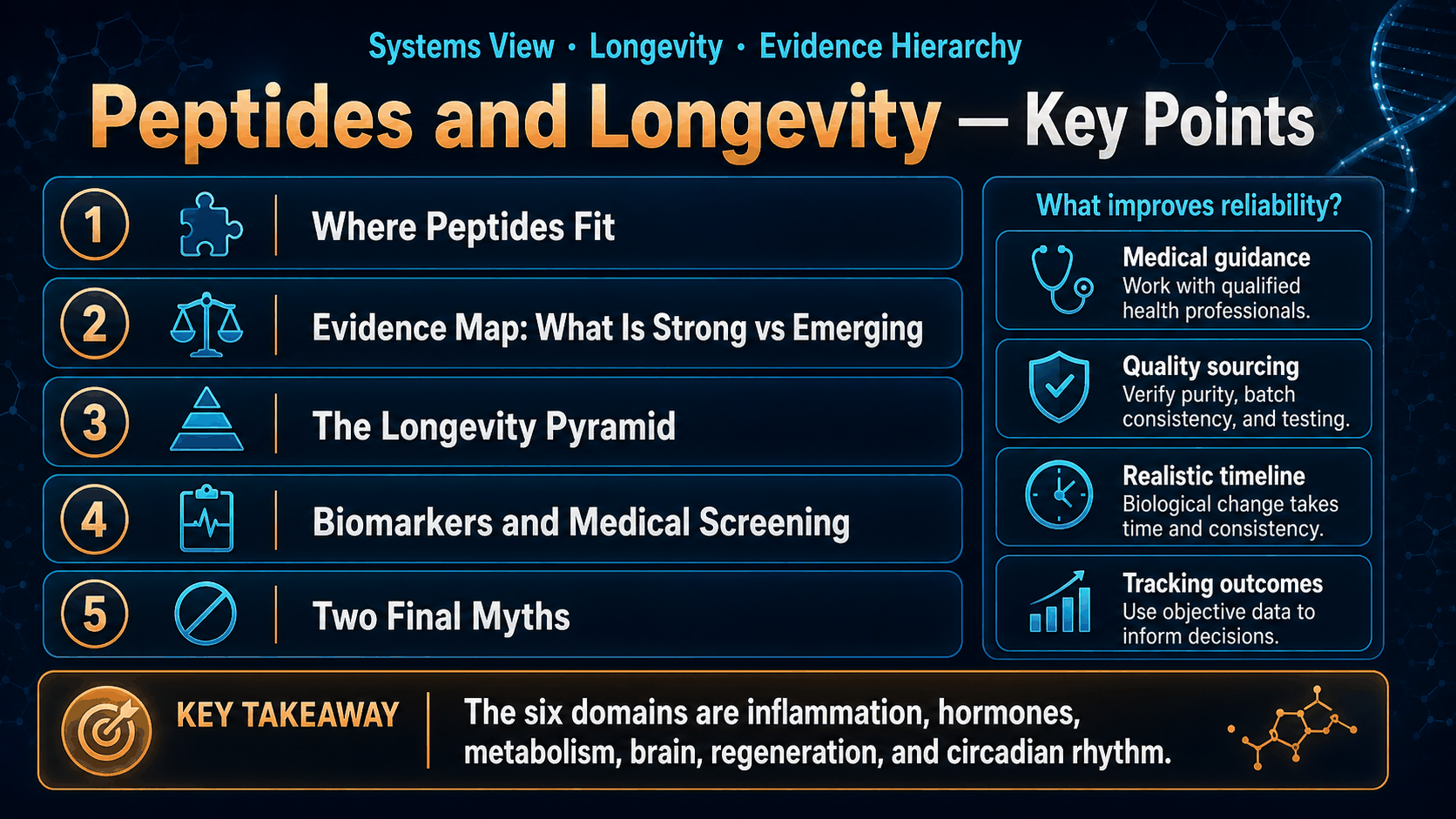
Evidence Map: What Is Strong vs Emerging
| Level | Examples | Evidence interpretation |
|---|---|---|
| ★★★★★ | Aerobic exercise, resistance training, sleep, stress management, whole-food diet | Strongest human healthspan and disease-risk evidence. |
| ★★★★☆ | Omega‑3, vitamin D when indicated, magnesium, berberine in metabolic contexts, topical GHK‑Cu skin data | Useful in selected contexts; evidence varies by indication. |
| ★★★☆☆ | GH secretagogues, BPC‑157, TB‑500, Epitalon, Semax in specific contexts | Mechanistic and/or limited human context; not universal proof. |
| ★★☆☆☆ | Thymalin and region-specific clinical use | Potentially interesting, but international RCT evidence is limited. |
 Sponsored / AffiliatePeptide ReGenesis · Peptide education, protocols, and wellness-focused resources
The Longevity Pyramid
Level 1 — Foundation ★★★★★
- Aerobic exercise and resistance training.
- Sleep 7–8 hours with N3 support.
- Time-restricted eating when appropriate and whole-food nutrition.
- Stress regulation and mental-health support.
- Regular screening and clinician-guided biomarkers.
Level 2 — Nutraceuticals ★★★★☆
- Omega‑3 EPA/DHA context.
- Vitamin D and K2 when indicated.
- Magnesium glycinate and glycine sleep context.
- Berberine when insulin-resistance context is relevant and interactions are reviewed.
- Collagen + vitamin C around tendon/joint loading.
Level 3 — Peptides ★★★☆☆
- GHK‑Cu topical context and cautious systemic discussion.
- BPC‑157 inflammation/gut/tissue context.
- Semax neurocognitive context.
- Epitalon circadian/sleep-aging context.
- GH secretagogues only with medical monitoring and rule review where relevant.
Biomarkers and Medical Screening
Longevity without measurement turns into guessing. Labs do not replace clinical judgment, but they help identify which system needs attention.
Baseline system view
TSH, free T4/T3 if indicated, HbA1c, fasting glucose/insulin, lipid panel, hs‑CRP, vitamin D, CBC, CMP, ferritin where appropriate.
Individualized layer
Sex hormones, IGF‑1, cortisol/DHEA‑S, thyroid antibodies, ApoB, Lp(a), kidney/liver markers, and cancer screening depend on personal context.
Two Final Myths
Myth: Peptides are only advanced biohacking.
Fact: Some peptide-related tools are practical, but they must be mechanism-aware, medically appropriate, and not treated as magic.
Myth: Peptides are the main longevity tool.
Fact: Peptides belong on the third level of the pyramid. Lifestyle and clinical prevention remain the foundation.
Frequently Asked Questions
Can peptides extend human lifespan?
There is no large, definitive human proof that the peptides discussed here extend lifespan. They are better framed around specific biological pathways and healthspan contexts.
What is the strongest longevity intervention?
Consistent exercise, sleep, nutrition, stress regulation, metabolic health, and medical screening have stronger human evidence than any peptide.
Why are peptides called the third layer?
Because they work best as targeted signals on top of a functioning lifestyle and nutraceutical foundation.
Which peptide is most “systemic” in this series?
BPC‑157 is often framed as systemic because of gut-barrier, inflammation, and tissue-repair context, but evidence remains emerging.
What should be avoided?
Self-treatment, skipping medical diagnosis, using peptides to compensate for poor sleep or diet, and believing “anti-aging cure” claims.
Key Takeaways
- Longevity is a system, not a single peptide or protocol.
- The six domains are inflammation, hormones, metabolism, brain, regeneration, and circadian rhythm.
- The seven pillars start with inflammation, sleep, movement, gut, hormones, stress, and hierarchy.
- Lifestyle is the foundation; nutraceuticals are the second layer; peptides are the third layer.
- Evidence levels must be stated honestly.
- Peptides can amplify a functioning system, but they cannot replace it.
- The page is mobile-responsive: grids collapse, pillar rows stack, sticky TOC becomes normal, and tables scroll horizontally.