
Why Quality Control Comes First
Even the most logical peptide framework is useless if the product is contaminated, degraded, mislabeled, or not the claimed molecule.
Peptide quality is not judged by a beautiful label, a premium website, or a high price. It is judged by batch-specific documentation, third-party testing, identity confirmation, impurity control, storage discipline, and supply-chain transparency.
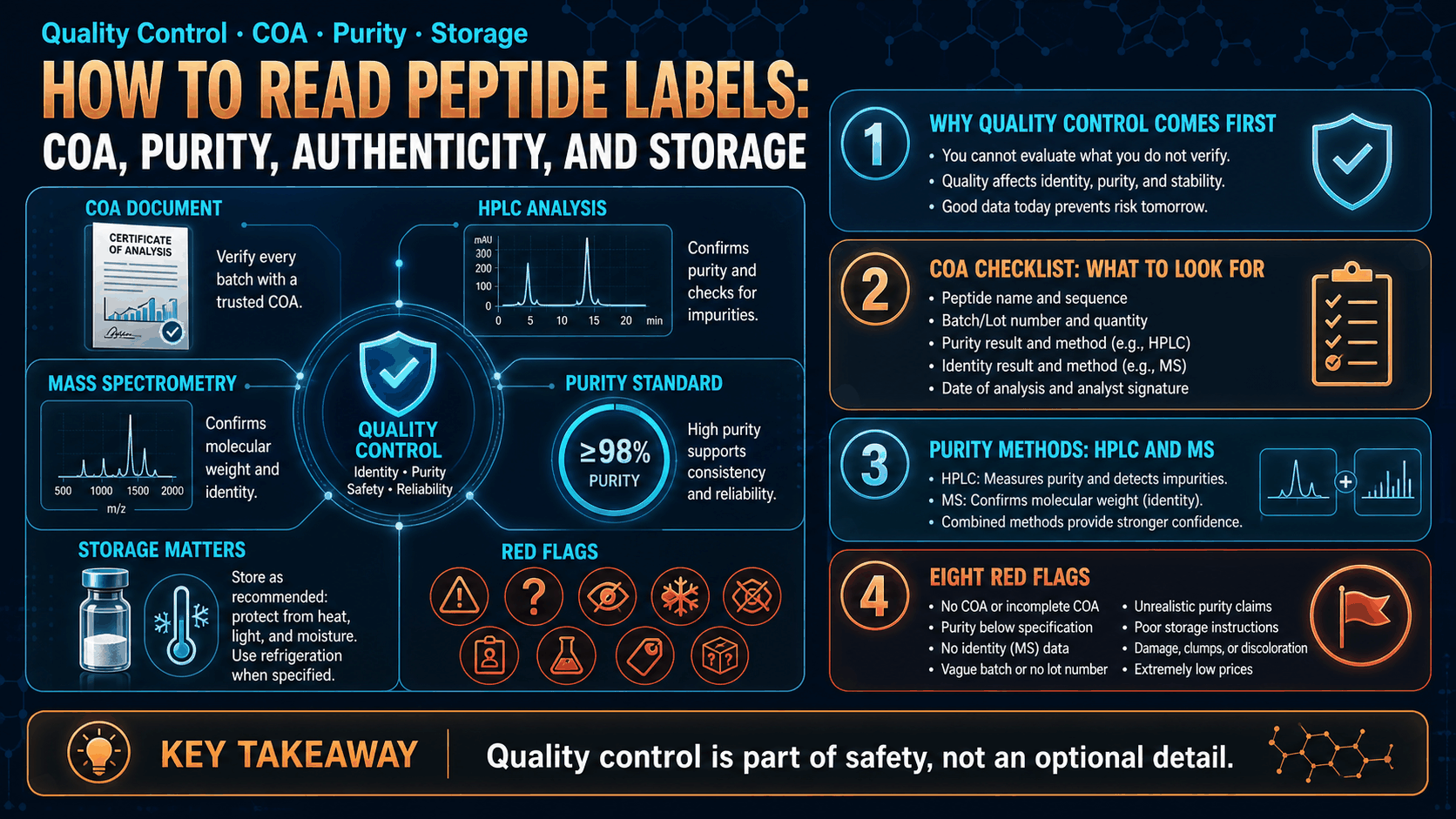
COA Checklist: What to Look For
 Sponsored / AffiliatePeptide ReGenesis · Peptide education, protocols, and wellness-focused resources
Purity Methods: HPLC and MS
Purity estimate
High-performance liquid chromatography separates components by retention time and estimates the target peak as a percentage of total peak area.
Identity confirmation
Mass spectrometry helps confirm whether the molecule is the claimed compound, not just a clean-looking unknown.
The remaining 1–2%
May include peptide fragments, residual solvents, TFA residues, isomers, acetate forms, or process-related contaminants.
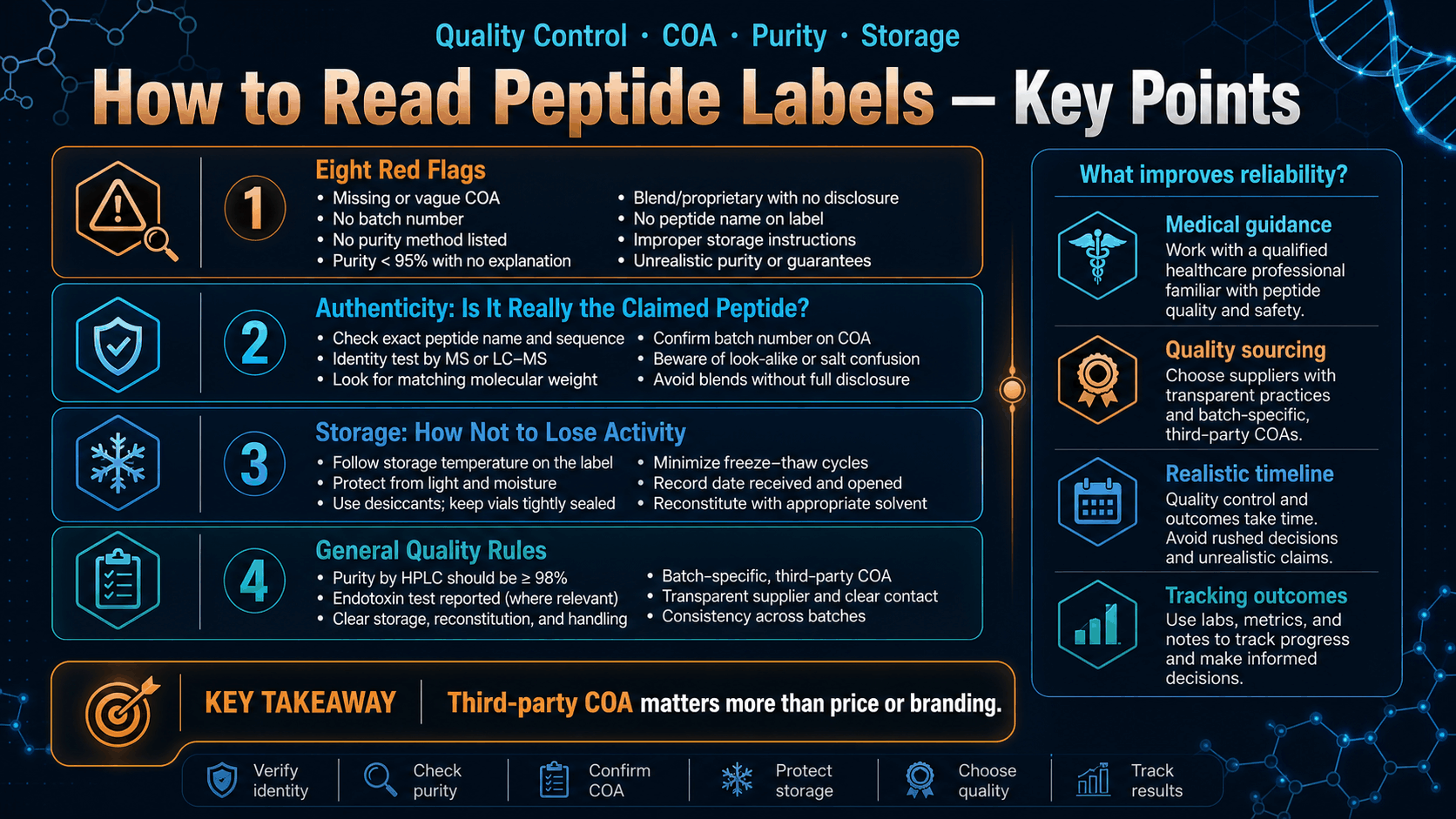
Eight Red Flags
Authenticity: Is It Really the Claimed Peptide?
Authenticity requires more than a purity number. The product page, vial, batch number, COA, HPLC report, and MS data should tell the same story.
Vial ↔ COA ↔ product page
The batch number on the vial should match the batch number on the COA and the supplier documentation.
Verifiable testing
A serious supplier should provide lab name, report date, testing method, and enough information to verify the source.
 Sponsored / AffiliateMito Red Light · Red light therapy devices for recovery and wellness routines
Storage: How Not to Lose Activity
Lyophilized powder
Store cold, dry, sealed, and protected from light. Follow manufacturer or pharmacy stability guidance.
Solution is more fragile
Use only appropriate sterile diluent, refrigerate, avoid cloudy solution or particles, and discard after supported beyond-use time.
Avoid heat and shaking
Heat, microwaves, hot water, and vigorous shaking can stress peptides. Handle gently and swirl rather than shake.
GHK‑Cu and GH-axis peptides
Protect from heat and light. Major color change, cloudiness, or visible particles are warning signs.
General Quality Rules
- Use only sterile, appropriate diluent when a product is intended for sterile reconstitution.
- One vial equals one product; do not mix products unless directed by qualified medical/pharmacy guidance.
- Keep reconstituted material in the vial unless pharmacy instructions specify otherwise.
- Write the reconstitution date on the vial.
- Discard after the supported beyond-use period or if contamination is suspected.
- When in doubt, consult a licensed clinician or pharmacist and avoid unverified products.
Two Common Myths
Myth: More expensive means cleaner and better.
Fact: Price is a poor marker. Documentation, third-party testing, and batch-specific traceability matter more than packaging.
Myth: A reconstituted solution can be frozen to last longer.
Fact: Dry powder and solution are different states. Solution is more fragile and should follow product-specific stability guidance.
Frequently Asked Questions
Is a COA enough to prove safety?
No. A COA is useful quality documentation, but it does not make an unapproved or non-sterile product safe for human use.
What is the difference between HPLC and MS?
HPLC estimates purity; MS helps confirm identity. A strong COA ideally includes both.
Why does batch number matter?
Because a COA should apply to the exact batch in your vial, not a different or older production lot.
Can I trust “pharmaceutical grade” claims?
Only if supported by regulatory documentation and appropriate quality systems. Marketing words alone are not evidence.
What are the biggest warning signs after reconstitution?
Cloudiness, particles, color change, unknown beyond-use date, non-sterile handling, or storage outside recommended conditions.
Key Takeaways
- Quality control is part of safety, not an optional detail.
- Third-party COA matters more than price or branding.
- HPLC estimates purity; MS supports identity confirmation.
- Batch number, lab identity, and analysis date must match the product.
- Sterility and endotoxin testing are critical for injectable/sterile contexts.
- Lyophilized powder is more stable than solution.
- The page is mobile-responsive: grids collapse, COA rows stack, sticky TOC becomes normal, and tables scroll horizontally.