
Why Periodization Matters
The most common mistake in sports peptide discussions is using the same tools the same way all year.
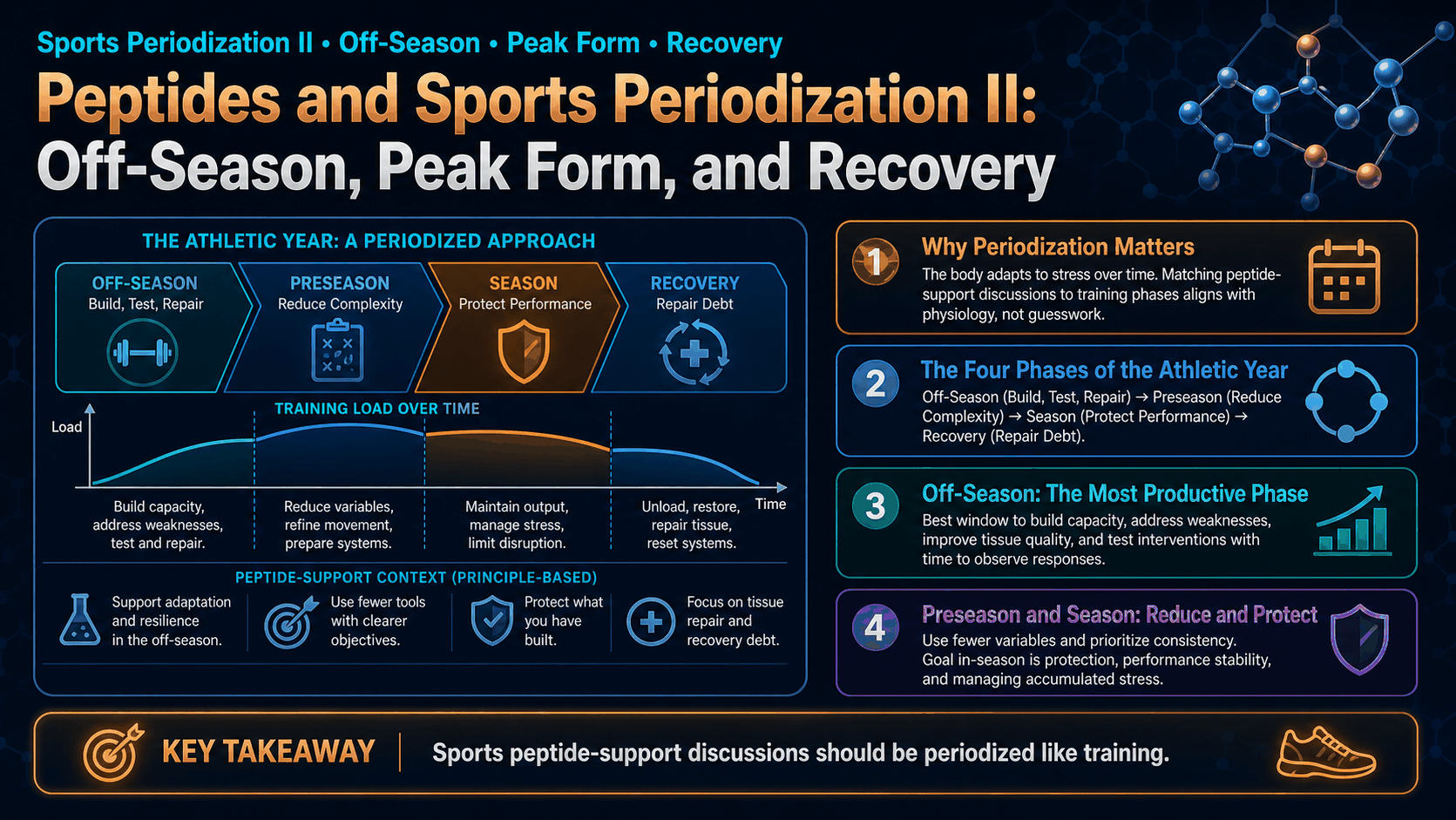
Sport is seasonal. The goal changes from tissue building to sharpening, then maintaining, then repairing. Training is periodized because the body adapts. Peptide-support discussions should follow the same logic: different phase, different risk-benefit profile, different emphasis.
The Four Phases of the Athletic Year
Build capacity
Muscle gain, body recomposition, tendon capacity, and old microtrauma remodeling. This is where testing and adaptation belong — if rule-compliant and medically cleared.
Sharpen performance
Convert strength into speed, power, and endurance. Reduce complexity and avoid anything that may disrupt sleep, reaction time, or predictability.
Maintain and compete
Minimize new variables. Prioritize sleep, immune resilience, injury care, recovery between starts, and proven routines.
Repair and reset
Address accumulated injuries, immune fatigue, psychological burnout, tendon issues, and post-season medical review.
 Sponsored / AffiliateQuest Health · Personal lab testing and health marker tracking
Off-Season: The Most Productive Phase
The off-season is the phase with the most room for adaptation. Training creates the stimulus; recovery biology determines how much of that stimulus becomes muscle, tendon capacity, improved body composition, or resilience.
- Progressive strength or base-building plan.
- Protein, energy intake, and body composition goals.
- Sleep quality, circadian consistency, and recovery tracking.
- BPC‑157 context for inflammation or joint/tendon irritation discussions.
- TB‑500 context for chronic tendon/scar-tissue remodeling discussions.
- Collagen + vitamin C timing around tendon-loading work.
- GH-axis support only with clinician oversight, labs, and rule review.
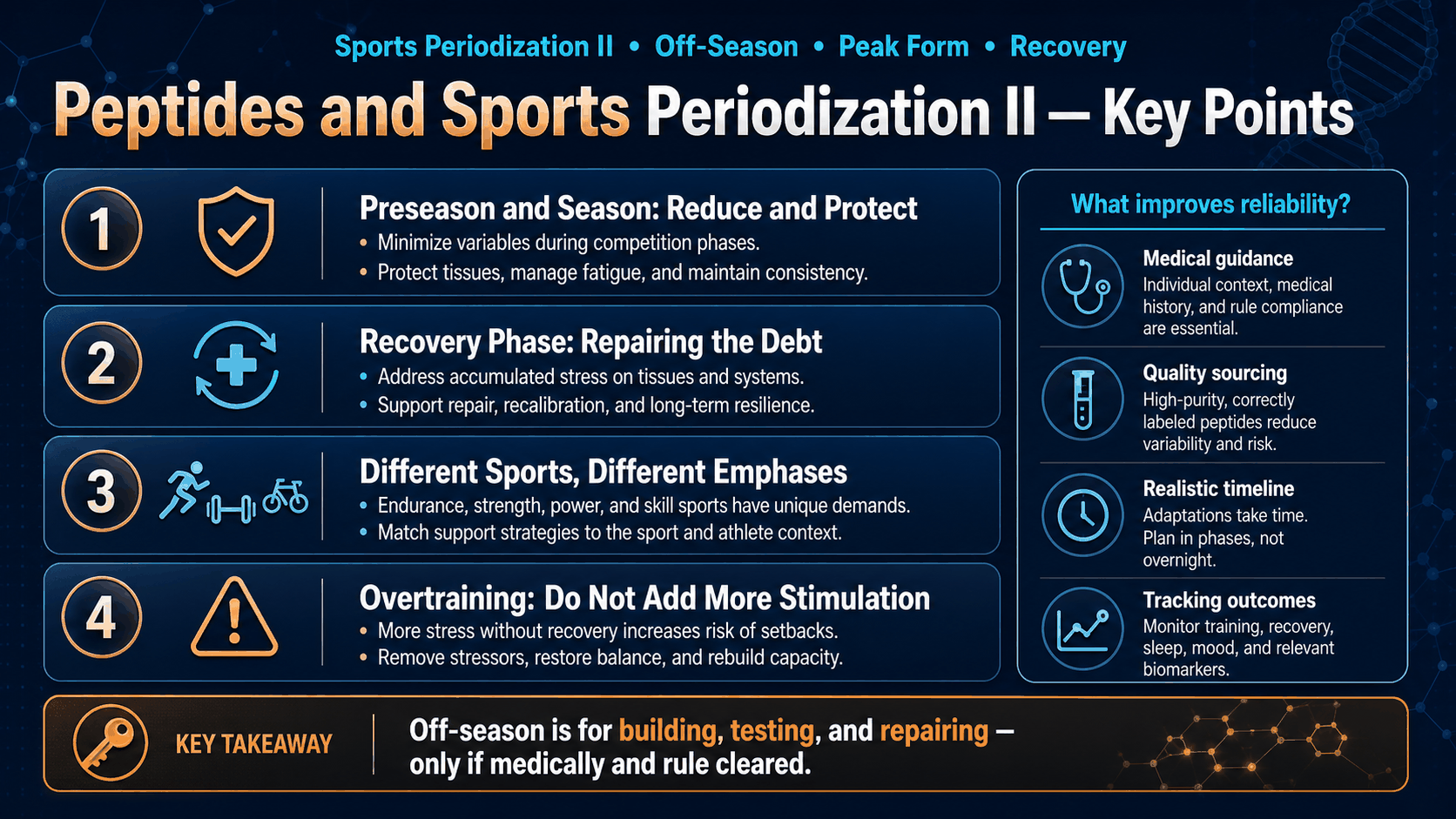
Preseason and Season: Reduce and Protect
Recovery Phase: Repairing the Debt
After a season, the body may carry accumulated microtrauma, tendinopathy, sleep debt, travel stress, immune fatigue, and psychological burnout. This phase is for repair — not immediate performance pushing.
Diagnose injuries
Imaging, physical therapy, tendon loading, surgical opinion when needed, and rehabilitation planning come before any peptide discussion.
BPC‑157 / TB‑500 context
BPC‑157 is discussed around inflammatory irritation. TB‑500 is discussed around migration, angiogenesis, and chronic remodeling context.
Sleep and immune recovery
Deep sleep, circadian rhythm, nutrition, stress downshifting, and immune resilience are the real recovery foundation.
 Sponsored / AffiliateApollo Peptide Sciences · Research-focused peptide science and molecular data
Different Sports, Different Emphases
| Phase / Sport | Strength sports | Endurance sports | Team sports |
|---|---|---|---|
| Off-season | Hypertrophy, recomposition, tendon capacity, recovery reserve. | Aerobic base, tendon capacity, overuse repair, gradual mileage. | Strength base, mobility, accumulated contact-injury repair. |
| Preseason | Power conversion, speed of execution, fewer new variables. | Intensity rise, tendon protection, fueling and sleep stability. | Tactical load, repeated sprint capacity, predictable recovery. |
| Season | Maintain performance, injury care only, tested tools only. | Between-event recovery, immune resilience, sleep preservation. | Travel stress, contact injuries, immune support, no new tools. |
| Recovery | Deload, tendon/joint evaluation, sleep and nutrition reset. | True rest, tendon recovery, gradual return to base training. | Repair accumulated injuries and restore circadian/immune stability. |
Overtraining: Do Not Add More Stimulation
Overtraining syndrome is not just being tired. It can involve poor sleep, loss of motivation, performance decline, mood changes, suppressed adaptive response, and altered stress-axis function.
Two Common Myths
Myth: GH secretagogues should be used all year.
Fact: The body adapts, goals change, and continuous use without monitoring or rule review is poor periodization. GH-axis discussions belong only in medically supervised and rule-cleared contexts.
Myth: BPC‑157 and TB‑500 are the same.
Fact: They are discussed around different mechanisms: BPC‑157 around inflammation/NO/gut/acute irritation context; TB‑500 around migration, angiogenesis, scar remodeling, and chronic injury context.
Frequently Asked Questions
Can athletes use peptides during competition season?
Only if medically appropriate and rules-compliant. Many peptide-related substances may be prohibited. Always check anti-doping rules before use.
When should new tools be tested?
Off-season, after medical review and anti-doping review. Never introduce unknown tools during competition.
What matters most in the recovery phase?
Diagnosis of injuries, sleep, nutrition, deloading, rehabilitation, and gradual return. Peptides do not replace physical therapy or medical care.
What is the difference between BPC‑157 and TB‑500 in this framework?
BPC‑157 is discussed more around inflammatory irritation and acute tissue environment; TB‑500 around chronic remodeling and migration/angiogenesis context.
What should be avoided in overtraining?
More stimulation, more intensity, and new experimental tools. The priority is recovery, not adding load.
Key Takeaways
- Sports peptide-support discussions should be periodized like training.
- Off-season is for building, testing, and repairing — only if medically and rule cleared.
- Preseason is for reducing complexity and sharpening performance.
- Season is for maintaining and avoiding new variables.
- Recovery is for injury diagnosis, sleep restoration, immune/circadian reset, and repair.
- Overtraining calls for rest and assessment, not more stimulation.
- The page is mobile-responsive: grids collapse, phase rows stack, sticky TOC becomes normal, and sport tables scroll horizontally.