
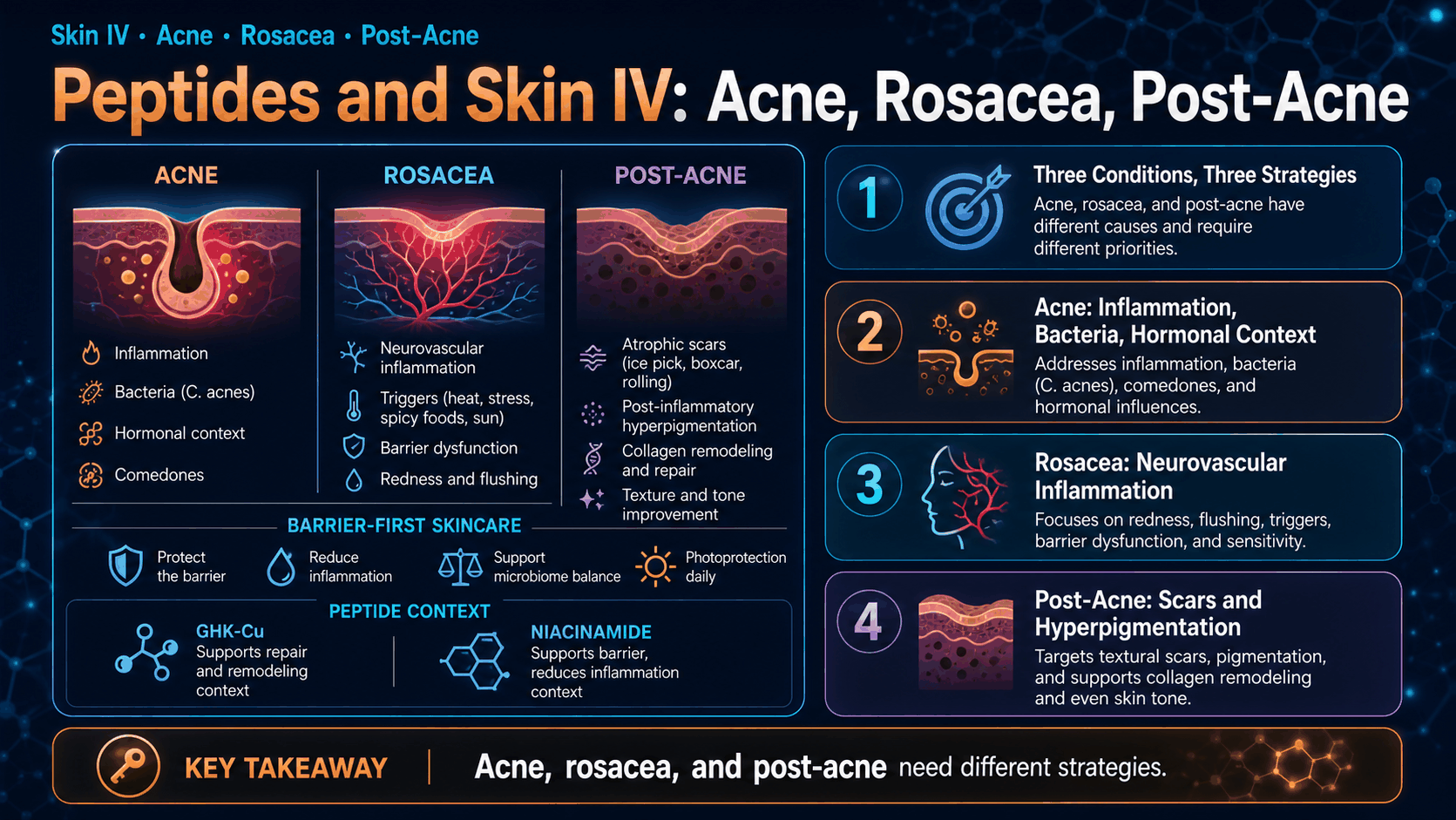
Three Conditions, Three Strategies
Acne, rosacea, and post-acne are often confused, but their biology is different.
Acne is follicular inflammation with sebum, keratinization, Cutibacterium acnes, and sometimes hormonal context. Rosacea is neurovascular inflammation and barrier hyperreactivity. Post-acne is the aftermath: scars, texture changes, and pigmentation. A one-size routine can make things worse.
Acne: Inflammation, Bacteria, Hormonal Context
Biology
Four drivers: excess sebum, follicular hyperkeratinization, Cutibacterium acnes, and inflammatory signaling such as IL‑1β and TNF‑α. Jawline/chin acne may have hormonal or insulin/IGF‑1 context.
Framework
Niacinamide 4–5% is discussed for sebum, inflammation, and post-acne marks. Salicylic acid can support comedolysis. BPC‑157 is only a systemic inflammation/gut-skin-axis discussion, not acne treatment.
 Sponsored / AffiliateQuest Health · Personal lab testing and health marker tracking
Rosacea: Neurovascular Inflammation
Biology
Rosacea is not acne. TRPV1 heat receptors, neuropeptides such as substance P/CGRP, vasodilation, barrier disruption, and triggers such as UV, heat, alcohol, stress, and spicy foods are central.
Framework
Azelaic acid 10–15% is a key active. Niacinamide 2–4% may support barrier and redness. GHK‑Cu can be discussed cautiously for barrier support if tolerated.
Post-Acne: Scars and Hyperpigmentation
Biology
Atrophic scars reflect collagen loss and dermal injury. PIH reflects increased melanin after inflammation, especially in darker skin tones. These problems require time, SPF, and remodeling logic.
Framework
GHK‑Cu is most relevant after active inflammation is controlled: collagen/matrix remodeling context. Niacinamide 5% may support PIH. Retinoids can support turnover but require slow introduction.
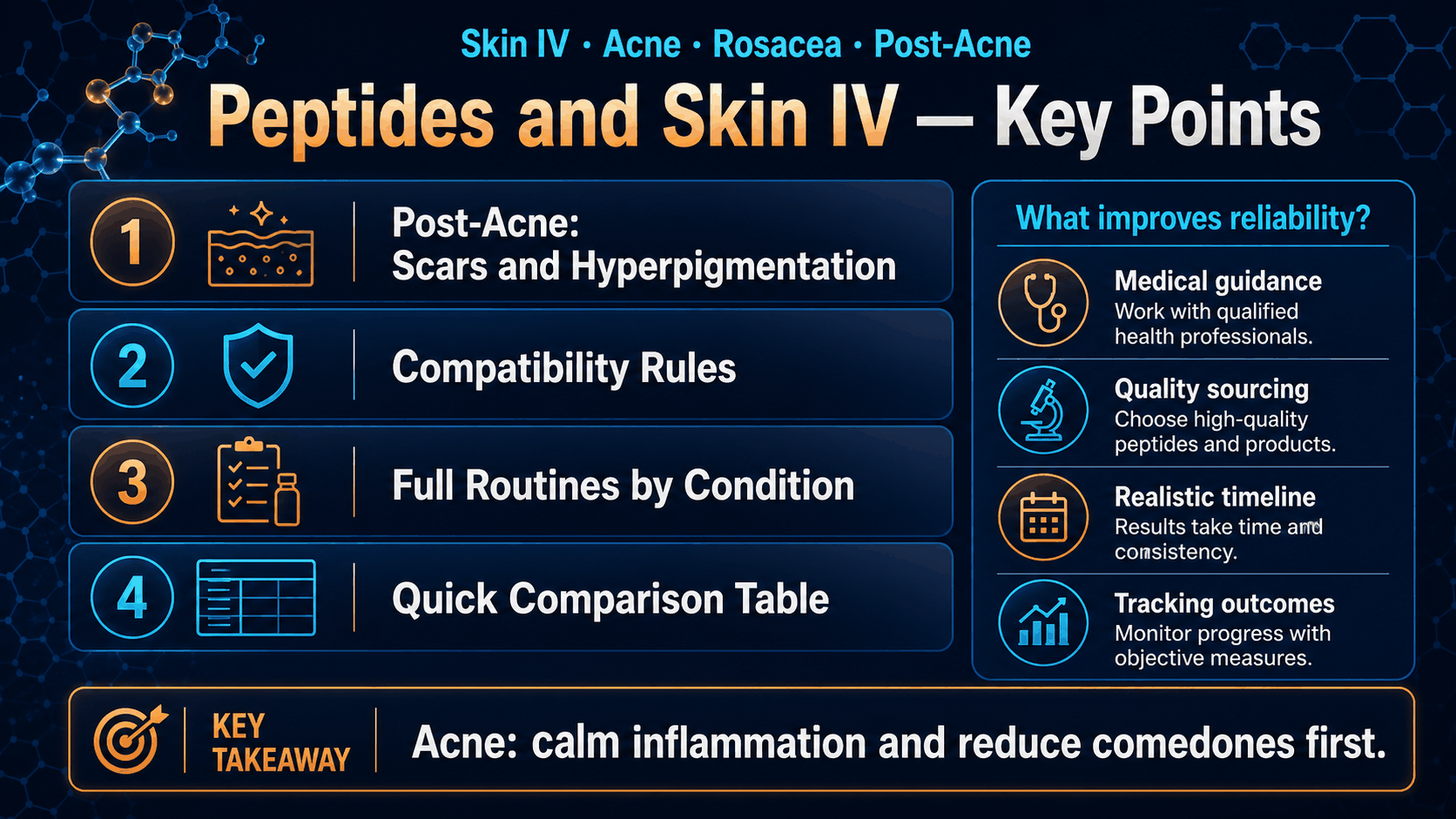
Compatibility Rules
Do not over-repair too early
- Avoid GHK‑Cu directly on active pustules.
- Avoid dermarolling over inflamed lesions.
- Avoid heavy comedogenic oils.
Barrier-first logic
- Avoid aggressive AHA/BHA during flares.
- Introduce retinoids very slowly, if at all.
- SPF and trigger control are baseline.
Acne + rosacea
- Niacinamide 2–4% is often the safer shared tool.
- Azelaic acid may work for both.
- GHK‑Cu waits until inflammation calms.
Repair phase
- GHK‑Cu is more relevant here.
- Retinoid and vitamin C need slow introduction.
- SPF determines pigmentation outcomes.
 Sponsored / AffiliateIntegrative Peptides · Practitioner-oriented peptide and wellness education
Full Routines by Condition
Stable / moderate context
Morning: gentle cleanser, niacinamide 4–5%, salicylic acid 0.5–1% slowly, SPF 50. Evening: gentle cleanse, non-comedogenic moisturizer, adapalene/prescription retinoid only if appropriate and clinician-guided.
Stage I–II context
Morning: soap-free cleanse, azelaic acid if tolerated, niacinamide 2–3%, mineral SPF 50. Evening: gentle cleanse, cautious GHK‑Cu 0.5% if tolerated, barrier cream.
Scars + PIH context
Morning: gentle cleanse, niacinamide 5%, optional stable vitamin C, SPF 50. Evening: GHK‑Cu, slow retinoid introduction, rich moisturizer. Procedures only on stable skin.
Quick Comparison Table
| Condition | Main biology | Most useful actives | What to avoid |
|---|---|---|---|
| Acne | Sebum, keratinization, Cutibacterium acnes, inflammation | Niacinamide, salicylic acid, adapalene/prescription care when needed | GHK‑Cu over active pustules, dermarolling, heavy oils |
| Rosacea | Neurovascular inflammation, flushing, barrier sensitivity | Azelaic acid, low-dose niacinamide, SPF, barrier support | Aggressive acids, scrubs, heat, trigger stacking |
| Post-acne | Collagen loss, scars, PIH | GHK‑Cu, niacinamide, SPF, retinoids slowly, professional procedures | Procedures on active acne, skipping SPF, over-exfoliation |
Two Common Myths
Myth: GHK‑Cu will cure acne because it is anti-inflammatory.
Fact: GHK‑Cu is more relevant for repair and post-acne contexts. Active inflamed pustules are not the place to introduce copper peptide aggressively.
Myth: Rosacea and acne are basically the same.
Fact: Acne is follicular inflammation with bacterial and sebum context. Rosacea is neurovascular inflammation with flushing and barrier sensitivity. Treating them the same can worsen rosacea.
Frequently Asked Questions
Can I use GHK‑Cu with acne?
Not directly over active inflamed lesions or pustules. It is better discussed for post-acne repair or acne-free areas after stabilization.
What is the safest shared active for acne + rosacea?
Low-dose niacinamide, usually around 2–4%, is often one of the gentler shared options.
Why is azelaic acid important for rosacea?
It is one of the better-established topical options for rosacea and can also be useful for acne-prone and pigmentation-prone skin.
When can post-acne scar repair start?
After active inflammation is controlled. Repairing scars while acne is inflamed can worsen irritation and spread bacteria if procedures are used incorrectly.
Is SPF really necessary?
Yes. UV worsens rosacea, inflammation, and PIH. SPF is part of the treatment logic, not just prevention.
Key Takeaways
- Acne, rosacea, and post-acne need different strategies.
- Acne: calm inflammation and reduce comedones first.
- Rosacea: barrier and trigger control come first.
- Post-acne: GHK‑Cu, niacinamide, SPF, and slow retinoid logic are more relevant after inflammation is controlled.
- GHK‑Cu is not a universal acne treatment.
- Never microneedle over active acne, infection, or active rosacea.
- The page is mobile-responsive: grids collapse, condition columns stack, sticky TOC becomes normal, and tables scroll horizontally.