
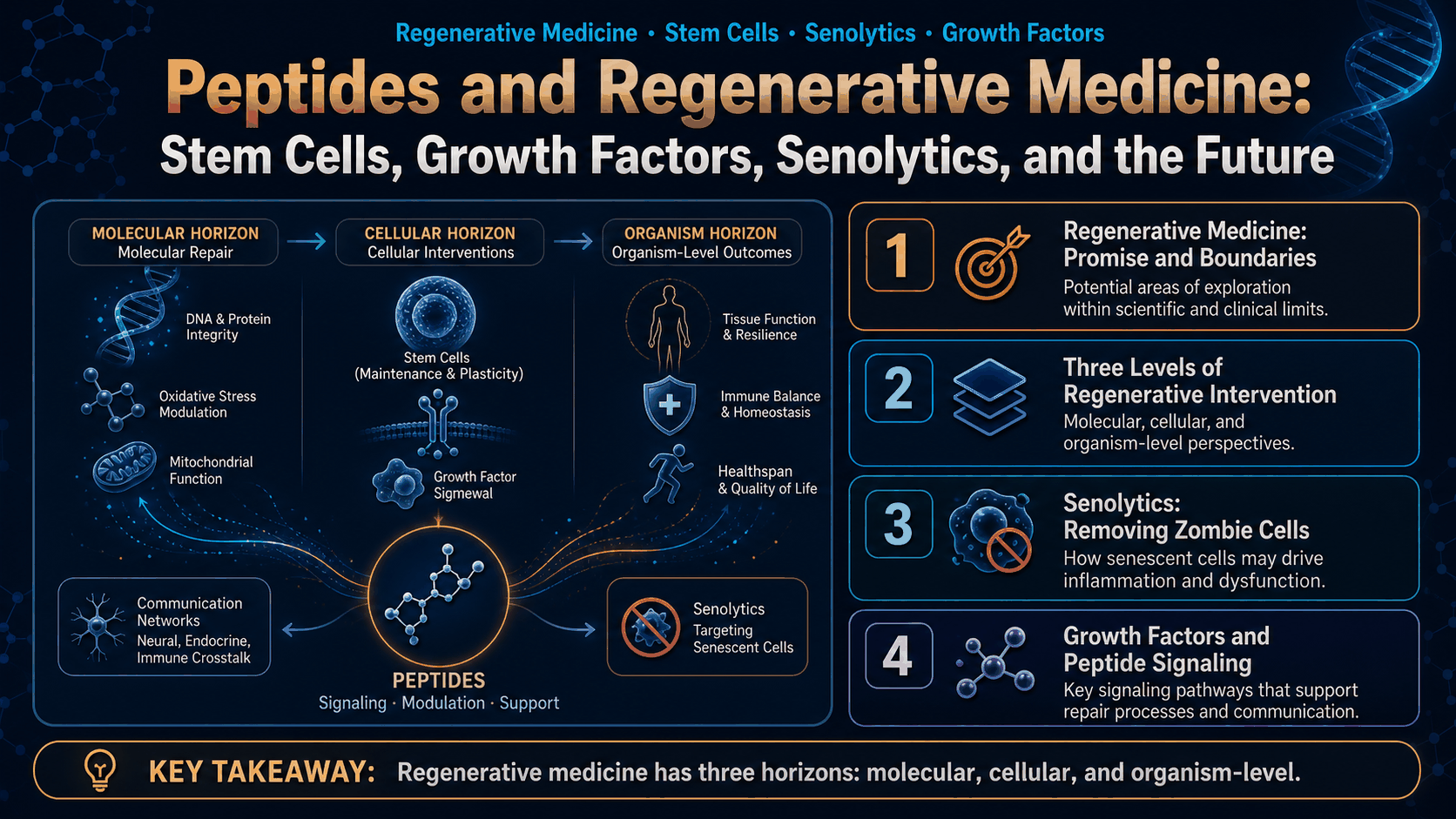
Regenerative Medicine: Promise and Boundaries
Regenerative medicine is the field where repair, rejuvenation, stem-cell biology, senolytics, and tissue engineering begin to overlap.
The exciting part is real: molecular signals can influence repair programs, stem-cell niches, inflammation, extracellular matrix remodeling, and gene-expression patterns. The risk is also real: marketing often jumps far ahead of clinical evidence.
Three Levels of Regenerative Intervention
Now
now
Near horizon
Future
 Sponsored / AffiliateDT Peptides · Peptide research products and laboratory-focused resources
Senolytics: Removing Zombie Cells
Senescent cells no longer divide properly but continue secreting SASP inflammatory factors. Senolytics aim to selectively remove these cells.
Early human research
One of the earliest senolytic combinations studied clinically, especially in age-related disease contexts. It is not a general wellness stack.
Natural flavonoid
Shows senolytic properties in preclinical contexts. Human evidence for healthy people remains insufficient.
Growth Factors and Peptide Signaling
Progenitor-cell context
Discussed around actin signaling, migration, repair programs, and progenitor-cell activation contexts. It is not stem-cell therapy.
Gene-expression re-tuning
Often discussed as a “soft” gene-expression remodulator: matrix remodeling, wound repair, and youthful transcriptional pattern context.
Stem-cell niche context
IGF‑1 can influence muscle satellite-cell and hematopoietic contexts. GH-axis tools require monitoring and clinician guidance.
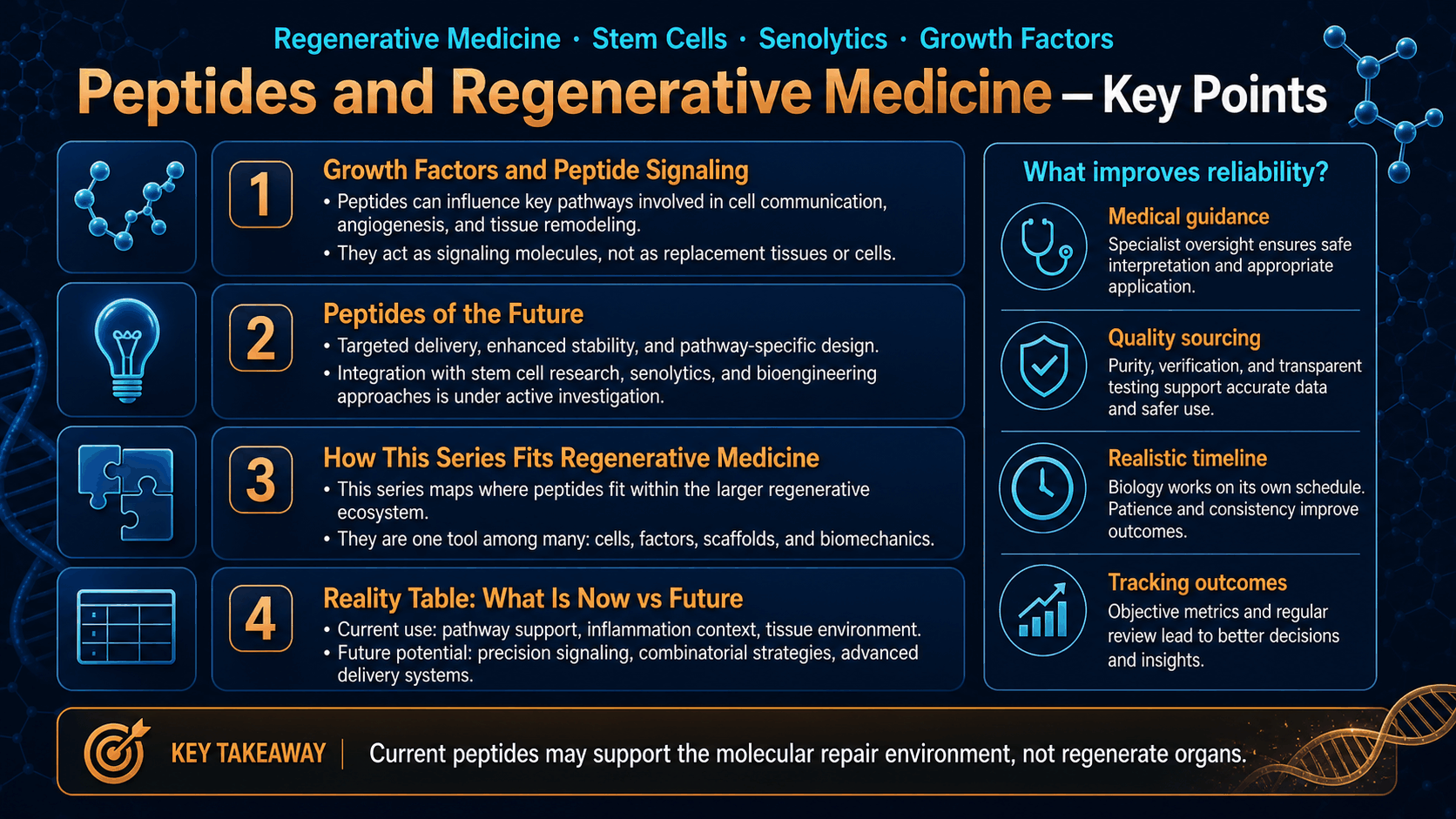
Peptides of the Future
MOTS-c and Humanin
Mitochondrial-derived peptides discussed around AMPK, metabolic health, neuroprotection, and aging biology.
BPC‑157 development
Early human clinical research in inflammatory-disease contexts could clarify whether BPC‑157 moves toward regulated medical use.
Exosomal delivery
Exosomes may improve tissue targeting and delivery, including blood-brain-barrier discussions, but this is not at-home medicine.
Senolytic peptides
FOXO4‑DRI is a peptide-senolytic candidate with mouse-model data. Human validation remains incomplete.
Partial reprogramming
Yamanaka-factor strategies may someday support rejuvenation biology, but safety, cancer risk, and delivery remain major hurdles.
Organ regeneration
True in-vivo regeneration of heart, cartilage, neurons, or organs remains a future research goal, not a current clinical promise.
 Sponsored / AffiliateUlta Lab Tests · Lab testing for hormones, inflammation, and wellness
How This Series Fits Regenerative Medicine
The peptides discussed across the series can be understood as first-generation molecular-regeneration tools. They do not regenerate organs, but they may influence the environment where repair happens.
- BPC‑157: inflammation and repair-context signaling.
- TB‑500: migration, actin, progenitor-cell context.
- GHK‑Cu: matrix remodeling and gene-expression context.
- Semax: neurotrophic factor context.
- IGF‑1 axis: anabolic and stem-cell niche context.
Reality Table: What Is Now vs Future
| Area | Status | Practical meaning |
|---|---|---|
| Molecular peptide support | Discussable now | Adjunctive repair-environment context, not organ regeneration |
| Stem-cell therapy | Regulated/limited | Depends on indication, country, product, and medical supervision |
| Exosomes | Developing | Promising delivery and signaling field, still highly regulated/variable |
| Senolytics | Early clinical research | Not general self-treatment; disease-context trials matter |
| FOXO4‑DRI | Preclinical/early | Interesting peptide-senolytic direction, not routine human use |
| Partial reprogramming | Experimental | Major safety and delivery barriers remain |
| Organ regeneration | Future research | No current peptide can reliably regenerate lost organs in humans |
Two Common Myths
Myth: TB‑500 is like stem-cell therapy.
Fact: TB‑500 is a signaling molecule discussed around progenitor-cell contexts. Stem-cell therapy involves cells. These are not the same.
Myth: GDF‑11 is a proven rejuvenation factor.
Fact: Early parabiosis research created excitement, but later findings were complicated and sometimes contradictory. It remains a research area, not a proven human rejuvenation therapy.
Frequently Asked Questions
Can peptides regenerate organs?
No. Current peptide discussions focus on molecular repair context, not reliable organ regeneration in humans.
Are exosomes safe for home use?
No. Exosomes are a regulated and complex biomedical area, not a casual at-home supplement.
Is BPC‑157 a senolytic?
No. It is discussed around inflammatory and repair-context signaling, not removal of senescent cells.
What is the most realistic current strategy?
Improve the repair environment: inflammation control, sleep, exercise, metabolic health, and medical guidance for any advanced therapy.
What should be avoided?
Unregulated stem-cell clinics, unapproved injections, guaranteed regeneration claims, and replacing medical care with experimental protocols.
Key Takeaways
- Regenerative medicine has three horizons: molecular, cellular, and organism-level.
- Current peptides may support the molecular repair environment, not regenerate organs.
- TB‑500 is not stem-cell therapy.
- BPC‑157 is not a senolytic.
- GHK‑Cu is gene-expression/matrix context, not full cellular reprogramming.
- Exosomes, senolytic peptides, and partial reprogramming are promising but not routine wellness tools.
- The page is mobile-responsive: grids collapse, level rows stack, sticky TOC becomes normal, and tables scroll horizontally.