
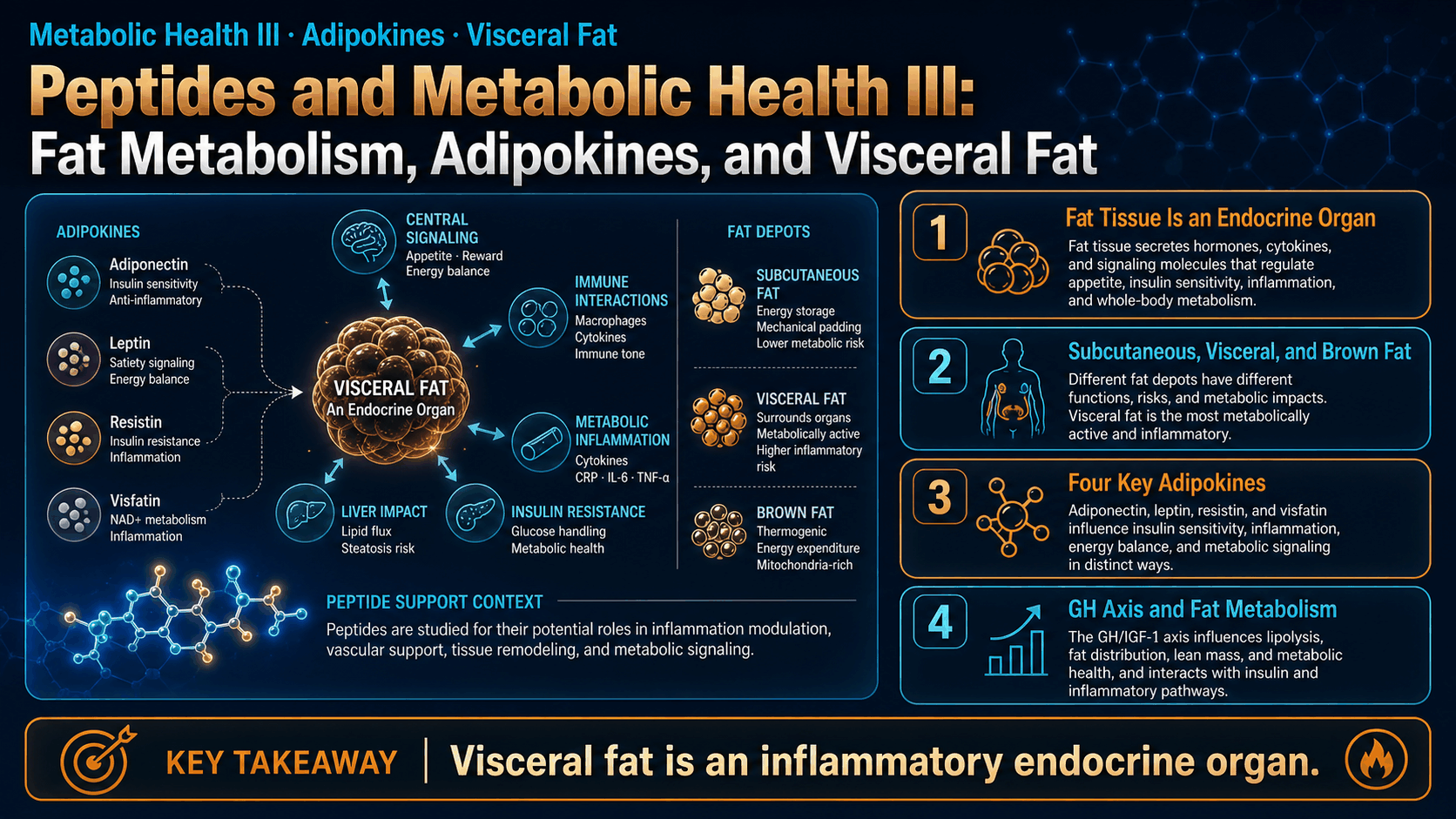
Fat Tissue Is an Endocrine Organ
Adipose tissue is not just a passive calorie warehouse. It secretes hundreds of biologically active molecules that affect the whole body.
Adipokines influence insulin sensitivity, inflammation, appetite, vascular tone, liver metabolism, and cardiometabolic risk. To improve metabolic health, the goal is not only “lose weight,” but improve fat-tissue function and reduce visceral-fat burden.
Subcutaneous, Visceral, and Brown Fat
More visible, often less harmful
Subcutaneous fat is often more aesthetic than metabolic. It still matters, but visceral fat is more strongly linked to cardiometabolic risk.
Inflammatory endocrine organ
Visceral fat surrounds organs and drains into portal circulation, sending inflammatory signals directly toward the liver.
Thermogenic tissue
Brown adipose tissue is involved in heat production. Cold, aerobic exercise, and fasting-style energy signaling are better-established supports.
 Sponsored / AffiliatePeptide University · Peptide learning resources and educational programs
Four Key Adipokines
The “good” adipokine
Supports insulin sensitivity through AMPK context, lowers inflammatory tone, and tends to decrease as visceral fat rises.
- Fasting-style energy signaling may support it.
- Aerobic exercise supports AMPK context.
- Higher adiponectin is generally favorable.
Satiety signal with resistance risk
Leptin signals fullness to the brain. In obesity, leptin may be high while the brain becomes resistant to the signal.
- Sleep loss can worsen leptin resistance.
- Stress management matters.
- N3 sleep is metabolically relevant.
Inflammation-associated adipokine
Resistin is linked to macrophage activity, insulin resistance, hs‑CRP, and cardiovascular-risk context.
- Lower visceral fat helps.
- Aerobic work helps inflammatory tone.
- BPC‑157 is discussed indirectly.
Insulin-mimetic context
Visfatin has insulin-like properties in some contexts, but its role in obesity and cancer biology is still debated.
- Evidence remains mixed.
- GH-axis effects are indirect.
- Do not overinterpret it as “good.”
GH Axis and Fat Metabolism
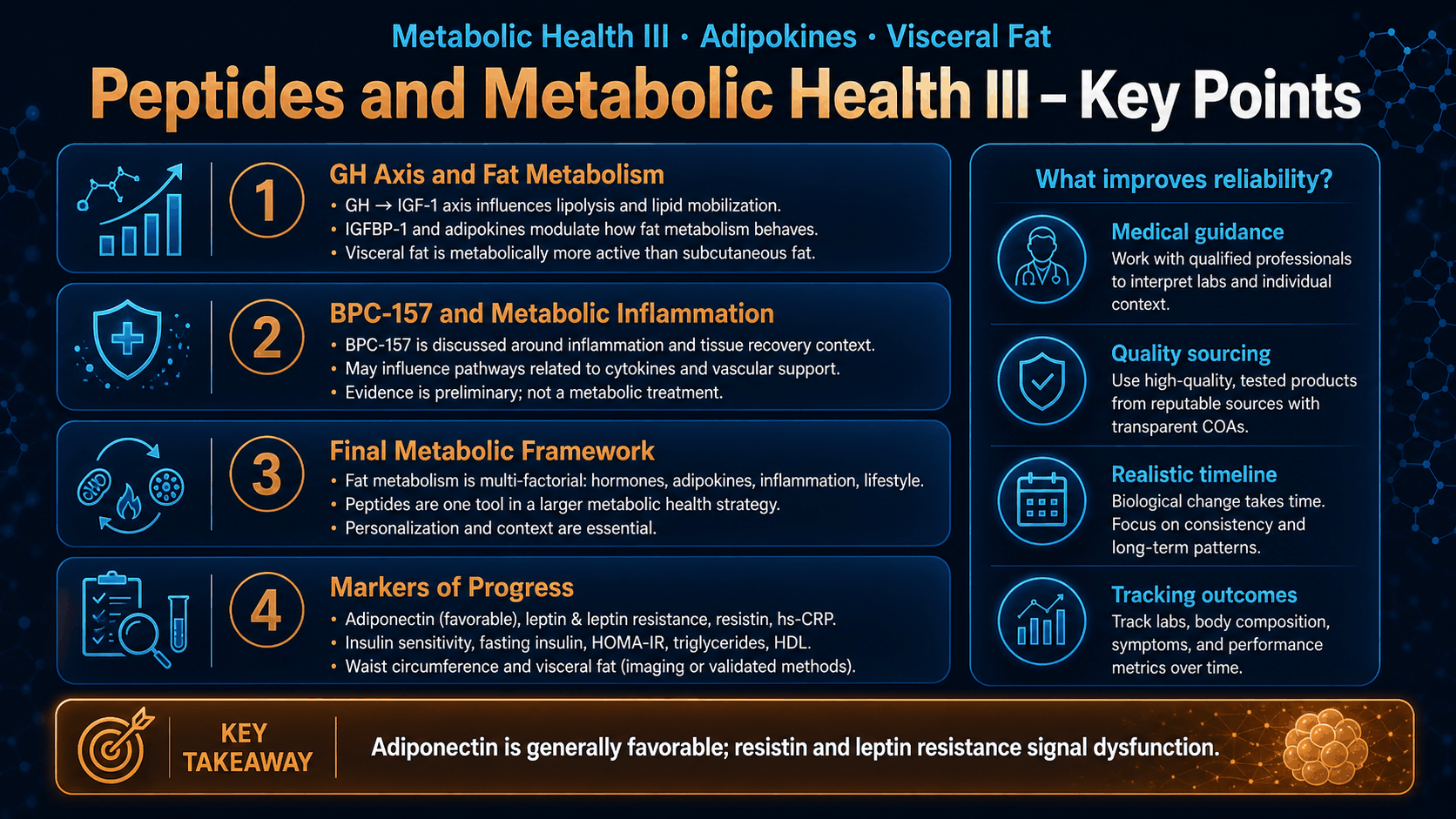
Growth hormone is a lipolytic signal. It can activate hormone-sensitive lipase and support breakdown of triglycerides into free fatty acids. But this only makes sense in a larger metabolic context: insulin, calorie balance, training, sleep, and monitoring.
BPC‑157 and Metabolic Inflammation
Visceral fat in obesity behaves like chronically inflamed tissue. M1-like macrophage activity can increase TNF‑α, IL‑6, MCP‑1, resistin, and systemic inflammatory tone.
BPC‑157 is discussed around lower inflammatory signaling and possible macrophage phenotype shift. This does not mean it burns fat directly. It is better framed as a potential inflammation-environment support tool.
 Sponsored / AffiliateUlta Lab Tests · Lab testing for hormones, inflammation, and wellness
Final Metabolic Framework
Cannot be bypassed
- Appropriate fasting-style schedule when safe.
- Zone 2 aerobic work, 150+ min/week.
- Strength training 3–4 times weekly.
- 7–8 hours of sleep with deep sleep.
- Stress management.
Only on top
- GH-axis discussions only with monitoring.
- Sleep support: glycine/magnesium context.
- BPC‑157 inflammation context.
- Epitalon circadian context.
- Omega‑3, berberine, glycine with interaction awareness.
What matters most
- Insulin context.
- Calorie and protein structure.
- Training consistency.
- Waist change.
- Inflammation and glucose markers.
Markers of Progress
| Marker | Why it matters | Practical use |
|---|---|---|
| Waist circumference | Practical proxy for visceral-fat burden | Track monthly |
| Body composition | Separates fat loss from muscle gain | InBody, DEXA, or comparable method |
| hs‑CRP | Systemic inflammatory tone | Useful cardiometabolic context |
| HOMA‑IR | Insulin-resistance estimate | Fasting glucose + insulin |
| HbA1c | Longer-term glucose exposure | Track metabolic trend |
| Triglycerides | Liver/insulin-resistance context | Part of lipid panel |
Two Common Myths
Myth: GH secretagogues will burn fat without nutrition changes.
Fact: GH-axis support cannot overcome high insulin, calorie excess, poor sleep, or lack of training. It is not a substitute for the foundation.
Myth: If the scale does not move, nothing is working.
Fact: Recomposition can reduce fat and increase lean mass simultaneously. Waist, body composition, and metabolic markers are more informative than scale weight alone.
Frequently Asked Questions
Does BPC‑157 burn fat?
No. It is discussed around inflammation context, not direct fat burning.
Are GH secretagogues weight-loss drugs?
No. They are GH-axis tools requiring medical context and monitoring. They do not replace nutrition, exercise, or sleep.
What is the most practical visceral-fat marker?
Waist circumference is simple and useful. Body composition testing adds more detail.
Why does sleep matter for fat metabolism?
Sleep affects leptin sensitivity, cortisol, appetite regulation, and the natural GH pulse.
Can berberine be used with diabetes medications?
Only with clinician guidance, because glucose-lowering effects and medication interactions matter.
Key Takeaways
- Visceral fat is an inflammatory endocrine organ.
- Adiponectin is generally favorable; resistin and leptin resistance signal dysfunction.
- GH-axis support is rational only in the right metabolic and low-insulin context.
- BPC‑157 is discussed as inflammation-environment support, not fat burning.
- Nutrition, aerobic training, strength training, sleep, and stress management come first.
- Track waist, body composition, hs‑CRP, glucose markers, and lipids — not just weight.
- The page is mobile-responsive: grids collapse, sticky TOC becomes normal, and tables scroll horizontally on small screens.