
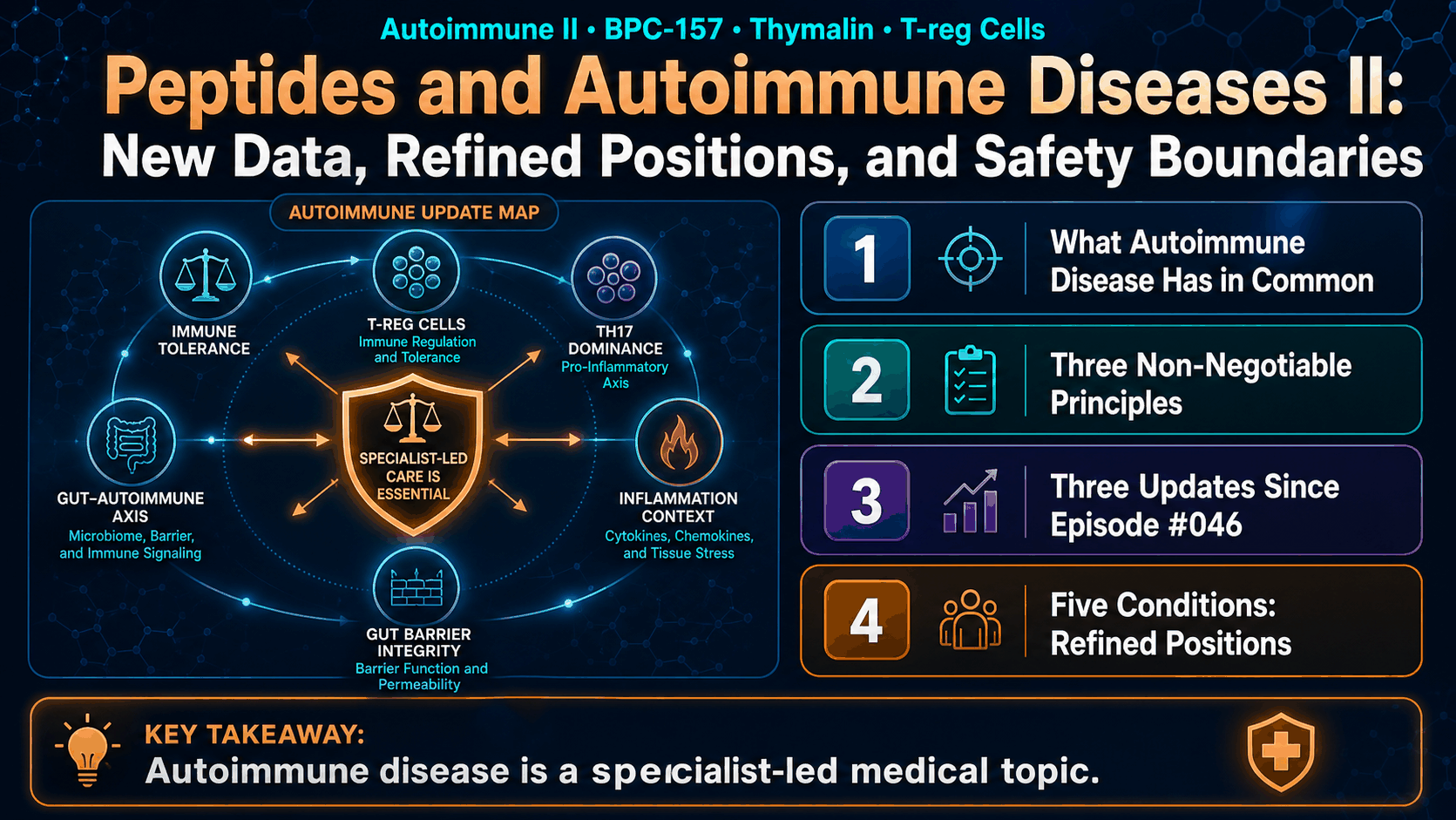
What Autoimmune Disease Has in Common
More than 80 autoimmune diseases can affect different organs, but they share a core concept: loss of immune tolerance toward self-tissue.
Many autoimmune patterns involve Th1/Th2/Th17 imbalance, chronic cytokine signaling, inflammatory load, and inadequate regulatory T-cell activity. That does not mean one universal protocol exists. It means any adjunctive support must be built around precision, medical supervision, and disease stability.
Three Non-Negotiable Principles
Specialist first
Autoimmune disease is not a self-treatment topic. DMARDs, biologics, corticosteroids, and disease-modifying therapies are primary when indicated.
Do not “boost immunity”
The immune system is already misdirected. Non-specific immune stimulation can worsen autoaggression. The goal is modulation, not activation.
Lower inflammatory load
BPC‑157 is discussed around NF‑κB, TNF‑α, IL‑6, and gut-barrier context. That is adjunctive inflammation support, not autoimmune treatment.
 Sponsored / AffiliateMomentous · Performance nutrition and recovery supplements
Three Updates Since Episode #046
Gut-autoimmune axis
Dysbiosis and impaired barrier function may increase LPS exposure, immune activation, and autoimmune trigger load. BPC‑157 is discussed around gut-barrier context, especially in IBD-style discussions.
Hashimoto’s and endocrine inflammation
Autoimmune thyroid and endocrine-inflammatory topics reinforce the same pattern: anti-inflammatory support and lab monitoring are adjunctive, not replacements for medical care.
Regulatory T cells
T-reg cells are the immune system’s braking mechanism. Vitamin D status is one of the better-studied nutrient contexts for T-reg support, but correction should be lab-guided.
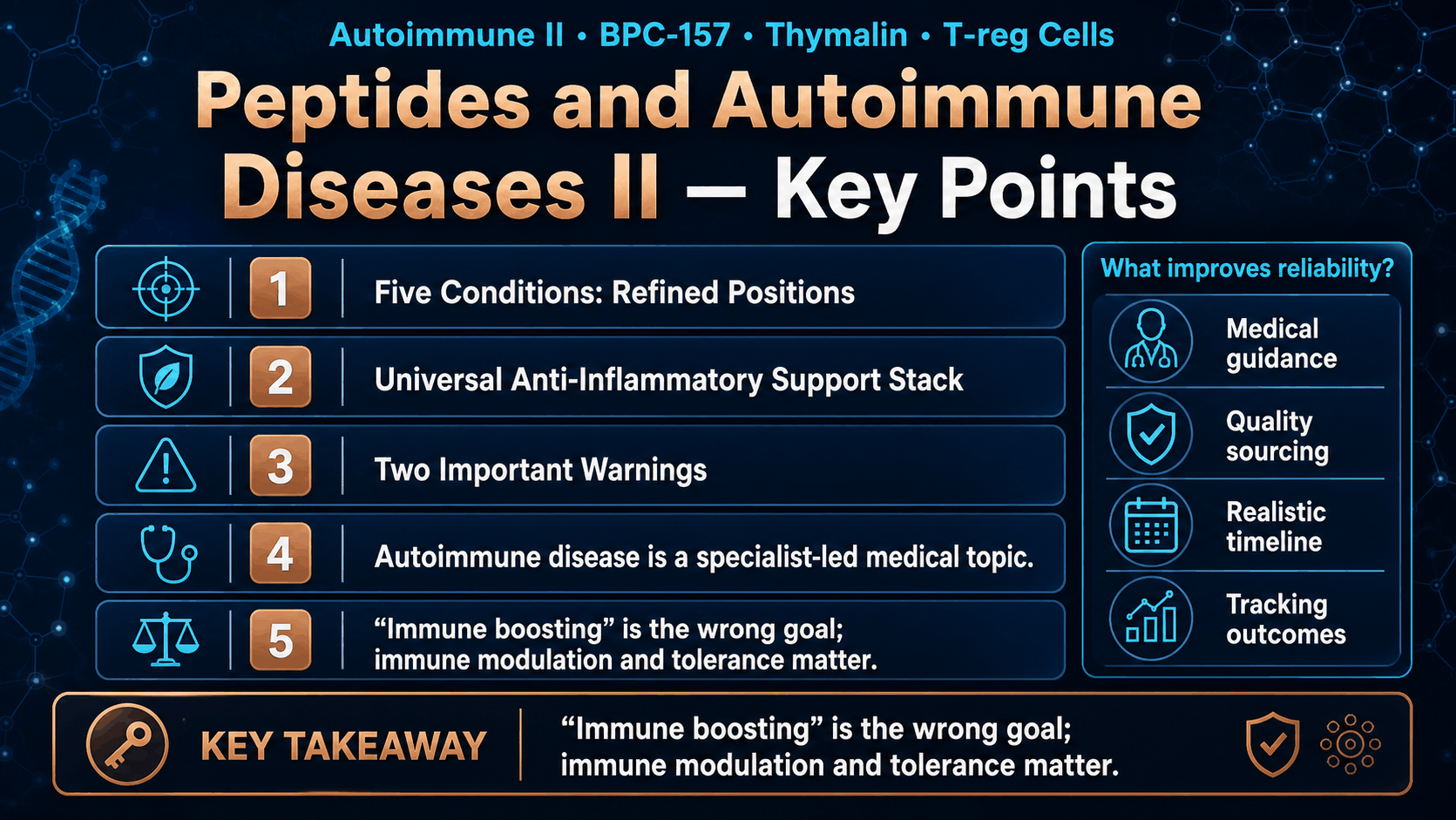
Five Conditions: Refined Positions
| Condition | Key mechanism | Adjunctive discussion | Limits |
|---|---|---|---|
| Rheumatoid arthritis | Th1/Th17, TNF‑α, IL‑6, synovitis, erosions | BPC‑157 inflammation context, omega‑3, vitamin D, selenium; thymic peptides only with rheumatologist | DMARDs/biologics are primary to prevent structural damage |
| Systemic lupus erythematosus | Autoantibodies, immune complexes, multi-organ inflammation | Very cautious BPC‑157 inflammation context, vitamin D if deficient, omega‑3 | SLE is flare-prone; immune peptides require strict specialist oversight |
| Ulcerative colitis / Crohn’s | Gut barrier disruption, dysbiosis, mucosal inflammation | Oral BPC‑157 barrier context, probiotics, omega‑3, curcumin, vitamin D in remission discussion | During active flare, standard therapy comes first |
| Multiple sclerosis | Demyelination, Th1/Th17, neuroinflammation, EBV trigger context | Semax neurorepair context only, vitamin D discussion, DHA omega‑3 | Disease-modifying therapy is primary; neurologist-led care required |
| Psoriasis | Th17 dominance, IL‑17/IL‑23, keratinization, skin inflammation | BPC‑157 systemic context, topical GHK‑Cu barrier/inflammation context, omega‑3, vitamin D, stress management | Severe psoriasis may require biologics |
 Sponsored / AffiliateDT Peptides · Peptide research products and laboratory-focused resources
Universal Anti-Inflammatory Support Stack
This is not a replacement for autoimmune therapy. It is a lower-risk support framework often discussed across inflammatory autoimmune contexts.
Lab-guided nutrient support
- Vitamin D status with clinician-aware correction.
- Omega‑3 EPA-focused inflammation-resolution context.
- Magnesium for stress and immune-regulation context.
- Gluten-free diet only when clinically relevant.
Inflammatory context
- Curcumin around NF‑κB context.
- Ashwagandha only when stress-triggered flares are relevant and appropriate.
- Probiotics for microbiome/T-reg context.
- Selenium in thyroid autoimmunity contexts.
Adjunctive only
- BPC‑157 in remission-context discussions.
- Epitalon for circadian/melatonin immune-modulation context.
- GHK‑Cu systemic/topical matrix and skin-barrier context.
- No replacement of prescribed therapy.
Two Important Warnings
Two Common Myths
Myth: Thymalin boosts immunity, so it helps autoimmune disease.
Fact: “Boosting immunity” is non-specific activation. In autoimmune disease, immune activation can worsen self-directed attack. Thymic peptides require precise specialist context.
Myth: BPC‑157 treats autoimmune disease because symptoms improve.
Fact: BPC‑157 is discussed around inflammation reduction and gut barrier context. Symptom improvement does not prove autoimmune progression or structural damage is controlled.
Frequently Asked Questions
Can peptides replace DMARDs or biologics?
No. Autoimmune disease-modifying therapy decisions belong with a specialist.
Is BPC‑157 a treatment for RA or IBD?
No. It is an adjunctive inflammation/gut-barrier discussion, not a disease-modifying autoimmune treatment.
Why are thymic peptides risky?
They may modulate T-cell activity, but autoimmune disease involves dysregulated immune activation. Non-specific stimulation can worsen autoaggression.
When is peptide support more reasonable?
Only in remission or stable disease context, with specialist awareness, and without stopping prescribed therapy.
What needs urgent medical attention?
Severe flare, fever, neurologic symptoms, organ involvement, severe GI bleeding, chest pain, shortness of breath, pregnancy-related autoimmune symptoms, or medication complications.
Key Takeaways
- Autoimmune disease is a specialist-led medical topic.
- “Immune boosting” is the wrong goal; immune modulation and tolerance matter.
- BPC‑157 is an inflammation/gut-barrier context discussion, not autoimmune treatment.
- Thymalin and Thymosin α1 require strong caution and specialist oversight.
- Vitamin D status, omega‑3, microbiome support, and stress management may be useful supportive layers.
- DMARDs, biologics, corticosteroids, and DMTs remain primary therapies when indicated.
- Peptides belong only as adjunctive support in stable/remission contexts.