Men’s Health Is a System
The goal is not “raise testosterone at any cost.”
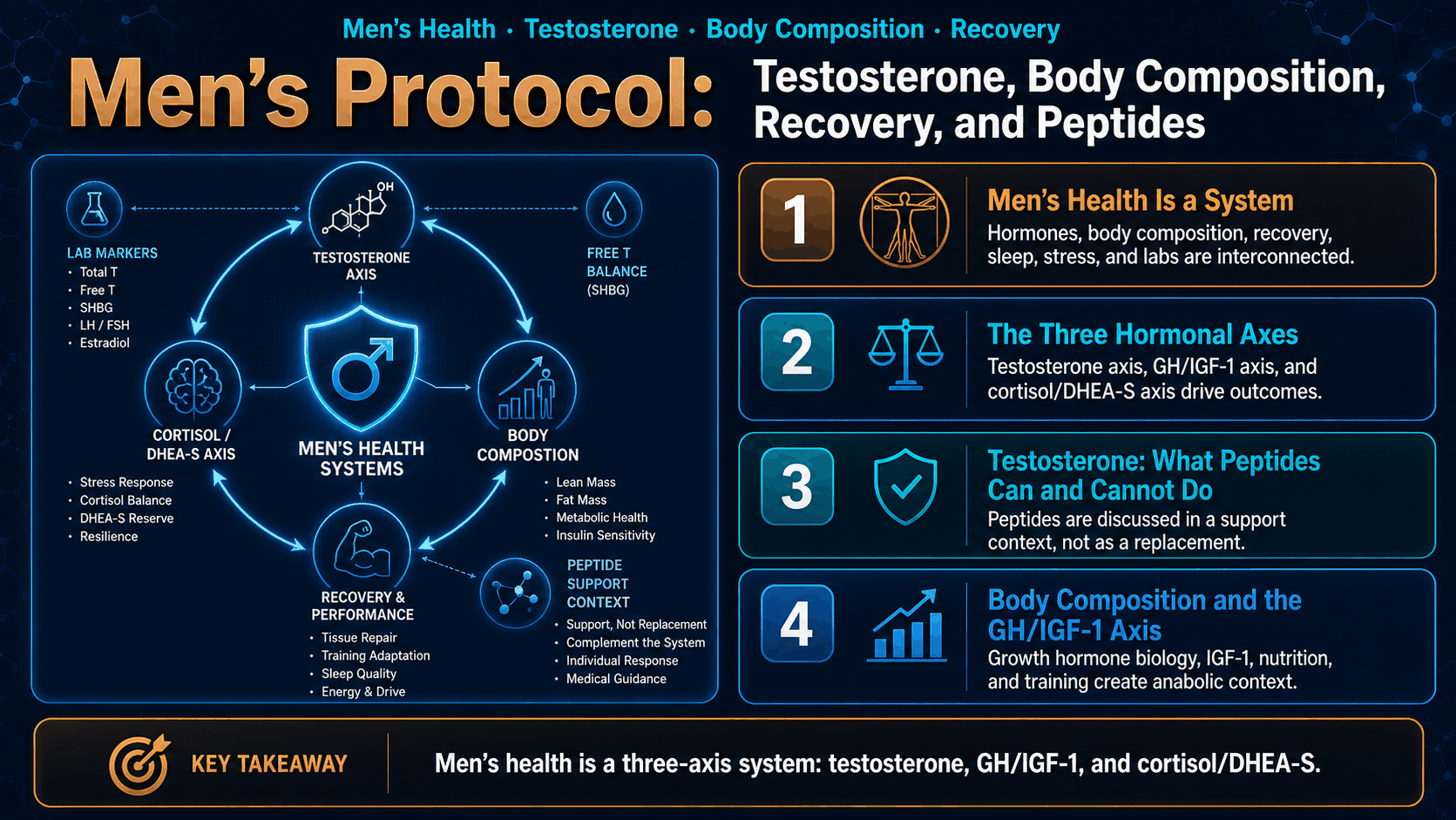
Testosterone, GH/IGF‑1, cortisol, DHEA‑S, sleep, inflammation, visceral fat, endothelial function, prostate context, medication effects, and training all interact. A peptide-support discussion only makes sense when labs, symptoms, lifestyle, and medical risk are reviewed together.
This Is Not a Peptide Protocol
No peptide schedules
This page does not give amounts, cycles, injection instructions, or stack recommendations.
TRT requires diagnosis
Testosterone therapy decisions require symptoms, repeat labs, risk review, and clinician supervision.
Symptoms matter
ED, elevated PSA, infertility, depression, prostate symptoms, or suspected hypogonadism should not be postponed for experiments.
The Three Hormonal Axes
Testosterone and SHBG
LH signals the testes to produce testosterone. SHBG regulates bioavailability. Free testosterone, SHBG, LH, symptoms, and age context matter more than total testosterone alone.
GH and IGF‑1
GH stimulates hepatic IGF‑1, a major anabolic mediator. GH secretagogues belong to this axis, not the testosterone axis. IGF‑1 monitoring matters.
Cortisol and DHEA‑S
Stress and high cortisol can suppress testosterone context. DHEA‑S can be discussed as an adrenal androgen and stress-axis marker.
One marker is not enough
Symptoms, sleep, medications, body composition, cardiovascular risk, and prostate context can change the interpretation of labs.
Testosterone: What Peptides Can and Cannot Do
The question “Do peptides raise testosterone?” is too simple. Most peptide discussions are indirect: SHBG bioavailability context, GH/IGF‑1 context, inflammation, sleep, stress, or recovery.
Body Composition and the GH/IGF‑1 Axis
Lower visceral fat can reduce aromatase burden and improve testosterone-to-estradiol context. Adipose tissue is a major estrogen-producing tissue in men.
Strength + aerobic
Resistance training and aerobic work remain the foundation for body composition and metabolic health.
IGF‑1 context
GH-axis tools require IGF‑1, estradiol, glucose/metabolic, and age-appropriate prostate monitoring.
Inflammation context
BPC‑157 is discussed as recovery/inflammation context, not hormone therapy.
Sexual Health: NO System and Neurochemistry
Erectile dysfunction is not only a performance issue. It can be an early marker of endothelial dysfunction and cardiovascular risk, so ED deserves medical evaluation.
Vascular context
BPC‑157 is discussed around eNOS and nitric oxide signaling, but this does not replace ED evaluation, PDE‑5 inhibitors when appropriate, or cardiology assessment.
Free testosterone context
High SHBG can mean low free testosterone even with “normal” total testosterone. Endocrine evaluation matters.
Mood and stress context
Low libido also requires screening for sleep apnea, depression, medications, metabolic disease, and hormone issues.
Cardiovascular warning
New or worsening ED, chest pain, shortness of breath, diabetes risk, or vascular symptoms warrant medical care.
Key Lab Markers
| Marker | Why it matters | Context |
|---|---|---|
| Total testosterone | Broad screening marker | Not enough alone |
| Free testosterone | Biologically active fraction | Often more symptom-relevant |
| SHBG | Controls testosterone bioavailability | High SHBG can reduce free T |
| LH + FSH | Pituitary-gonadal signaling | Helps distinguish primary vs secondary patterns |
| IGF‑1 | GH-axis response marker | Monitor with GH-secretagogue discussions |
| Estradiol / E2 | Aromatization context | Important with visceral fat and GH-axis changes |
| PSA | Prostate monitoring marker | Age-appropriate clinician review |
| TSH | Thyroid foundation | Thyroid affects energy, libido, IGF‑1, and mood |
| hs‑CRP | Inflammatory tone | Cardiometabolic context |
| DHEA‑S | Adrenal androgen context | Stress-axis discussion |
Age-Based Framework
Optimization
Hormones often remain in range, but resilience, sleep, stress control, fitness, and metabolic health can improve.
Support
Testosterone and IGF‑1 may decline; insulin resistance may rise. Discuss TRT only when symptoms and labs support it.
Monitoring
Sarcopenia, bone density, cardiovascular risk, prostate monitoring, strength training, and clinician oversight become central.
Two Common Myths
“GH secretagogues raise testosterone because both are anabolic.”
Fact: GH secretagogues act on the somatotropic axis. Testosterone belongs to the gonadal axis. Indirect links exist, but GH secretagogues do not replace testosterone therapy when true hypogonadism is present.
“Total testosterone in range means hormones are definitely fine.”
Fact: Free testosterone, SHBG, LH, FSH, estradiol, symptoms, sleep, medications, age, metabolic health, and PSA context all matter.
Frequently Asked Questions
Can peptides replace TRT?
No. TRT decisions require diagnosis, symptoms, labs, risk review, and clinician supervision.
Can BPC‑157 raise testosterone?
Not directly. It is discussed in SHBG and bioavailability context, but this is not established testosterone treatment.
Are GH secretagogues safe for men over 40?
They require careful IGF‑1, estradiol, glucose/metabolic, and age-appropriate prostate monitoring, plus clinician context.
What should be checked before any protocol?
Total/free testosterone, SHBG, LH/FSH, IGF‑1, E2, PSA when appropriate, TSH, hs‑CRP, DHEA‑S, sleep, medications, metabolic markers, and symptoms.
Key Takeaways
- Men’s health is a three-axis system: testosterone, GH/IGF‑1, and cortisol/DHEA‑S.
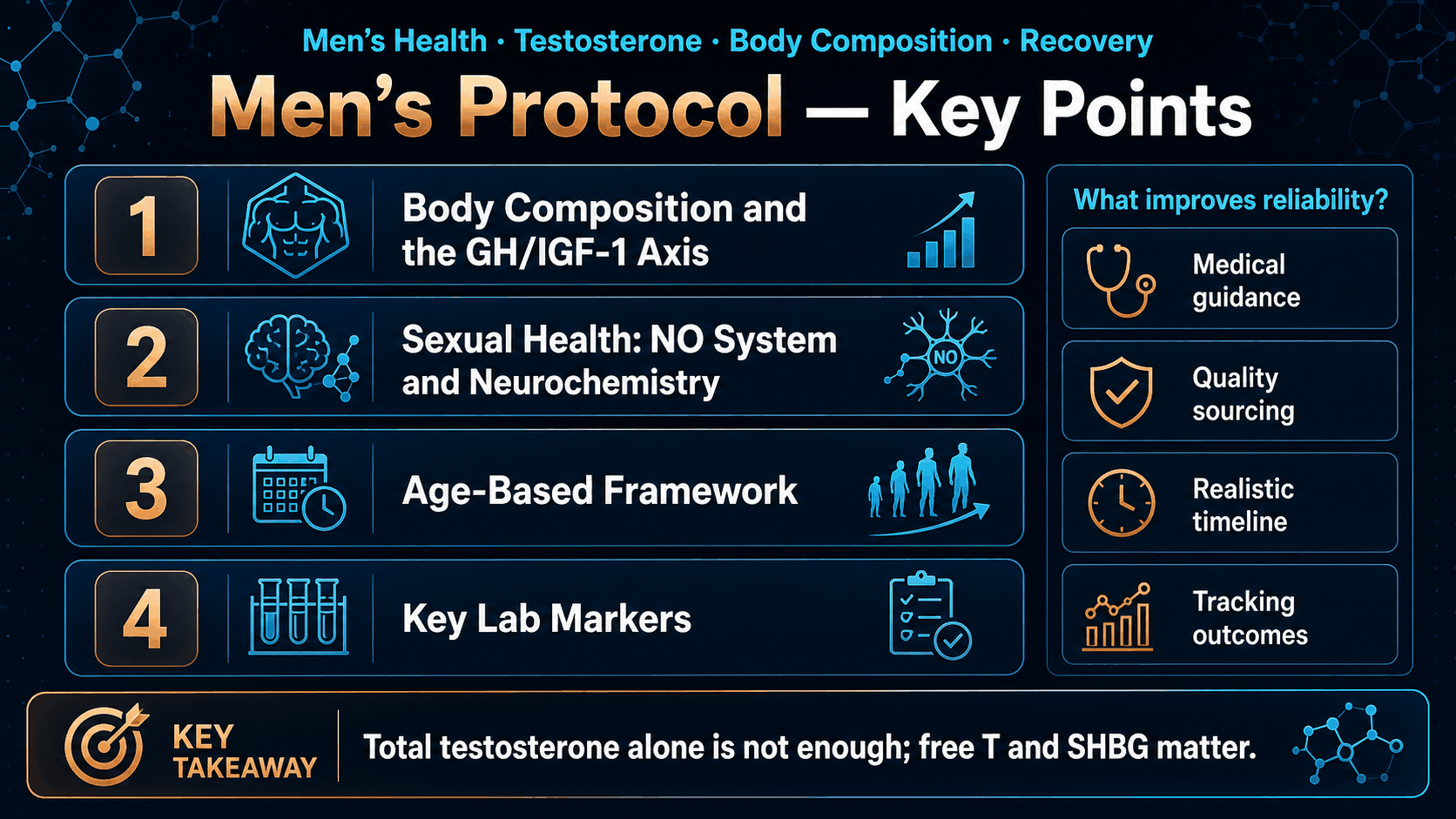
- Total testosterone alone is not enough; free T and SHBG matter.
- BPC‑157 is discussed around SHBG, NO, and inflammation context, not hormone replacement.
- GH secretagogues support GH/IGF‑1 context, not direct testosterone production.
- ED can be an endothelial and cardiovascular warning sign.
- Labs, lifestyle, and clinician guidance come before peptide-support decisions.
References and Further Reading
These sources are provided to make the page more useful and transparent. They do not turn this article into medical advice.
- Endocrine Society — Testosterone Therapy for Hypogonadism Guideline Resources
- PubMed — Testosterone Therapy in Men With Hypogonadism: Endocrine Society Guideline
- MedlinePlus — Testosterone Levels Test
- NIDDK — Diagnosis of Erectile Dysfunction
- NIDDK — Symptoms & Causes of Erectile Dysfunction
- MedlinePlus — Prostate-Specific Antigen (PSA) Test
- NIDDK — Enlarged Prostate / Benign Prostatic Hyperplasia
Sponsored Resources
Some links may be affiliate links. They do not influence the educational content, safety framing, or references on this page.
 Sponsored / AffiliateMomentous · Performance nutrition and recovery supplements
 Sponsored / AffiliatePeptide ReGenesis · Peptide education and wellness-focused resources