
Why These Three Are Different
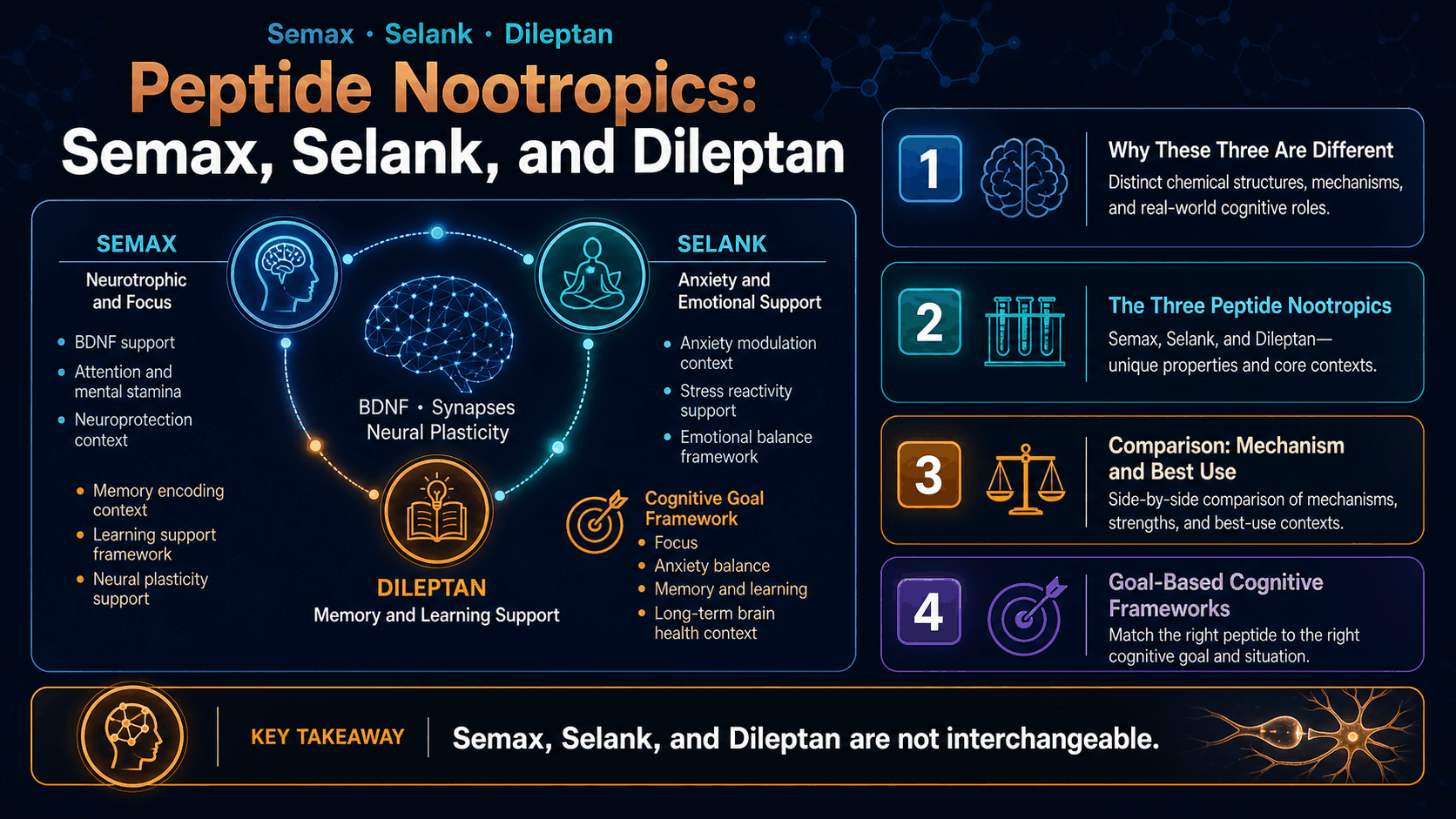
Most nootropics are surrounded by strong marketing and weak evidence. Semax, Selank, and Dileptan are different because they were designed around specific neurobiological targets.
They are not the same kind of “brain booster.” Semax is usually discussed as neurotrophic and focus-oriented. Selank is more anxiolytic and stress-focused. Dileptan is discussed around memory and learning with a smaller evidence base.
The Three Peptide Nootropics
Neurotrophic activator
Semax is discussed around BDNF, NGF, dopamine context, cerebral blood-flow context, and neuroprotection. It is the main “focus and neuroplasticity” peptide in the series.
Anxiolytic nootropic
Selank is discussed around GABAergic modulation, cortisol reduction context, serotonergic tone, and cognitive clarity when anxiety is the limiting factor.
Memory and learning
Dileptan is discussed around GABA-B modulation, memory consolidation, and learning. It is newer, and the evidence base is more limited than for Semax and Selank.
 Sponsored / AffiliateTeleWellnessMD · Telehealth wellness consultations and health optimization support
Comparison: Mechanism and Best Use
Goal-Based Cognitive Frameworks
Focus and working memory
Semax is the main discussion point when the bottleneck is mental speed, motivation, and focus.
New knowledge consolidation
Semax + Dileptan is discussed conceptually as a neuroplasticity plus memory-consolidation pairing. Deep sleep remains essential.
Stress blocks thinking
Selank is most relevant when anxiety or stress reduces cognitive performance. Clinical anxiety still requires professional care.
Neuroprotection context
Semax, aerobic exercise, DHA omega-3, vitamin D status, magnesium, sleep quality, blood pressure, and glucose control form the broader frame.
Stroke / TIA / TBI
Semax in neurologic recovery is strictly physician-led. Acute neurologic symptoms are emergency territory.
Healthy-brain optimization
Rotation and breaks are more rational than constant stacking. Sleep, aerobic exercise, and stress management remain the base.
 Sponsored / AffiliateDynamic Peptides · Research peptide catalog and product education resources
Safety Boundaries
- Avoid late-day stimulating use if it disrupts sleep.
- Avoid continuous long-term use without breaks or clinician context.
- Do not treat Semax/Selank/Dileptan as replacements for ADHD, anxiety, depression, or neurologic care.
- Any acute stroke-like symptoms require emergency care, not nootropic experimentation.
Two Common Myths
Myth: More Semax means smarter.
Fact: More is not always better. The rational model is matching timing, goal, tolerance, and breaks rather than continuous overstimulation.
Myth: Selank always improves studying.
Fact: Selank is most useful when anxiety or stress is the cognitive bottleneck. Without anxiety, Semax or Dileptan may be more targeted.
Frequently Asked Questions
Which one is best for focus?
Semax is the main focus and neurotrophic-support discussion in this framework.
Which one is best for anxiety?
Selank is the main anxiolytic nootropic discussion, but clinical anxiety requires psychiatric or medical care.
Which one is best for memory?
Dileptan is most directly framed around memory and learning, although evidence is more limited.
Can I combine all three?
The script argues against constant “everything at once” stacking. Mechanism-based rotation is more rational.
Are these approved everywhere?
No. Regulatory status varies by country. The article discusses educational mechanisms and Russian-use context, not universal medical approval.
Key Takeaways
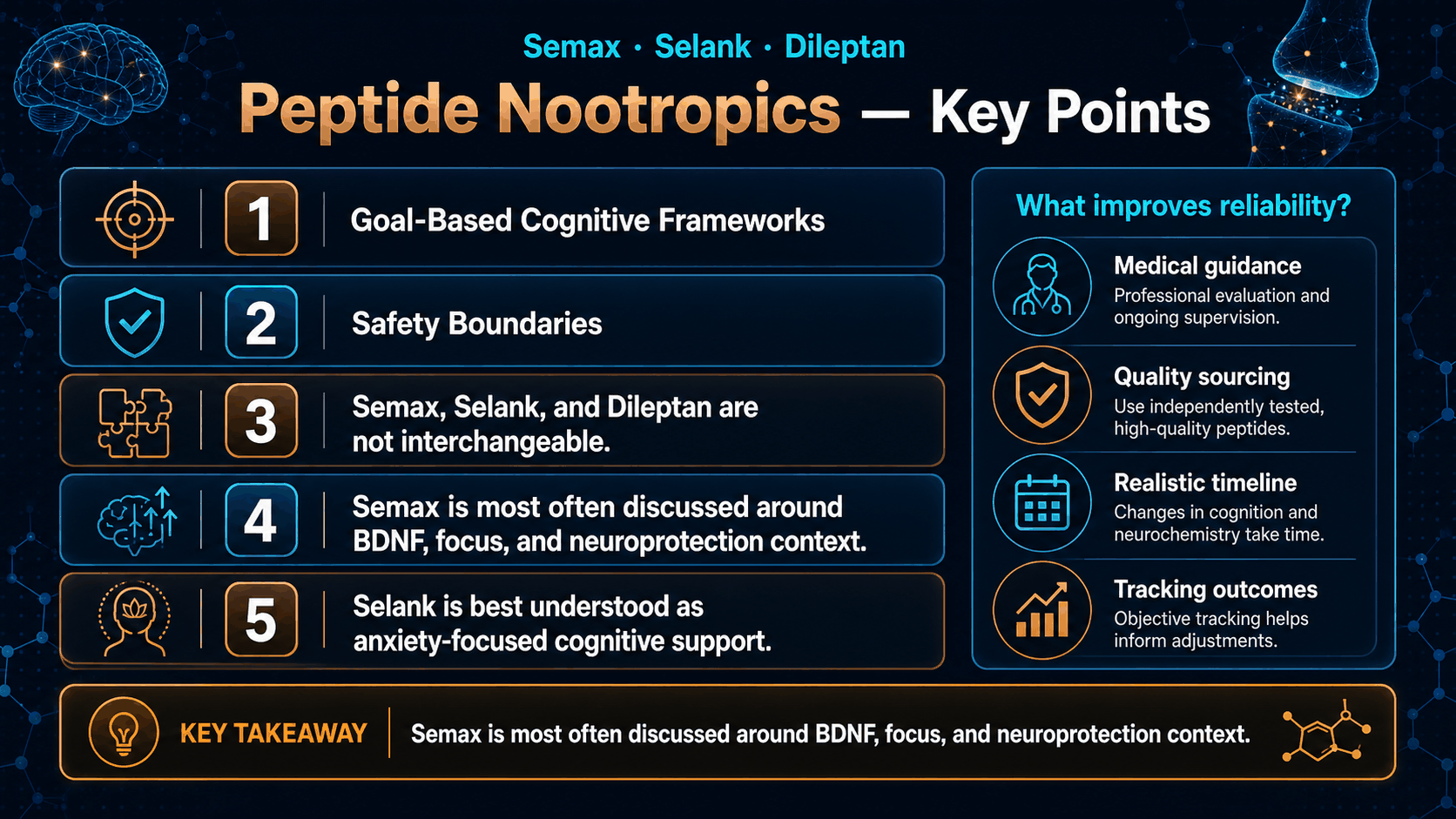
- Semax, Selank, and Dileptan are not interchangeable.
- Semax is most often discussed around BDNF, focus, and neuroprotection context.
- Selank is best understood as anxiety-focused cognitive support.
- Dileptan is framed around memory and learning, with a smaller evidence base.
- Choose by cognitive bottleneck: focus, anxiety, memory, recovery, or resilience.
- Safety matters most when psychiatric, neurologic, sleep, or medication issues are present.
- The page is mobile-responsive: grids collapse, comparison rows stack, and the TOC becomes non-sticky on smaller screens.