
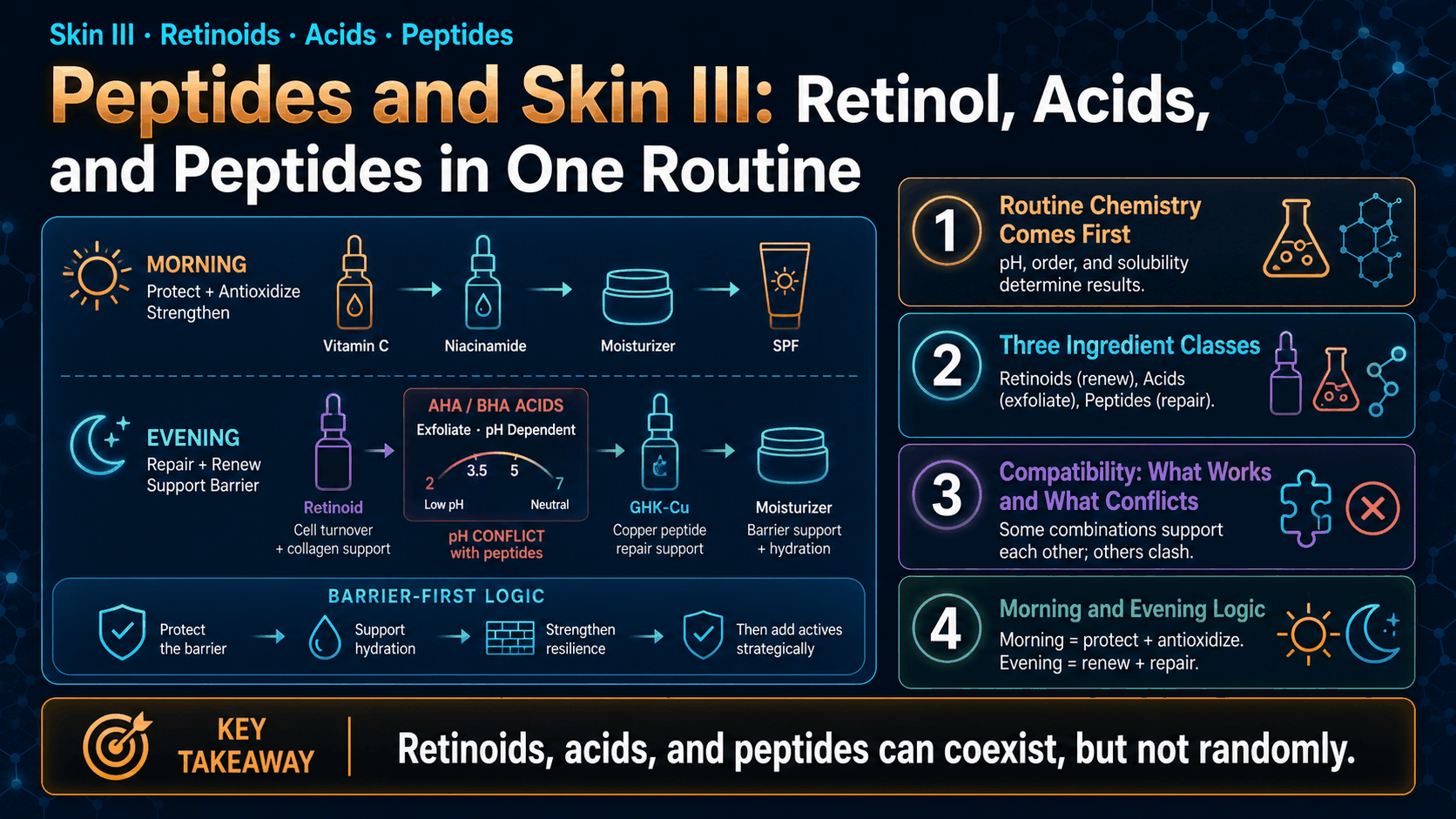
Routine Chemistry Comes First
A skincare routine is not just a collection of products. It is a system where every ingredient needs the right conditions.
Retinoids, AHA/BHA acids, and cosmetic peptides can all be valuable. The problem begins when they are layered without regard to pH, skin tolerance, photosensitivity, barrier condition, and irritation load.
Three Ingredient Classes
RAR/RXR receptor pathway
Retinoids influence gene transcription related to collagen, keratinization, and turnover. They have strong topical anti-aging logic but can irritate when overused.
- Best placed at night.
- Start low and slow.
- SPF the next morning is mandatory.
Acid exfoliation
AHA acids support surface exfoliation; BHA is oil-soluble and pore-focused. They need an acidic environment and can increase sensitivity.
- Use on separate acid nights.
- Avoid direct copper-peptide layering.
- Do not combine with retinoids when starting.
Matrix and signaling context
GHK-Cu, matrikines, and neuropeptide-style ingredients work through different signaling routes than retinoids. They usually fit better in barrier-friendly pH ranges.
- Morning under SPF can work well.
- Also useful on non-acid nights.
- Avoid low-pH acid layering.
 Sponsored / AffiliateMomentous · Performance nutrition and recovery supplements
Compatibility: What Works and What Conflicts
Can fit together
- Retinoid + peptide in a non-irritating, near-neutral routine.
- GHK-Cu + niacinamide in compatible formulas.
- AHA + BHA in one acid step if tolerated.
- Stable vitamin C derivatives + retinoid or peptides in separate balanced routines.
Separate by time or day
- AHA/BHA + GHK-Cu directly.
- Retinoid + low-pH L-ascorbic acid.
- AHA + niacinamide if flushing or stinging occurs.
- Benzoyl peroxide + retinoid unless formulated for that use.
Morning and Evening Logic
Morning is protection: stable vitamin C derivative, GHK-Cu or peptides, niacinamide if tolerated, moisturizer, and SPF. The skin faces UV, pollution, and oxidative stress.
Evening is renewal: retinoids or acids. Not necessarily both. Retinoids and acids can both increase irritation and photosensitivity, so SPF the next morning is non-negotiable.
 Sponsored / AffiliateQuest Health · Personal lab testing and health marker tracking
Full Routine Framework
Gentle cleanse
Use a pH-balanced cleanser and avoid damaging the acid mantle with harsh surfactants.
Stable vitamin C derivative
Choose a well-formulated, lower-irritation derivative such as ascorbyl glucoside or tetrahexyldecyl ascorbate if L-ascorbic acid is too harsh.
Peptide serum
GHK-Cu or matrikines can be placed after the previous layer settles. Avoid applying directly after strong acids.
Moisturizer + SPF
SPF is the non-negotiable collagen-protection step.
Cleanse
Double-cleanse if wearing sunscreen or makeup; otherwise one gentle cleanse may be enough.
Acid nights
Use AHA/BHA 1–3 times weekly depending on tolerance. Keep the rest of the routine simple.
Retinoid nights
Use retinoid on separate nights from acids when starting. Apply to dry skin and use a moisturizer “sandwich” if sensitive.
Barrier or peptide layer
On non-acid nights, GHK-Cu plus moisturizer can fit. On acid nights, barrier care is usually safer.
Microneedling and Peptides
Microneedling can increase penetration of topical ingredients by creating microchannels. This can also increase irritation and infection risk if done incorrectly.
Keep it simple
- Use bland, low-irritation products.
- GHK-Cu may be discussed for repair context, but formula quality matters.
- Barrier cream is safer than active stacking.
No aggressive actives
- Retinoids.
- AHA/BHA acids.
- Low-pH L-ascorbic acid.
- Fragrance, essential oils, alcohol-heavy formulas.
Two Common Myths
Myth: More actives means faster results.
Fact: Too many actives can create irritation, pH conflicts, and barrier damage. Two or three well-placed ingredients often perform better than a chaotic stack.
Myth: Retinoids and peptides cancel each other.
Fact: Retinoids and peptides act through different pathways. The real issue is not competition but irritation management, formula compatibility, and correct placement.
Frequently Asked Questions
Can I use retinol and peptides together?
Often yes, especially in a non-irritating, near-neutral routine. Start slowly and monitor tolerance.
Can I use acids and GHK-Cu together?
Avoid direct same-step layering. Separate by time or use them on different days.
Should vitamin C go in the morning?
Often yes, especially stable derivatives. Low-pH L-ascorbic acid may irritate sensitive skin and should be placed carefully.
Can I use retinoids after microneedling?
No. Avoid retinoids, acids, and strong vitamin C after microneedling until the skin barrier has recovered.
What should I do if my skin burns or peels?
Stop actives, use gentle cleanser, moisturizer, and SPF. Seek dermatology care if irritation is severe, persistent, swollen, painful, or infected-looking.
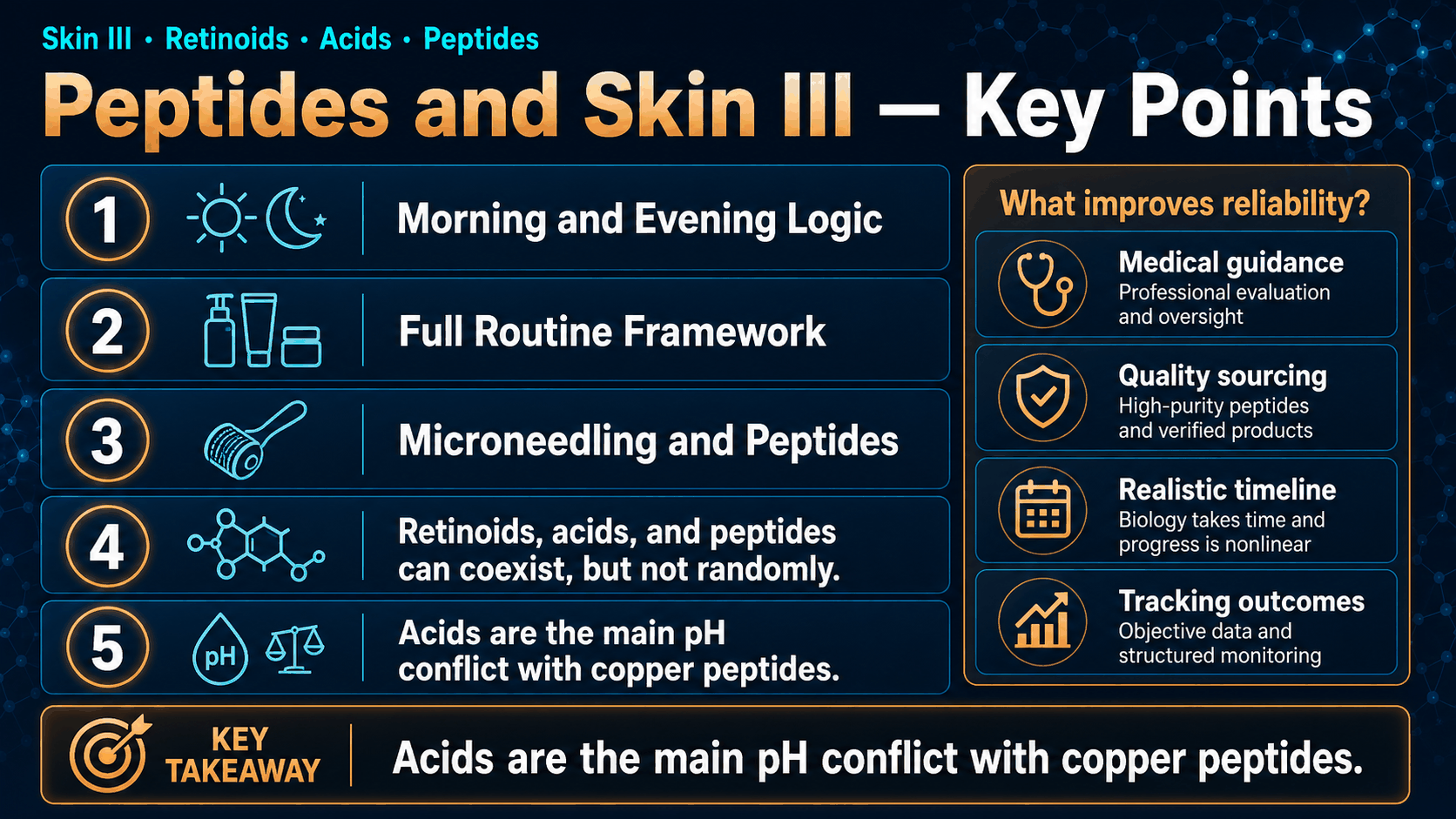
Key Takeaways
- Retinoids, acids, and peptides can coexist, but not randomly.
- Acids are the main pH conflict with copper peptides.
- Morning is for antioxidant support, peptides, moisturizer, and SPF.
- Evening is for retinoids or acids, usually separated when starting.
- GHK-Cu can fit well under SPF or on non-acid nights.
- Microneedling requires caution and barrier-first aftercare.
- SPF is non-negotiable after acids and retinoids.