Why Joints Matter
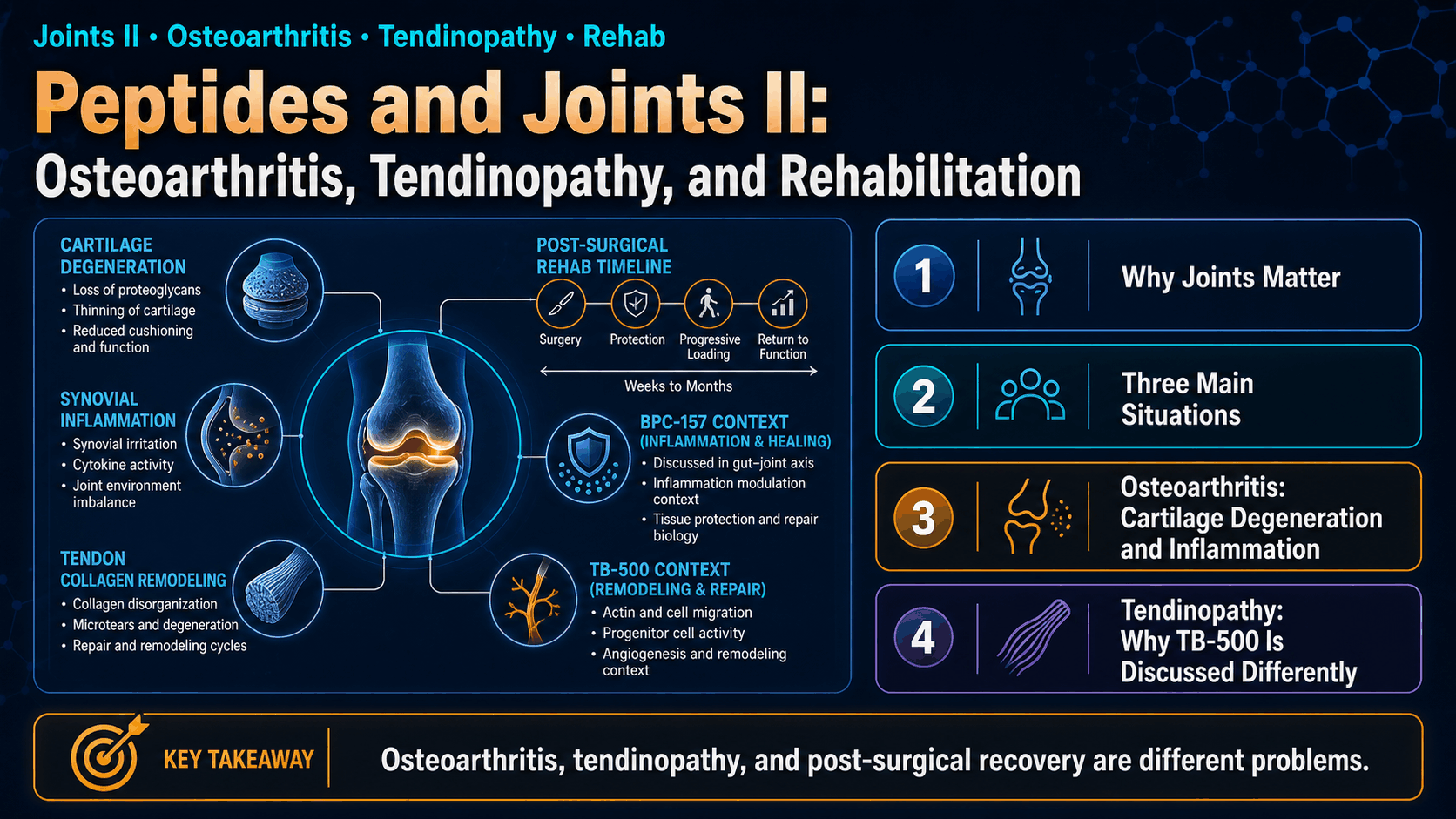
Joint pain is one of the most common chronic complaints, but “joint pain” is not one condition.
Osteoarthritis, chronic tendinopathy, and post-surgical rehabilitation involve different tissues and different biological tasks. Cartilage, tendon, ligament, bone, synovium, and scar tissue respond differently to loading, inflammation, nutrition, and adjunctive peptide discussions.
Three Main Situations
Osteoarthritis
Cartilage degeneration, inflammatory synovitis, subchondral bone changes, and progressive function loss. Earlier support is more realistic than late-stage reversal.
Chronic tendinopathy
Often a remodeling problem rather than classic inflammation. The tendon needs progressive loading and matrix reorganization.
Post-surgical rehab
Healing phases must follow surgeon and PT instructions. Adjuncts must fit the phase of inflammation, proliferation, and remodeling.
 Sponsored / AffiliateQuest Health · Personal lab testing and health marker tracking
Osteoarthritis: Cartilage Degeneration and Inflammation
Osteoarthritis involves cartilage matrix loss, chondrocyte dysfunction, inflammatory synovitis, and subchondral bone changes. IL‑1β and TNF‑α are important inflammatory mediators in OA discussions.
- BPC‑157 is discussed around inflammation and vascular-support context.
- UC-II is discussed around oral tolerance and cartilage immune context.
- Collagen I/III supports connective-tissue building blocks, especially with loading.
- Load management, weight management when relevant, PT, and medical care remain central.
Tendinopathy: Why TB-500 Is Discussed Differently
Chronic tendinopathy is frequently tendon degeneration and matrix disorganization, not simply inflammation. Tendons need mechanical signaling through progressive loading.
Eccentric loading or other progressive tendon-specific loading is a major evidence-based foundation. Without loading, any biochemical support is incomplete.
Post-Surgical Rehabilitation
After surgery, tissue healing has phases. Early inflammation is not automatically bad; it is part of healing. Proliferation and remodeling later require collagen synthesis, vascularization, scar maturation, and functional movement.
- BPC‑157 is discussed around NO-system, EGF-R, and repair-signaling context.
- TB-500 is discussed later around remodeling and scar-quality context.
- Collagen + vitamin C before physical therapy is a connective-tissue support concept.
- Rehab phase determines any adjunct.
 Sponsored / AffiliateMito Red Light · Red light therapy devices for recovery and wellness routines
Tissue × Tool Matrix
Chondrocytes and matrix
BPC‑157 inflammation context, UC-II oral tolerance context, collagen building blocks. Not a cartilage-regrowth claim.
Tenocytes and remodeling
TB-500 remodeling context, BPC‑157 vascular context, collagen + vitamin C before loading.
Stability and collagen
BPC‑157 collagen-synthesis context, TB-500 chronic scar remodeling discussion, GHK-Cu matrix-support context.
Osteoblasts
GH/IGF‑1 context, collagen I, vitamin D3/K2/calcium when appropriate, BPC‑157 progenitor-cell context. Not fracture treatment.
Collagen Timing Framework
One of the most practical connective-tissue ideas is taking collagen or gelatin with vitamin C before tendon or joint loading. The goal is to provide collagen-derived peptides and vitamin C near the time fibroblasts receive a mechanical signal.
Substrate window
- Hydrolyzed collagen or gelatin with vitamin C.
- Usually discussed before target-tissue loading or PT.
- Load should be specific and medically appropriate.
Mechanical signal
- Progressive loading creates tissue instruction.
- Eccentric or tendon-specific loading is essential in tendinopathy.
- Do not push through sharp or worsening pain.
Peptide context
- BPC‑157: inflammation/vascular context.
- TB-500: remodeling context.
- GHK‑Cu: matrix context.
- UC-II: OA immune/cartilage context.
Two Common Myths
Myth: BPC‑157 will regrow cartilage in advanced OA.
Fact: BPC‑157 is discussed around collagen synthesis, inflammation, and vascular-support biology, but advanced structural cartilage loss is not reversed by peptides.
Myth: Collagen is useless because it becomes amino acids.
Fact: Collagen peptides can appear in circulation as bioactive fragments. Timing them near loading is more specific than taking random protein, although it still depends on rehab and total nutrition.
Frequently Asked Questions
Can peptides replace physical therapy?
No. Rehab loading is the main instruction for connective-tissue remodeling. Peptides are only adjunctive discussion.
Can peptides treat stage III–IV osteoarthritis?
They are not cartilage-regrowth therapy. Advanced OA requires orthopedic evaluation and may need injections, bracing, weight/load management, or surgery.
What is most important for chronic tendinopathy?
Diagnosis, load management, progressive tendon-specific loading, sleep, protein, collagen timing, and consistency.
Is post-surgery peptide use safe?
Only with surgeon approval. Post-operative timing and inflammation control must not conflict with surgical healing.
When is imaging needed?
Acute trauma, swelling, instability, severe pain, suspected rupture/fracture, loss of function, or neurologic symptoms require medical evaluation and often imaging.
Key Takeaways
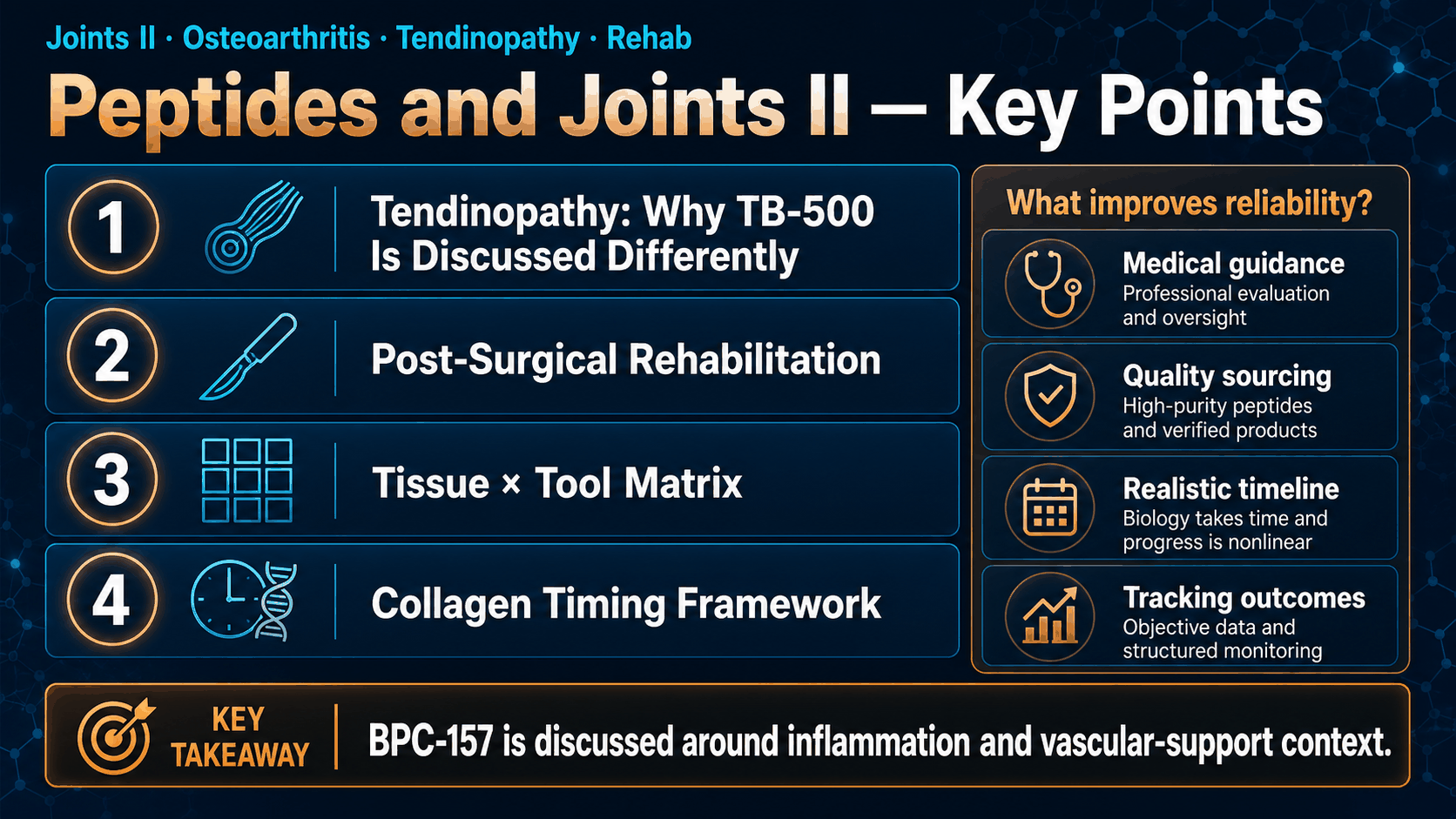
- Osteoarthritis, tendinopathy, and post-surgical recovery are different problems.
- BPC‑157 is discussed around inflammation and vascular-support context.
- TB-500 is discussed around remodeling and scar-quality context.
- Collagen + vitamin C before loading is a practical connective-tissue support idea.
- Eccentric or progressive loading is essential for tendinopathy.
- Advanced OA cannot be reversed with peptide support.
- Rehab, imaging, surgical follow-up, and clinician guidance come first.