
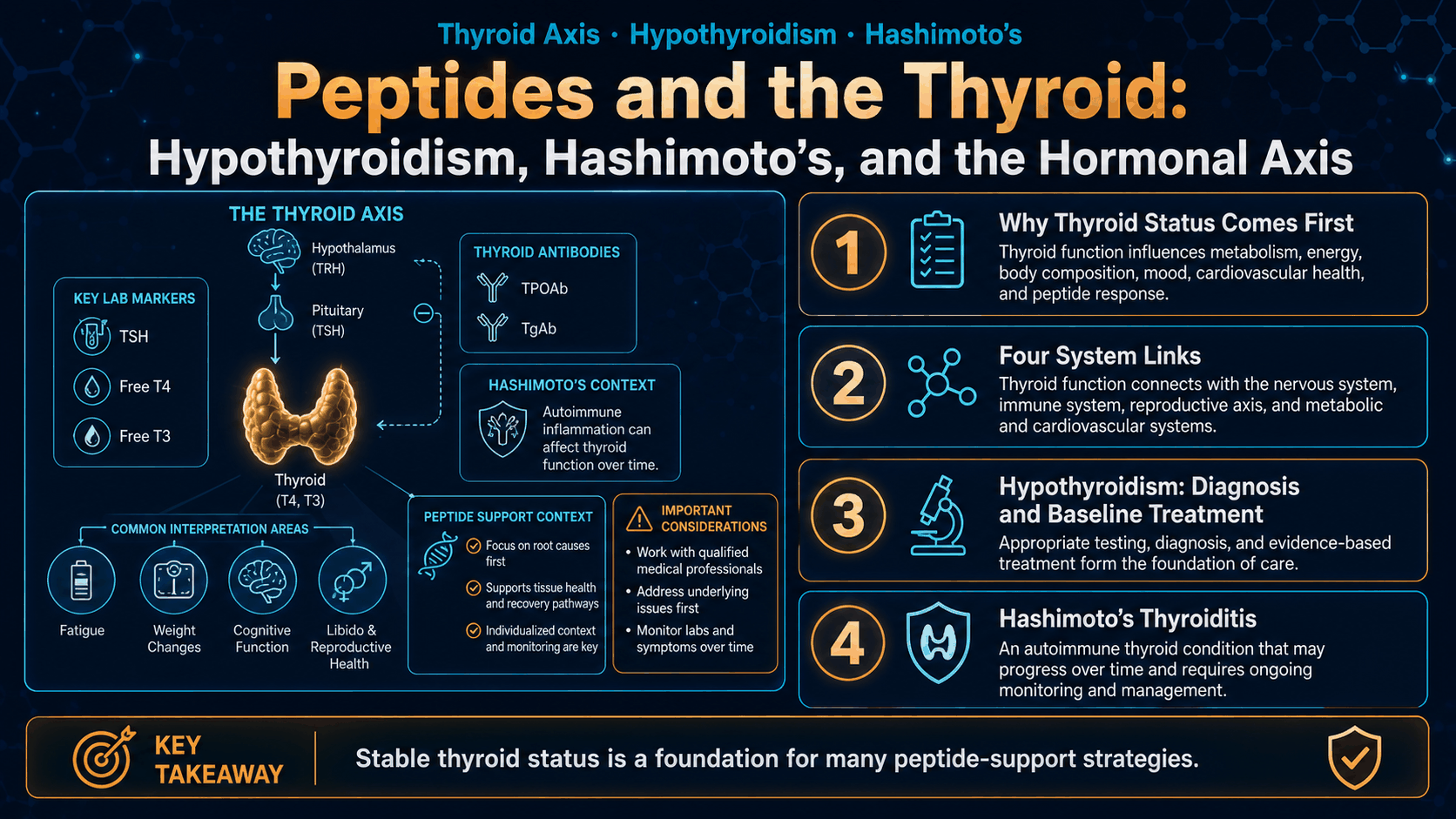
Why Thyroid Status Comes First
The thyroid is the metabolic foundation beneath many peptide-support strategies.
T4 and T3 influence protein synthesis, heart function, nervous-system tone, fertility, metabolic rate, mood, and energy. When hypothyroidism is not addressed, GH secretagogues, sex-hormone strategies, nootropic peptides, and recovery protocols may underperform.
Four System Links
T3/T4 and IGF‑1
Hypothyroidism may reduce hepatic IGF‑1 synthesis, which can weaken the logic of GH-secretagogue use before thyroid compensation.
SHBG and hormone availability
Thyroid dysfunction can alter SHBG and mimic or worsen low-androgen or low-estrogen symptoms.
T3 as neuromodulator
T3 influences serotonin, dopamine, and BDNF-context signaling. Brain fog should not automatically be treated as a nootropic problem.
Hashimoto’s inflammation
Hashimoto’s is autoimmune and involves inflammatory pathways such as TNF‑α, IL‑6, and Th1-dominant signaling.
 Sponsored / AffiliateUlta Lab Tests · Lab testing for hormones, inflammation, and wellness
Hypothyroidism: Diagnosis and Baseline Treatment
The basic evaluation usually starts with TSH, free T4, and TPO antibodies. TSH is the screening marker, but symptoms, pregnancy status, medications, age, and clinical context matter.
Levothyroxine is the standard therapy when thyroid-hormone replacement is indicated. Peptides do not treat hypothyroidism; they may only support downstream symptoms or inflammatory context after thyroid care is addressed.
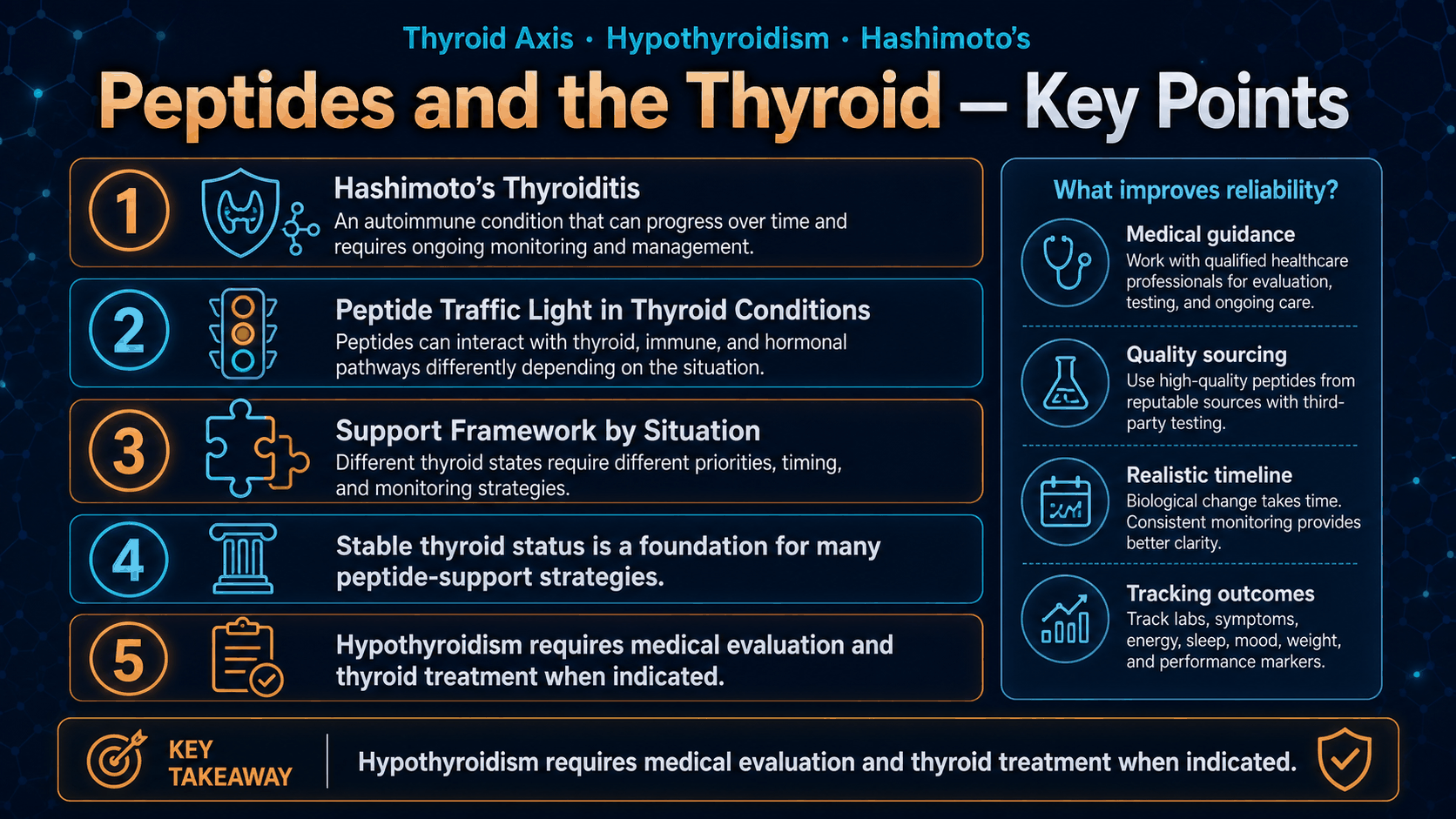
Hashimoto’s Thyroiditis
Hashimoto’s is an autoimmune condition, not simply a slow thyroid. The immune system attacks thyroid tissue, and the inflammatory component matters.
Key markers include TPO antibodies and sometimes thyroglobulin antibodies. A downward antibody trend may be encouraging, but must be interpreted with TSH, free T4, symptoms, medication history, ultrasound when indicated, and clinician review.
 Sponsored / AffiliateMomentous · Performance nutrition and recovery supplements
Peptide Traffic Light in Thyroid Conditions
| Tool | Compensated hypothyroidism | Stable Hashimoto’s | Uncompensated / active disease |
|---|---|---|---|
| BPC‑157 | Inflammation-context discussion | Adjunctive only, monitor antibodies | After thyroid evaluation |
| Glycine + magnesium | Sleep support context | Generally supportive | Basic support, not replacement for care |
| GH secretagogues | Only after stable TSH | TSH + IGF‑1 monitoring | Not logical before compensation |
| Semax | BDNF/cognition context | Usually immune-neutral discussion | May underperform if T3 context is poor |
| Thymalin / Thymosin α1 | Clinician only | Extra caution in autoimmunity | Do not self-use |
| Epitalon | Sleep/circadian context | Circadian context | Supportive only, not thyroid treatment |
| Vitamin D / Omega‑3 / Selenium | Foundational context | TPOAb and inflammation context | Avoid excess; clinician-guided |
Support Framework by Situation
Stable foundation
- GH-axis discussions only after thyroid stability.
- BPC‑157 as inflammation-context support.
- Semax for cognition/BDNF context.
- Epitalon for sleep/circadian context.
- Monitor TSH, free T4, and relevant markers.
Autoimmune context
- Vitamin D, selenium if appropriate, omega‑3, sleep, gut assessment.
- BPC‑157 only as adjunctive inflammation-context discussion.
- Thymic peptides only with endocrinologist guidance.
- Gluten-free diet only when clinically relevant.
Medical care first
- Endocrinologist and thyroid-hormone replacement when indicated.
- Pause advanced peptide protocols.
- Basic support: vitamin D, omega‑3, glycine, magnesium.
- Revisit peptide support after TSH stabilization.
Two Common Myths
Myth: Epitalon normalizes TSH, so peptides treat thyroid disease.
Fact: Epitalon is discussed around melatonin and circadian rhythm. It is not thyroid treatment and does not replace levothyroxine or endocrinology care.
Myth: TSH is normal, so the thyroid is definitely fine.
Fact: TSH is a screening marker, not the whole picture. Hashimoto’s can exist with normal TSH and elevated antibodies. Symptoms, free T4, TPO antibodies, ultrasound, medication history, and clinician review may matter.
Frequently Asked Questions
Can peptides treat hypothyroidism?
No. Peptides do not replace thyroid-hormone replacement when it is indicated.
What labs are most important?
TSH and free T4 are core. TPO antibodies are important when Hashimoto’s is suspected. Clinicians may add free T3, thyroglobulin antibodies, ultrasound, ferritin, vitamin D, B12, or other markers depending on symptoms.
Can GH secretagogues be used with hypothyroidism?
They are more logical only after thyroid status is stable and monitored, because hypothyroidism can weaken IGF‑1 context.
Why are thymic peptides cautioned in Hashimoto’s?
Hashimoto’s is autoimmune. Immune-modulating peptides can be risky without clinician oversight.
When should someone see a doctor?
Persistent fatigue, hair loss, depression, infertility, weight change, cold intolerance, palpitations, neck swelling, abnormal labs, or pregnancy-related thyroid questions require medical evaluation.
Key Takeaways
- Stable thyroid status is a foundation for many peptide-support strategies.
- Hypothyroidism requires medical evaluation and thyroid treatment when indicated.
- Hashimoto’s is autoimmune; antibody and inflammatory context matters.
- BPC‑157 is an inflammation-context discussion, not Hashimoto’s treatment.
- GH secretagogues are not logical before thyroid compensation.
- Thymic peptides require extra caution in autoimmunity.
- Peptides support layers; they do not replace endocrinology care.