
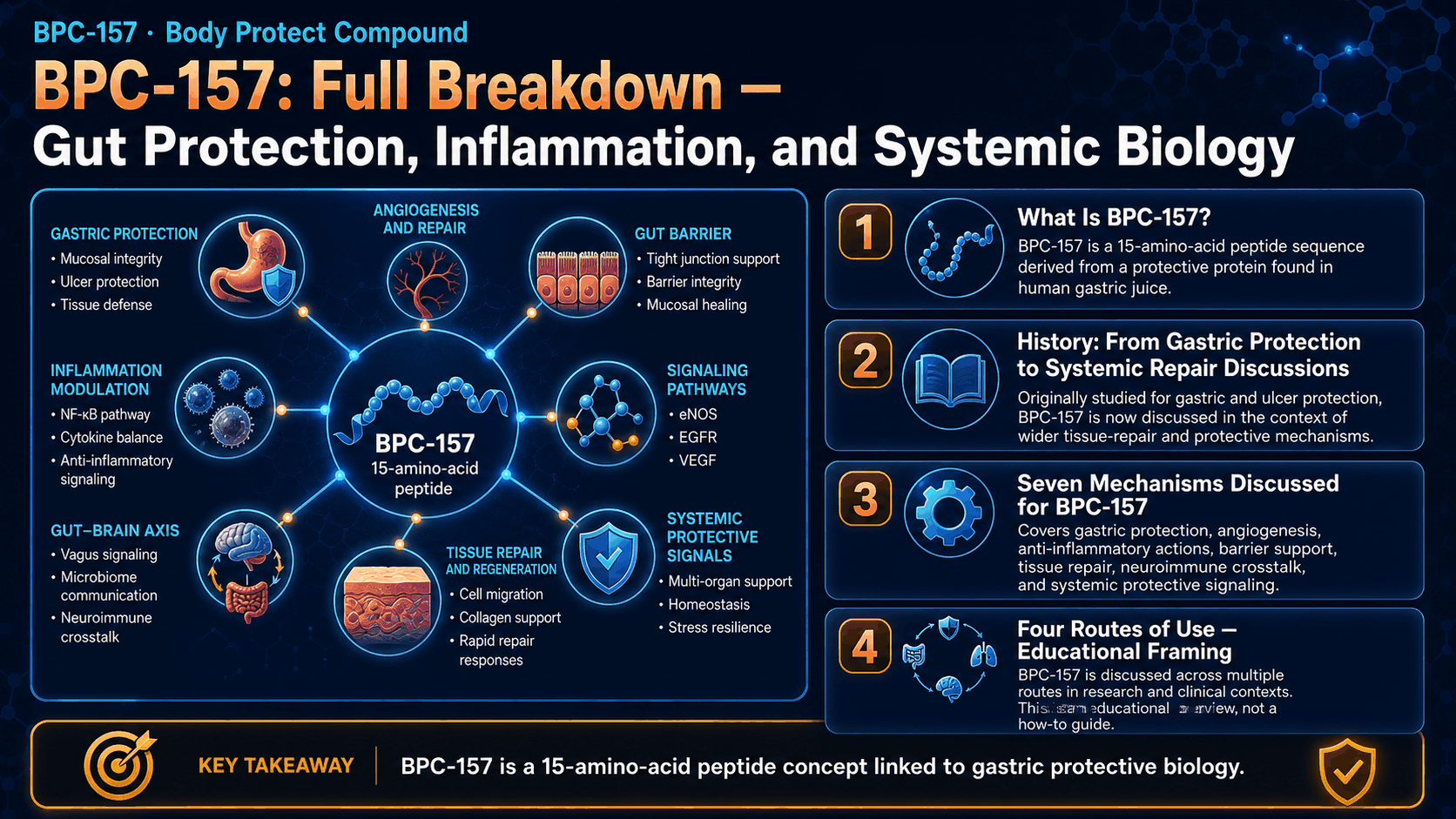
What Is BPC-157?
BPC-157 stands for Body Protect Compound and is commonly described as a 15-amino-acid pentadecapeptide related to protective peptide fragments found in gastric juice.
The reason BPC-157 appears in so many discussions is not because it “treats everything.” It is because it intersects with several central biological themes: inflammatory signaling, epithelial repair, vascular signaling, angiogenesis, gut-barrier support, and gut-brain-axis biology.
History: From Gastric Protection to Systemic Repair Discussions
The BPC-157 research story is closely associated with Professor Predrag Sikiric and colleagues at the University of Zagreb. Their work explored protective factors in gastric juice and the idea of a stable “Body Protect Compound.”
A key concept is gastric stability. Unlike many peptides that degrade quickly in the digestive tract, BPC-157 is discussed as unusually stable in acidic conditions. That is why oral use is commonly discussed in GI-targeted contexts.
 Sponsored / AffiliateDT Peptides · Peptide research products and laboratory-focused resources
Seven Mechanisms Discussed for BPC-157
Nitric oxide balance
BPC-157 is discussed around eNOS activation and nitric-oxide balance, with implications for vascular signaling and anti-inflammatory vessel context.
Epithelial repair
EGF-receptor signaling is central to epithelial growth, differentiation, and mucosal repair discussions.
Inflammatory signaling
BPC-157 is discussed around lower NF-κB, TNF-α, IL‑1β, and IL‑6 context, making it relevant to inflammaging and chronic-inflammation discussions.
Hormone context
Some discussions connect BPC-157 with SHBG and bioavailable testosterone context. This is not a hormone-replacement claim.
Angiogenesis
New capillary growth can support tissue-repair models, but angiogenesis is also why cancer history requires caution.
Dopamine and serotonin
Preclinical work discusses dopamine and serotonin receptor modulation, anxiety-like behavior, and toxin-related neuroprotection contexts.
LPS and neuroinflammation
Gut-barrier support may reduce LPS exposure, systemic inflammation, and downstream neuroinflammatory signaling.
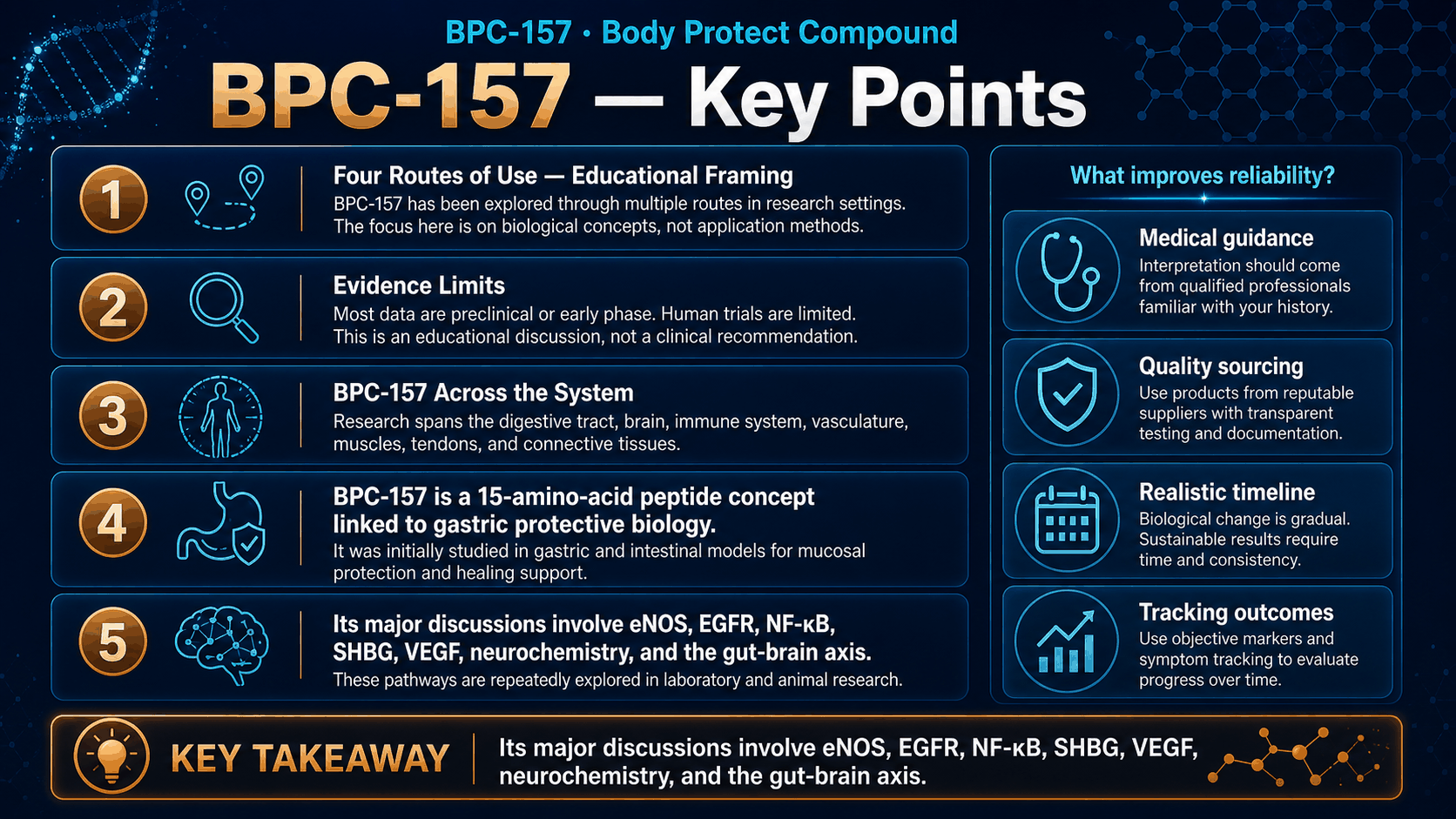
Four Routes of Use — Educational Framing
GI-targeted discussion
Because of gastric-stability discussions, oral use is most often connected with gut-barrier and mucosal-support themes.
- Diagnosis first.
- GI symptoms require medical workup.
- Not an IBD or ulcer treatment claim.
Systemic context
Subcutaneous use is discussed in systemic inflammation, joints, vessels, hormone-context, and tissue-repair conversations.
- Clinician-guided only.
- No injection instructions here.
- Sterility and indication are medical questions.
Neuroinflammation context
Nasal use appears in long-COVID, cognitive, and neuroinflammatory discussions because of nose-to-brain delivery theories.
- Evidence remains limited.
- Product quality matters.
- Not a cognitive-treatment claim.
Skin and local support
Topical use appears in skincare and local-support discussions, but the evidence is less developed than for GHK-Cu.
- Adjunctive concept.
- Not wound-care replacement.
- Dermatology guidance when needed.
 Sponsored / AffiliateIntegrative Peptides · Practitioner-oriented peptide and wellness education
Evidence Limits
BPC-157 Across the System
Local repair context
Discussed around tendon, ligament, collagen-support, and local inflammatory signaling.
Barrier and mucosa
Oral route is commonly discussed for gut-barrier and mucosal-support rationale.
NO / eNOS context
Appears in vascular tone, endothelial signaling, and inflammatory-vessel context.
Gut-brain axis
Connected to LPS, systemic inflammation, and neuroinflammatory signaling.
NF‑κB theme
Repeatedly discussed because chronic inflammation is a major aging biology theme.
Insulin-resistance context
Discussed around TNF‑α, IRS‑1, and inflammation-related insulin signaling.
Two Common Myths
Myth: BPC-157 is a magic pill that treats everything.
Fact: The broad mechanism profile is real, but chronic diseases require diagnosis and comprehensive medical care. BPC-157 is an adjunctive research discussion, not monotherapy.
Myth: If most studies are in rats, it cannot work in humans.
Fact: Lack of human RCTs does not prove ineffectiveness, but it does mean we do not know reliable human effect size, indications, protocols, or long-term safety. Claims must remain cautious.
Frequently Asked Questions
Is BPC-157 approved for medical treatment?
No. It should not be presented as an approved treatment for gut disease, joint injury, cardiovascular disease, neurologic disease, or long COVID.
Why is oral BPC-157 discussed?
Because BPC-157 is described as unusually stable in acidic gastric conditions, making oral GI-targeted discussion biologically plausible.
Can BPC-157 replace medical care for IBD or ulcers?
No. IBD, ulcers, bleeding, severe pain, weight loss, anemia, or persistent GI symptoms require medical evaluation and standard care.
Why is cancer history a caution?
BPC-157 is discussed around VEGF and angiogenesis. Angiogenesis can be relevant to tumor biology, so cancer history requires clinician guidance.
Does this page provide dosing or injection instructions?
No. This page intentionally avoids self-treatment protocols, dosing, reconstitution, and injection instructions.
Key Takeaways
- BPC-157 is a 15-amino-acid peptide concept linked to gastric protective biology.
- Its major discussions involve eNOS, EGFR, NF‑κB, SHBG, VEGF, neurochemistry, and the gut-brain axis.
- Oral, subcutaneous, nasal, and topical routes are discussed for different contexts, but route choice is a medical question.
- BPC-157 appears across joint, gut, cardiovascular, neuro, metabolic, and inflammaging topics because inflammation is a shared pathway.
- Large independent human randomized trials are lacking.
- Diagnosis first, clinician guidance, and realistic expectations are essential.