
What Is GHK-Cu?
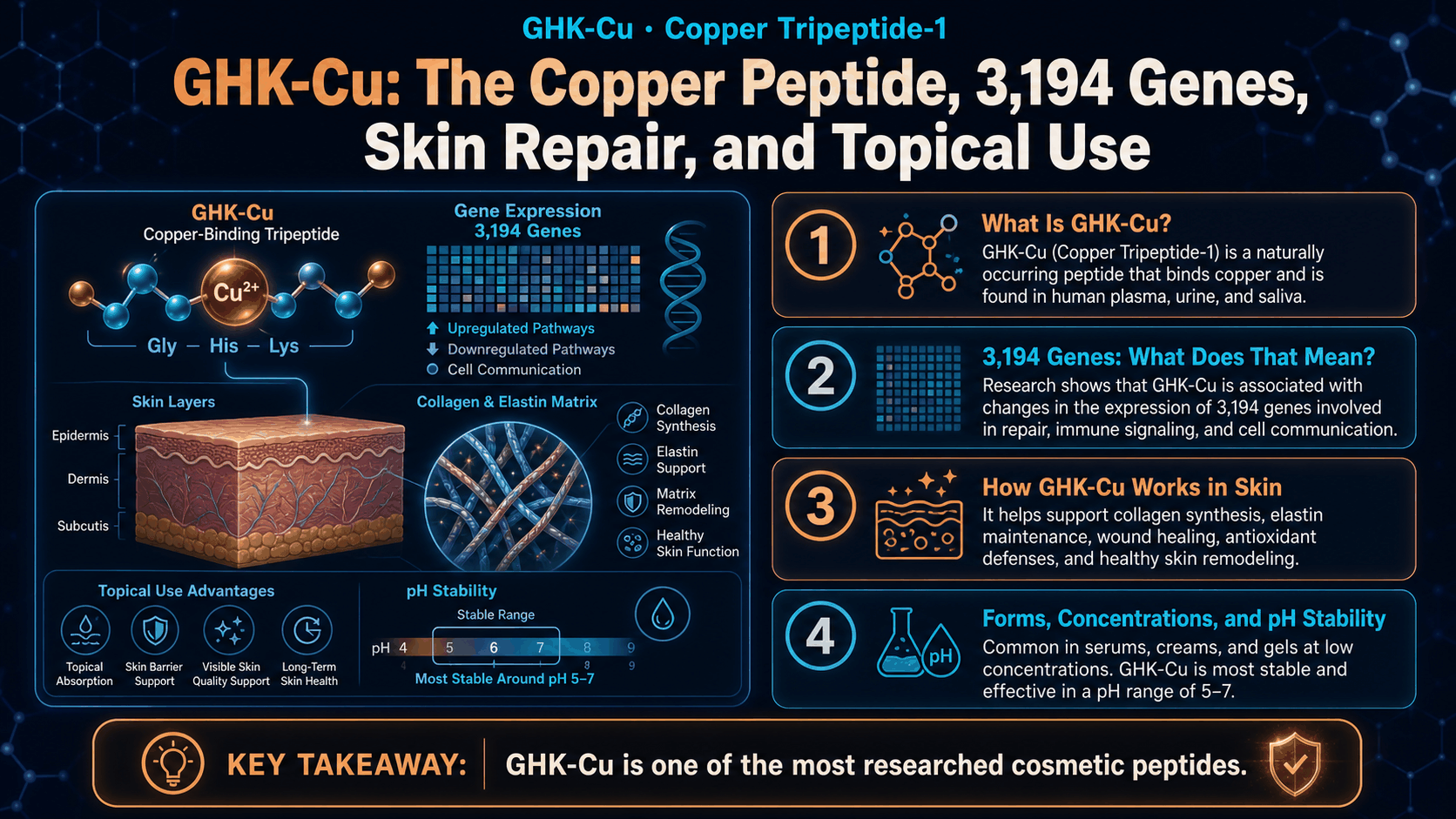
GHK-Cu is a copper-binding tripeptide: glycyl-L-histidyl-L-lysine complexed with copper.
It is known in cosmetic INCI language as Copper Tripeptide-1. The molecule is widely discussed in anti-aging skincare because of its connection to collagen synthesis, extracellular matrix remodeling, wound-repair signaling, inflammatory modulation, antioxidant-enzyme context, and age-related changes in skin quality.
3,194 Genes: What Does That Mean?
The “3,194 genes” figure comes from gene-expression research discussed in the GHK-Cu literature. The point is not that every gene change is automatically clinically meaningful. The point is that GHK-Cu appears to influence a broad repair-oriented transcriptional profile.
Genomic stability
GHK-Cu is discussed around DNA-repair gene activation, genomic maintenance, and repair pathways.
Collagen and elastin
Collagen I, III, IV, VII, elastin, and glycosaminoglycan pathways are central to GHK-Cu skincare discussions.
Immune modulation
GHK-Cu is discussed around lower NF-κB signaling, inflammatory mediators, and antioxidant-enzyme context.
BDNF / NGF context
NGF, BDNF, and neurotrophin pathways are mechanistically interesting, but human clinical outcome data remain limited.
Cellular energy
GHK-Cu is discussed around mitochondrial biogenesis, cellular respiration, and oxidative-stress signaling.
Younger expression profile
Gene-expression research suggests a shift toward more repair-oriented, youthful transcriptional patterns.
 Sponsored / AffiliateUlta Lab Tests · Lab testing for hormones, inflammation, and wellness
How GHK-Cu Works in Skin
GHK-Cu is a small tripeptide complex, which makes topical penetration more plausible than with many larger peptides. But penetration depends on formula quality, pH, vehicle, concentration, and skin condition.
Fibroblast signaling
GHK-Cu is discussed as helping shift fibroblast behavior toward matrix repair and collagen-support signaling.
Extracellular matrix remodeling
It is not just “more collagen.” The more accurate framing is balanced remodeling: building new matrix while supporting removal of damaged matrix.
Inflammatory modulation
GHK-Cu is discussed around lower inflammatory signaling, which matters because chronic inflammation accelerates visible skin aging.
Antioxidant context
Copper is involved in antioxidant-enzyme biology, but excess copper can become problematic. Concentration discipline matters.
Forms, Concentrations, and pH Stability
| Form / concentration | Characteristics | Best for | Important nuance |
|---|---|---|---|
| 0.05–0.1% topical | Starter range · good tolerability | Daily care · sensitive skin | Effects take time — often discussed over 8–12 weeks. |
| 0.5–1% topical | Common working range | Anti-aging care · mature skin · post-procedure support when appropriate | Often viewed as the practical range for visible cosmetic use. |
| 2–3% topical | Possible pro-oxidant concern | Not ideal for daily unsupervised use | Excess copper may increase oxidative-stress or irritation risk. |
| Systemic use | Clinician-guided only | Research / medical-supervision context | Safety, cancer history, copper status, and comorbidities matter. |
| INCI after preservative | Marketing-level amount | Label claim only | Likely too low for meaningful clinical cosmetic effect. |
 Sponsored / AffiliateQuest Health · Personal lab testing and health marker tracking
Four Use Cases
Anti-aging skincare
The main use case. GHK-Cu is discussed around wrinkles, firmness, collagen, elastin, post-acne marks, and scar-remodeling context.
- Topical-first.
- Separate from strong acids.
- Use SPF during daytime routines.
Joint and matrix context
Matrix-remodeling biology leads to joint and connective-tissue interest, but clinical evidence is weaker than for skincare.
- Not a replacement for orthopedic care.
- Systemic use requires clinician guidance.
- Evidence is more extrapolative.
BDNF and NGF context
Mechanistically interesting, but human clinical outcome data for neurologic use remain limited.
- Not a neurologic treatment claim.
- Research-context discussion.
- Do not replace medical care.
Genomic and epigenetic context
GHK-Cu is interesting for aging research, but consumer-facing practical use should remain topical-first.
- Systemic use is clinician-only.
- Cancer history requires extra caution.
- No anti-aging guarantees.
Evidence Matrix
Two Common Myths
Myth: More copper is always better.
Fact: Higher copper concentration is not automatically better. At high topical concentrations, excess copper can become pro-oxidant or irritating. Practical formulas usually focus on tolerable working ranges.
Myth: Any INCI listing means the product is effective.
Fact: INCI position matters. If Copper Tripeptide-1 is buried at the end of the formula, it may be a marketing-level amount. Look for transparent concentration, appropriate pH, and credible formulation.
Frequently Asked Questions
Is GHK-Cu the same as Copper Tripeptide-1?
Yes. Copper Tripeptide-1 is the common cosmetic INCI name for GHK-Cu.
Can I layer GHK-Cu with vitamin C or acids?
It is better to avoid layering GHK-Cu directly with strong acidic products. Use acids or low-pH vitamin C in a separate routine.
Is higher concentration better?
No. Very high copper-peptide percentages may increase irritation or oxidative-stress concerns. More is not automatically better.
Is systemic GHK-Cu safe?
Systemic use should be clinician-guided. Copper status, cancer history, liver status, medications, and medical history matter.
How long before visible skin changes?
Cosmetic changes are usually discussed over weeks to months, not days. Consistency and formulation quality matter.
Key Takeaways
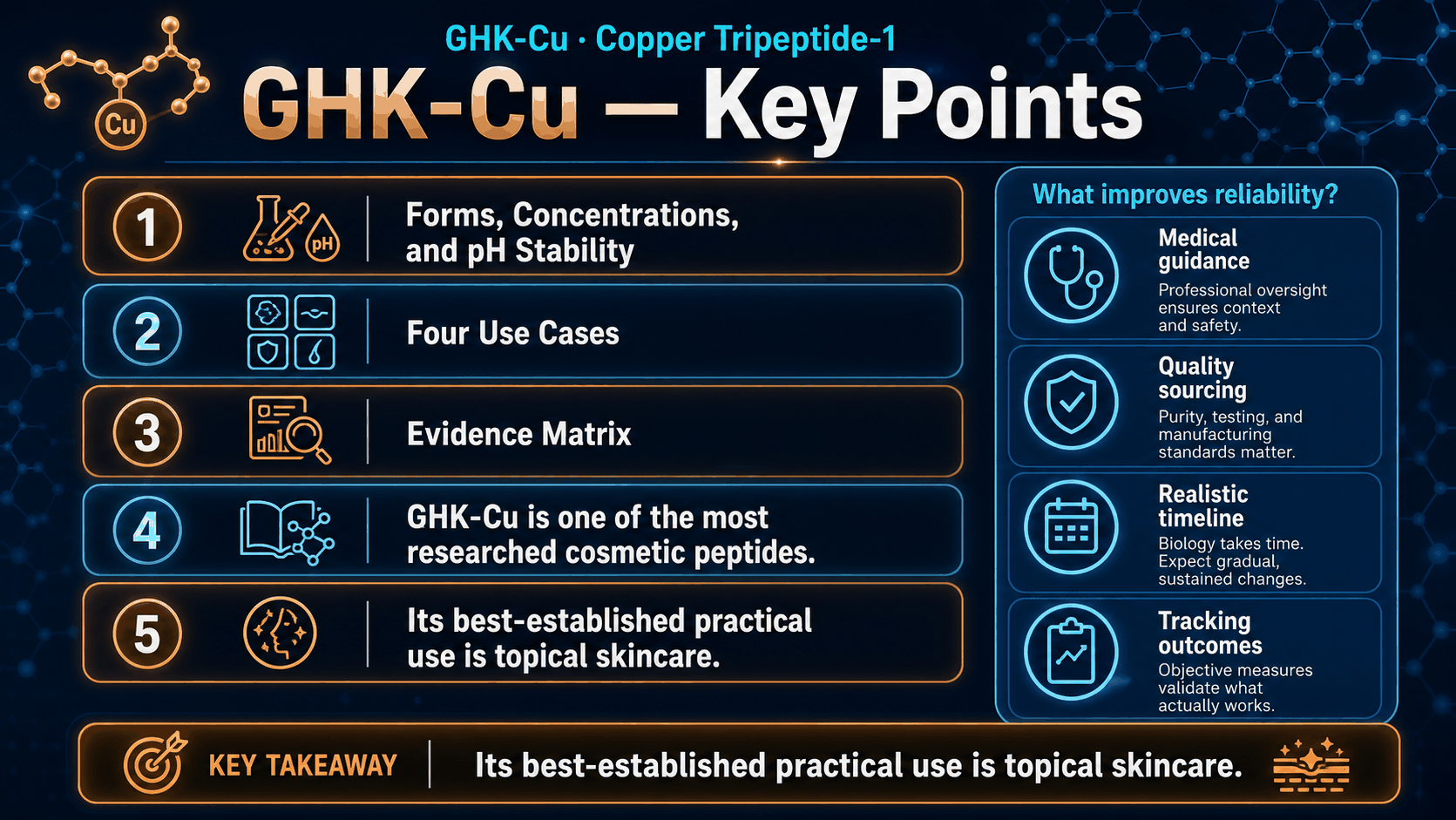
- GHK-Cu is one of the most researched cosmetic peptides.
- Its best-established practical use is topical skincare.
- It is discussed around collagen, elastin, DNA repair, inflammation, and gene-expression regulation.
- pH and formulation quality matter.
- Very high copper concentrations are not necessarily better.
- Systemic use requires clinician guidance, especially with cancer history or copper-related concerns.