
What Is TB-500?
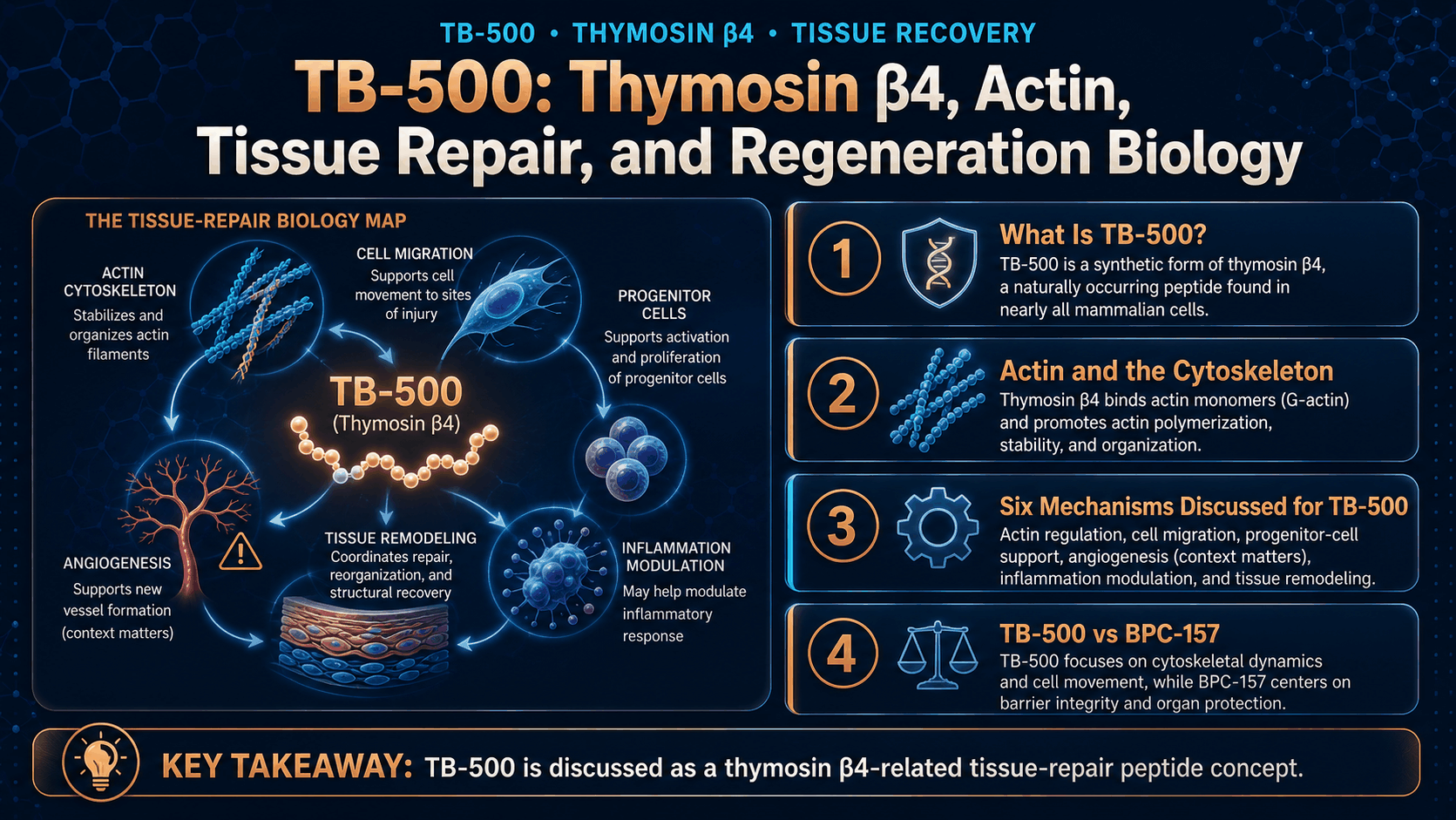
TB-500 is a synthetic peptide concept related to thymosin β4, a 43-amino-acid peptide involved in actin regulation and tissue-repair biology.
In practical peptide discussions, TB-500 is often linked to the Acti-4 region, commonly described by the sequence LKKTETQ. The central idea is that thymosin β4-related biology influences actin dynamics, cell migration, progenitor-cell signaling, angiogenesis, and remodeling.
Actin and the Cytoskeleton
Actin is one of the most conserved and abundant proteins in eukaryotic cells. It exists as free monomeric G-actin and polymerized filamentous F-actin. The balance between these forms controls cell shape, migration, repair, and tissue remodeling.
When tissue is injured, fibroblasts, immune cells, endothelial cells, and progenitor cells need to move into the damaged area. That movement depends on actin. This is why TB-500 discussions begin with the cytoskeleton rather than with a simple “healing peptide” label.
 Sponsored / AffiliateQuest Health · Personal lab testing and health marker tracking
Six Mechanisms Discussed for TB-500
Cell migration
G-actin regulation may support the cellular movement required for fibroblasts and immune cells to reach damaged tissue.
Progenitor-cell signaling
Thymosin β4-related literature discusses progenitor cells in muscle, vascular, and cardiac repair models.
Angiogenesis
Blood-vessel formation may support tissue repair, but angiogenesis also creates major caution in oncology contexts.
Inflammation-to-repair transition
TB-500 is discussed around moving tissue from chronic inflammatory signaling toward repair and remodeling.
Neurorepair context
Animal CNS-injury and stroke models discuss oligodendrocytes and neural progenitors. Human clinical claims must remain cautious.
Muscle and tendon remodeling
Sports-recovery interest centers on muscle tears, tendinopathy models, scar burden, and functional matrix remodeling.
TB-500 vs BPC-157
TB-500 and BPC-157 are often discussed together, but the mechanisms are not identical.
Actin, progenitors, angiogenesis
- Thymosin β4-related origin.
- Cell migration and cytoskeleton context.
- Chronic remodeling and scar/fibrosis discussion.
- Animal model cardiac and CNS repair context.
- Angiogenesis caution, especially with cancer history.
NO system, gut, inflammatory signaling
- Gastric peptide fragment origin.
- Gut and barrier-support discussions.
- Acute injury and local inflammatory context.
- Neuroinflammation and gut-brain-axis context.
- Still requires medical caution and clinician guidance.
 Sponsored / AffiliateDT Peptides · Peptide research products and laboratory-focused resources
Evidence Limits: What Is Actually Supported?
The strongest TB-500 story is mechanistic and animal-model based. The human sports-injury evidence gap is important.
Use Frameworks by Situation
Acute injury
Muscle tear, ligament sprain, or sudden pain first requires diagnosis, severity assessment, imaging if indicated, rest, and rehabilitation. Peptide discussion is an adjunct, not first-line care.
Chronic tendinopathy
Chronic tendon pain often requires load management, progressive rehab, eccentric or heavy-slow resistance training, and sports-medicine evaluation. TB-500 is discussed only as a remodeling adjunct.
Off-season recovery
Athletes should consider anti-doping rules, medical supervision, sleep, nutrition, deloading, and recovery periodization before any advanced peptide discussion.
Scars and fibrosis
TB-500 + GHK-Cu is discussed as a remodeling concept, but post-surgical scars and fibrosis require clinician or dermatology follow-up.
Two Common Myths
Myth: TB-500 and BPC-157 do the same thing.
Fact: Their mechanisms differ. BPC-157 is discussed around inflammatory signaling, NO-system context, gut, and local repair. TB-500 is discussed around actin, progenitor cells, scar remodeling, and angiogenesis.
Myth: More frequent use means faster recovery.
Fact: More is not automatically better. Injury recovery depends on diagnosis, rehabilitation, load management, sleep, nutrition, and medical supervision.
Frequently Asked Questions
Is TB-500 approved for tendon injuries?
No. It should not be described as an approved tendon-injury treatment. Human injury evidence is limited.
Why is angiogenesis a caution?
Angiogenesis supports new blood-vessel formation in repair, but blood-vessel growth is also relevant to tumor biology. Cancer history requires clinician guidance.
Does TB-500 replace physical therapy?
No. Rehab, progressive loading, diagnosis, and recovery planning remain central for tendon and muscle injuries.
Is TB-500 safe for athletes?
Athletes must consider anti-doping rules, medical supervision, and the lack of robust human outcome data.
What is the safest framing?
Research-context, clinician-guided, diagnosis-first, rehab-first, and cautious with cancer history or vascular concerns.
Key Takeaways
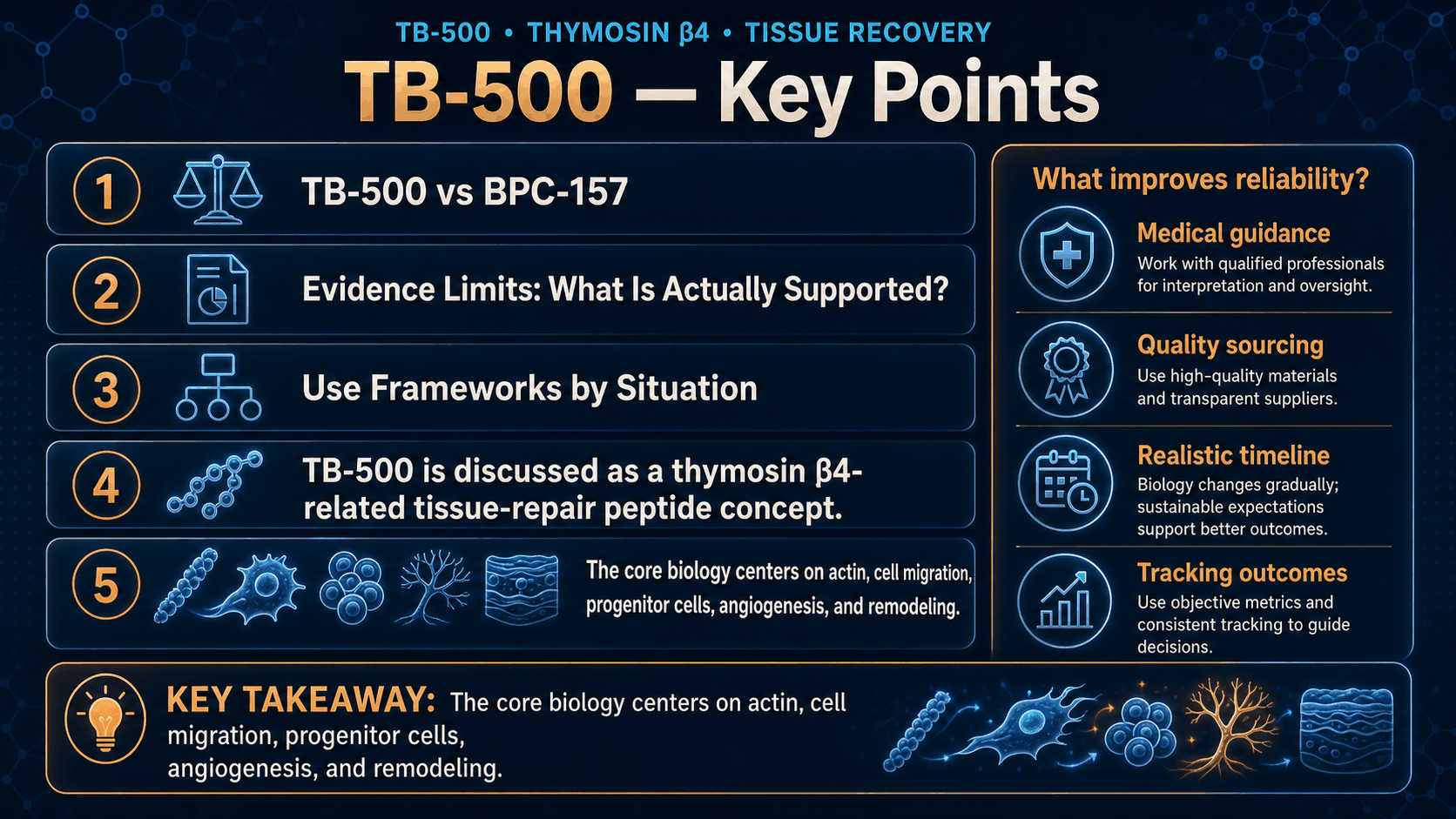
- TB-500 is discussed as a thymosin β4-related tissue-repair peptide concept.
- The core biology centers on actin, cell migration, progenitor cells, angiogenesis, and remodeling.
- TB-500 and BPC-157 are complementary concepts, not duplicates.
- Most evidence is mechanistic or animal-model based; human sports-injury trials are limited.
- Angiogenesis creates extra caution for anyone with cancer history.
- Injury recovery still requires diagnosis, rehab, load management, sleep, nutrition, and clinician guidance.