
Why Long COVID Changed the Conversation
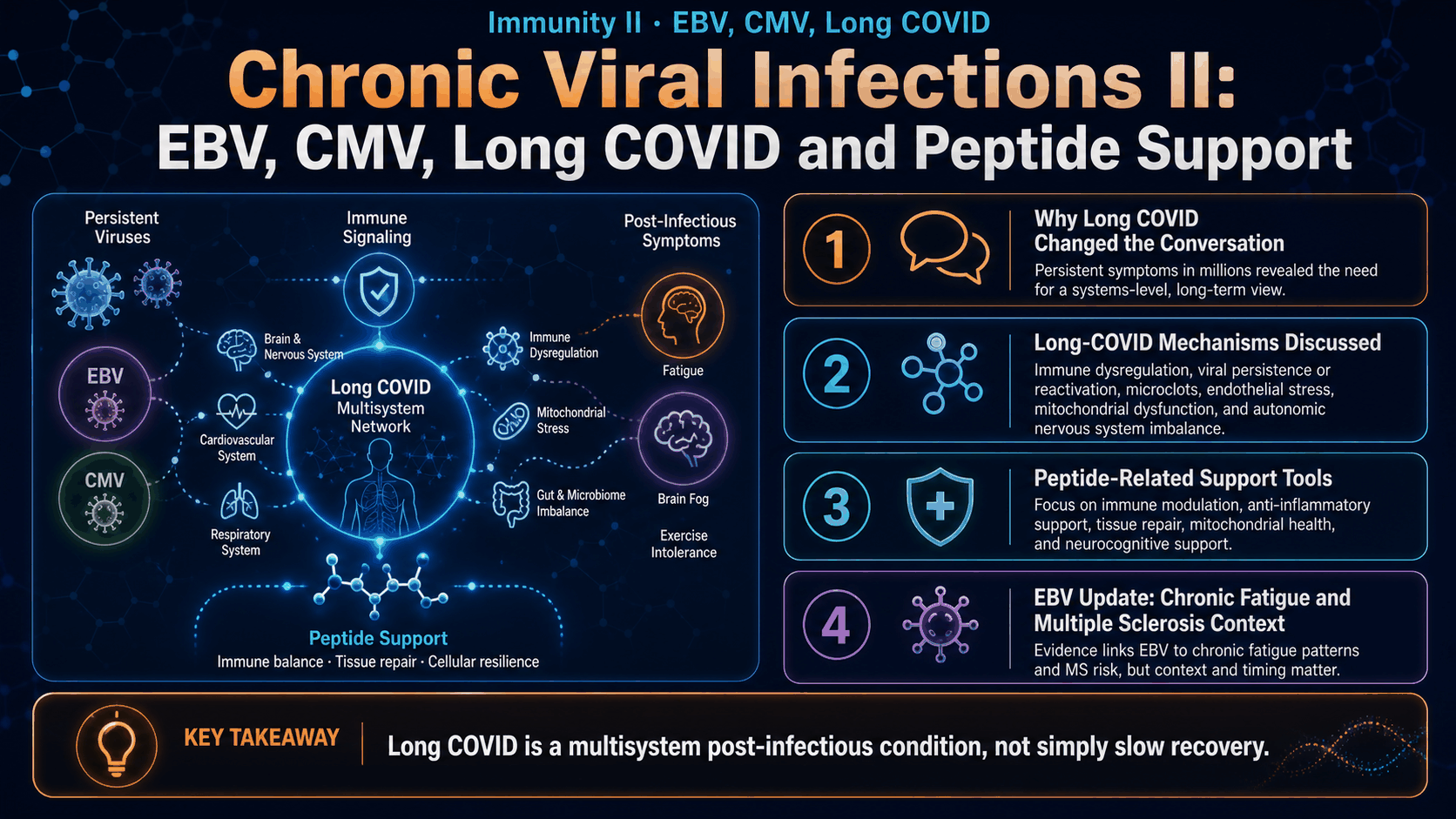
Long COVID made post-viral biology visible at population scale.
For many people, recovery after infection is not linear. Symptoms may involve immune dysregulation, endothelial dysfunction, autonomic changes, neuroinflammation, mitochondrial stress, and in some cases viral-reactivation markers. This does not mean every case has the same cause. It means the evaluation must be layered.
Long-COVID Mechanisms Discussed
Possible viral persistence
In some patients, viral material or immune activation may persist. This is still an evolving research area and should not be assumed without evaluation.
EBV reactivation context
Some studies have linked EBV reactivation markers with long-COVID symptom patterns in subsets of patients.
Neuroinflammation
Microglial activation and inflammatory signaling are discussed in brain fog, fatigue, and cognitive symptoms.
Endothelial dysfunction
Vascular dysregulation, NO-system disruption, clotting markers, and exercise intolerance are discussed in some long-COVID contexts.
Mitochondrial stress
Impaired cellular energy metabolism is discussed in chronic fatigue and post-infectious syndromes.
 Sponsored / AffiliatePeptide ReGenesis · Peptide education, protocols, and wellness-focused resources
Peptide-Related Support Tools
These tools should be framed as supportive pathway discussions, not cures or antiviral treatments.
Immune modulation
Discussed around T-cell, NK-cell, and antiviral immune contexts. Should be clinician-guided and not self-directed.
Gut-brain-axis context
Discussed around gut-barrier support, intestinal reservoir hypotheses, and neuroinflammation pathways.
Cognitive-support context
Discussed around BDNF, brain fog, and cerebral blood-flow context. Not a long-COVID treatment claim.
Sleep and connective support
Discussed around sleep quality, tissue support, and glutathione-related metabolic context.
Inflammation-resolution context
Discussed around resolvins, endothelial support, and inflammatory balance. Review interactions with a clinician.
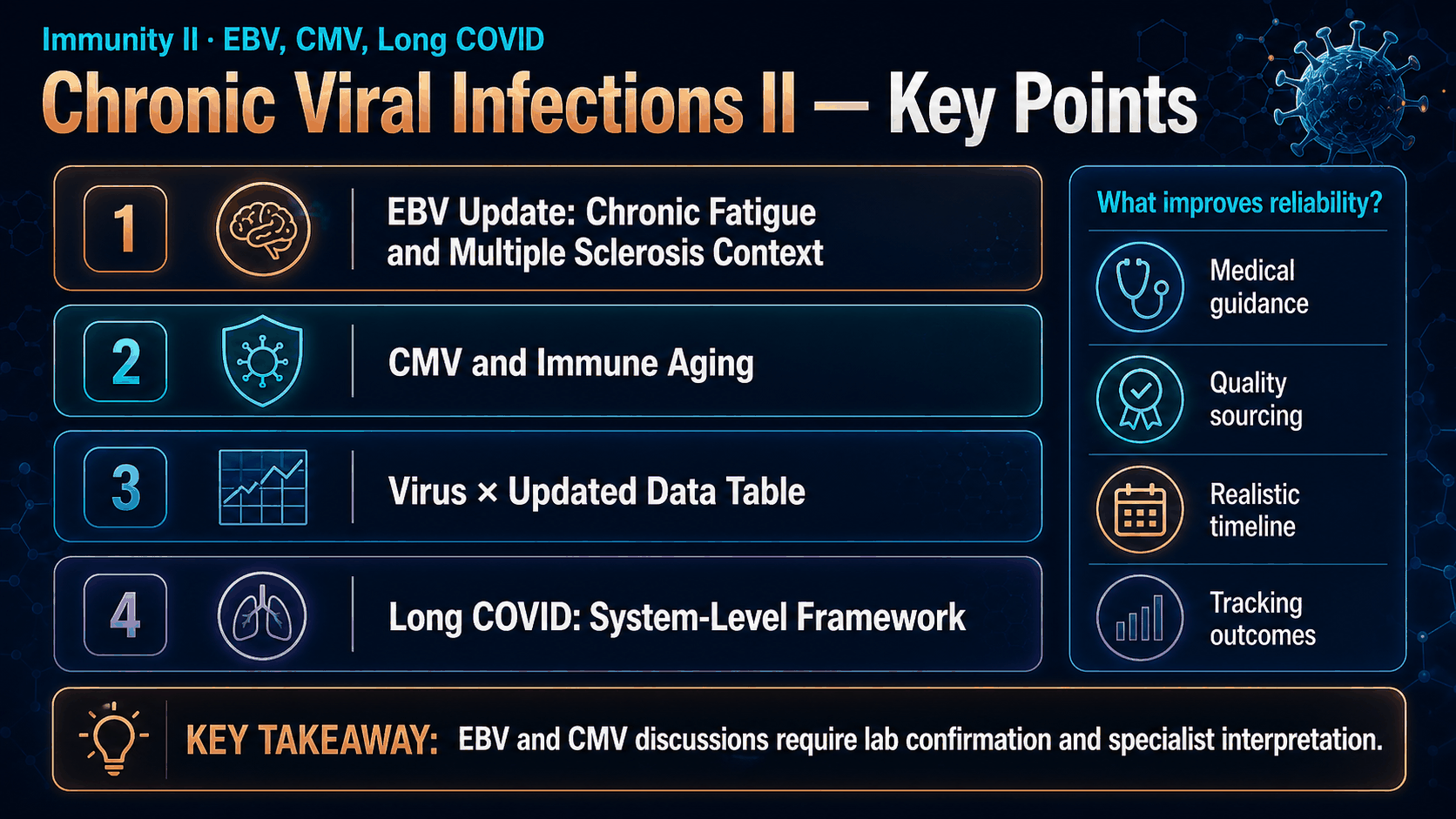
EBV Update: Chronic Fatigue and Multiple Sclerosis Context
EBV is common, but infection state matters. Latent exposure is not the same as reactivation or post-infectious immune burden.
Immune-support peptides such as Thymalin or Thymosin α1 are sometimes discussed in EBV-associated contexts, but only with infectious-disease, immunology, or clinician supervision and appropriate lab interpretation.
CMV and Immune Aging
CMV can contribute to immune aging discussions, especially in older adults. A large share of T-cell attention may be chronically directed toward CMV in some people, a concept often called immune inflation.
 Sponsored / AffiliateTeleWellnessMD · Telehealth wellness consultations and health optimization support
Virus × Updated Data Table
| Virus / condition | Updated context | Support discussion | Clinical caution |
|---|---|---|---|
| SARS‑CoV‑2 / Long COVID | Neuroinflammation, endothelial dysfunction, EBV reactivation context, possible viral reservoirs. | Thymosin α1, BPC‑157, Semax, omega‑3 as pathway discussions. | Physician evaluation first; not a peptide cure. |
| EBV | More central in MS discussions, ME/CFS context, and long-COVID subsets. | Thymic-support and stress-axis discussions. | EBV DNA / serology interpretation with specialist care. |
| CMV | Immune inflation and immunosenescence discussions, especially in older adults. | Thymic-support discussion. | CMV DNA PCR and immune evaluation if clinically relevant. |
| HSV‑1 / HSV‑2 | Recurrent herpes may reflect immune stress and stress-axis dysregulation in some people. | Stress control and immune-support discussions. | Antiviral care when indicated; clinician-guided. |
Long COVID: System-Level Framework
Confirm before acting
EBV DNA, CMV DNA, relevant serology, inflammatory markers, and clinical evaluation come before immune-focused interventions.
Brain fog and neuroinflammation
Semax, BPC‑157, and omega‑3 are discussed as pathway-support tools, not as long-COVID treatment.
Endothelium and clotting context
Endothelial symptoms, D-dimer concerns, chest pain, tachycardia, and shortness of breath require medical assessment.
Mitochondria and fatigue
Glycine, CoQ10, magnesium, sleep quality, and nutrition may support energy context, but fatigue requires diagnosis.
PEM changes everything
Post-exertional malaise means activity must increase slowly and not through force. Pacing may be more important than “pushing through.”
Two Common Myths
Myth: Peptides cure long COVID because it is just immune weakness.
Fact: Long COVID is multisystem: immune, vascular, neurologic, autonomic, mitochondrial, and sometimes viral-reactivation contexts may overlap. Peptides may touch selected pathways, but they are not a cure.
Myth: EBV is present in almost everyone, so it cannot matter.
Fact: Latent exposure is not the same as reactivation. Common does not mean irrelevant. The clinical question is activity, symptoms, immune status, and lab interpretation.
Frequently Asked Questions
Can peptides treat long COVID?
No. They should be discussed only as supportive pathway tools, not as long-COVID cures or antiviral treatments.
Should EBV or CMV be tested before immune peptides?
Testing and interpretation should be discussed with a clinician. Lab confirmation is important before assuming viral reactivation.
Why is PEM important?
Post-exertional malaise means symptoms worsen after exertion. In that context, forced exercise may backfire and pacing becomes essential.
When is medical care urgent?
Chest pain, severe shortness of breath, fainting, neurological deficits, high fever, severe weakness, or clotting concerns require medical evaluation.
What is the safest first layer?
Diagnosis, pacing, sleep, nutrition, hydration, stress management, symptom tracking, and physician-guided care.
Key Takeaways
- Long COVID is a multisystem post-infectious condition, not simply slow recovery.
- EBV and CMV discussions require lab confirmation and specialist interpretation.
- Peptides are supportive pathway discussions, not antiviral cures.
- PEM means activity must be paced carefully.
- Immune support should not be self-directed in complex post-viral syndromes.
- Diagnostics and clinician supervision come before any protocol.