
Why This Topic Is Different
Neurodegenerative disease is not a wellness topic. It is a serious medical category.
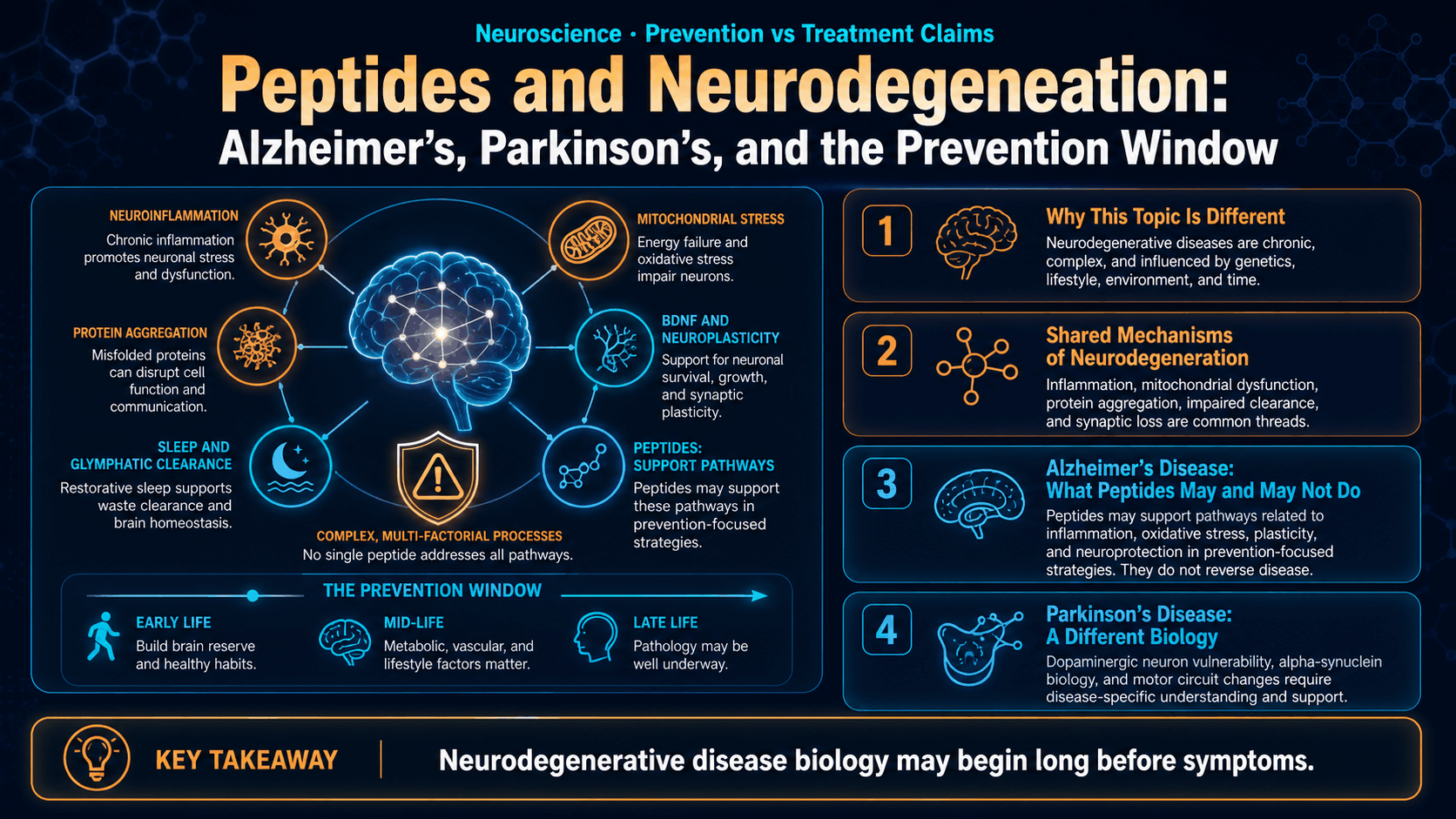
Alzheimer’s disease and Parkinson’s disease can involve long preclinical phases, progressive neuronal dysfunction, and complex biology. By the time symptoms are obvious, significant pathology may already exist. That makes prevention and risk reduction important — but it also makes overclaiming dangerous.
Shared Mechanisms of Neurodegeneration
Neuroinflammation
Activated microglia can contribute to a chronically inflamed neuronal environment. BPC‑157 is discussed in anti-inflammatory and gut-brain-axis contexts, but not as disease-specific treatment.
Lower neurotrophic support
BDNF supports neuronal survival, plasticity, and resilience. Semax is discussed in relation to BDNF signaling and cognitive-support contexts.
Mitochondrial dysfunction
Neurons are energy-intensive. Mitochondrial stress and reduced energy supply are discussed across neurodegenerative processes.
Sleep and waste clearance
The glymphatic system is more active during sleep and is discussed in relation to clearance of metabolic waste, including amyloid-related material.
 Sponsored / AffiliateiHerb · Supplements, wellness products, and daily health essentials
Alzheimer’s Disease: What Peptides May and May Not Do
Alzheimer’s disease
Prevention context · not treatmentPathogenesis and limits
Amyloid-beta and tau pathology are associated with neuronal dysfunction and neurodegeneration. Pathological changes may begin long before symptoms. Once neurons are lost, peptides cannot bring them back.
Peptide-related discussion
Semax is discussed around BDNF and neuroplasticity; glycine around sleep quality and glymphatic clearance; BPC‑157 around neuroinflammation and gut-brain-axis mechanisms. In mild cognitive impairment, any discussion belongs with a neurologist.
Support, not cure
The most reasonable peptide-related contribution in Alzheimer’s discussions is prevention and support, not treatment. The practical window is before major symptoms, when risk reduction and neuroprotective habits still matter most.
Parkinson’s Disease: A Different Biology
Parkinson’s disease
Neurologist onlyPathogenesis
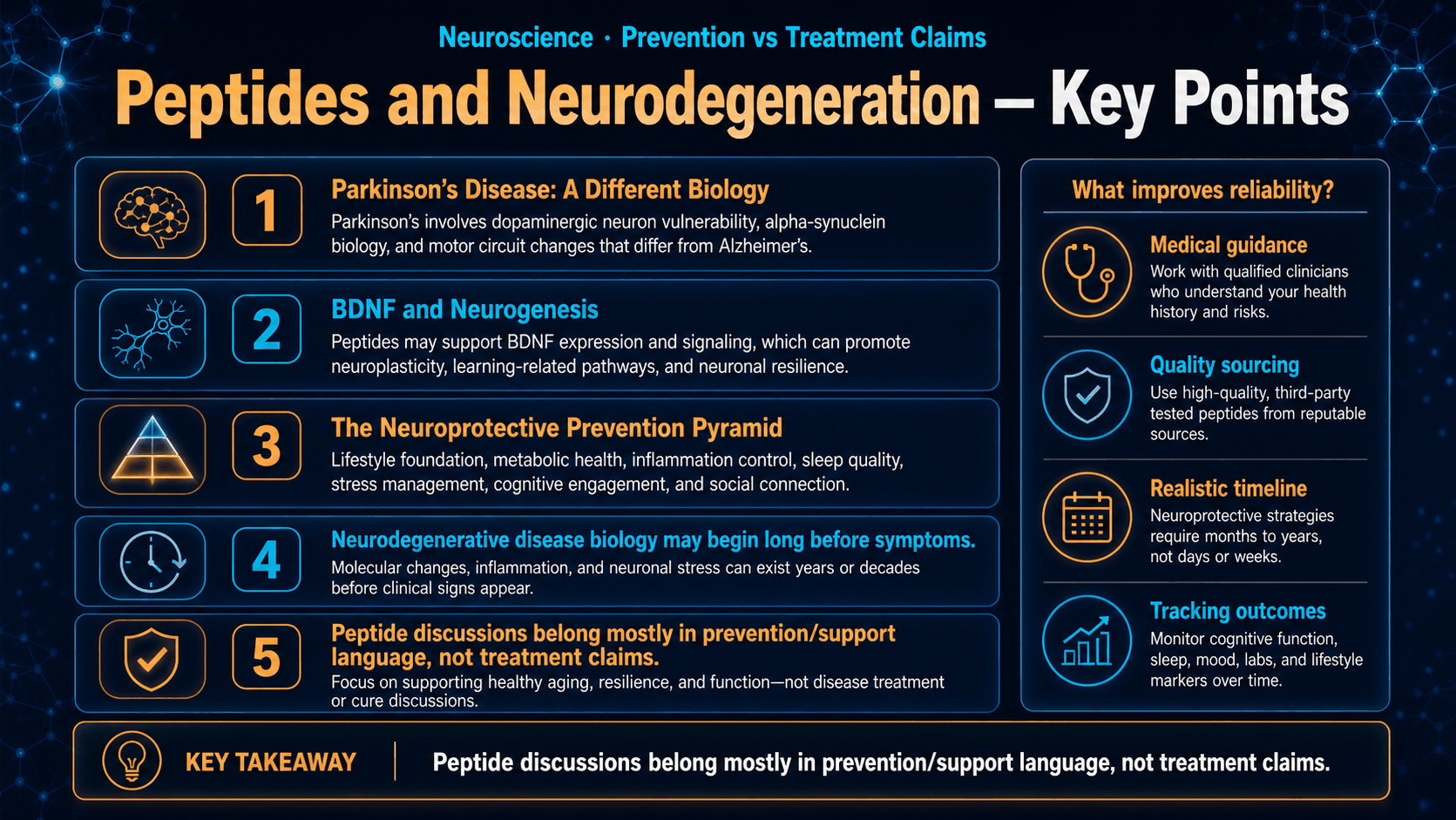
Parkinson’s disease involves loss of dopaminergic neurons in the substantia nigra and alpha-synuclein pathology. Standard treatment involves dopaminergic therapy and specialist management.
Peptide-related discussion
Semax may be discussed around general neurotrophic signaling. BPC‑157 may be discussed around neuroinflammation and gut-brain-axis mechanisms. GDNF is relevant to dopaminergic neurons, but it is a specialized research area.
Interesting, but not a protocol
Alpha-synuclein pathology is discussed in relation to the gut and nervous system. Gut-barrier and neuroinflammation mechanisms are interesting hypotheses, but hypotheses need studies. This is not a self-directed Parkinson’s protocol.
 Sponsored / AffiliateTeleWellnessMD · Telehealth wellness consultations and health optimization support
BDNF and Neurogenesis
BDNF, or brain-derived neurotrophic factor, is one of the key molecules involved in neuroplasticity and neuronal resilience. It is a major peptide-adjacent target because lifestyle and some peptide discussions may converge on this pathway.
Aerobic exercise
Exercise is one of the strongest non-peptide ways to support BDNF and neurovascular health.
Metabolic health
Insulin sensitivity, mitochondrial function, and vascular health support brain resilience.
Learning new skills
Novel learning and cognitive challenge support plasticity and cognitive reserve.
Semax discussion
Semax is discussed as a peptide-related BDNF-support layer, but not as treatment for Alzheimer’s or Parkinson’s disease.
The Neuroprotective Prevention Pyramid
- Aerobic exercise for BDNF, neurovascular health, and hippocampal support.
- Sleep quality for glymphatic clearance and cognitive consolidation.
- Mediterranean-style diet and polyphenol-rich foods for lower inflammatory burden.
- Stress management to reduce chronic cortisol load.
- Omega‑3 fatty acids for neuronal membrane and inflammation context.
- Vitamin D when deficient or clinically indicated.
- Polyphenols such as curcumin in inflammation and amyloid-context discussions.
- Magnesium threonate as a brain-health discussion point.
- Semax: BDNF and cerebral blood-flow discussion.
- Glycine: sleep quality and glymphatic context.
- BPC‑157: neuroinflammation and gut-brain-axis discussion.
- Epitalon: melatonin and circadian rhythm context.
- Memory complaints, tremor, rigidity, movement changes, or cognitive decline require evaluation.
- Mild cognitive impairment is not a DIY category.
- Peptides, if discussed, are adjunctive and clinician-guided.
Two Common Myths
Myth: Semax treats Alzheimer’s because BDNF restores neurons.
Fact: BDNF supports survival and plasticity of existing neurons. It does not resurrect dead cells. Semax may be discussed for support, not as a cure or reversal therapy.
Myth: Dementia is just aging, so nothing can be done.
Fact: Many dementia risk factors are modifiable: activity, metabolic health, blood pressure, sleep, hearing, social connection, education, smoking, and nutrition. Peptides may touch a few pathways, but prevention is much broader.
Frequently Asked Questions
Can peptides treat Alzheimer’s disease?
No. Peptides discussed here should not be presented as Alzheimer’s treatment or disease reversal.
Can peptides treat Parkinson’s disease?
No. Parkinson’s disease requires neurologist-led diagnosis and treatment. Peptide discussions are adjunctive and hypothetical in this context.
What is the strongest prevention foundation?
Aerobic exercise, sleep, metabolic health, vascular risk control, nutrition, stress management, and clinician-guided care.
Why is sleep important?
Sleep supports cognitive consolidation and glymphatic clearance, which is discussed in relation to metabolic waste clearance in the brain.
When should someone see a doctor?
Any persistent memory loss, confusion, tremor, rigidity, movement change, hallucination, personality change, or functional decline should be evaluated.
Key Takeaways
- Neurodegenerative disease biology may begin long before symptoms.
- Peptide discussions belong mostly in prevention/support language, not treatment claims.
- BDNF, neuroinflammation, sleep, glymphatic clearance, and gut-brain-axis mechanisms are relevant pathways.
- Semax, BPC‑157, glycine, and Epitalon should not be framed as Alzheimer’s or Parkinson’s cures.
- Exercise, sleep, metabolic health, and nutrition remain the base of prevention.
- Any cognitive or movement symptoms require neurologist evaluation.