
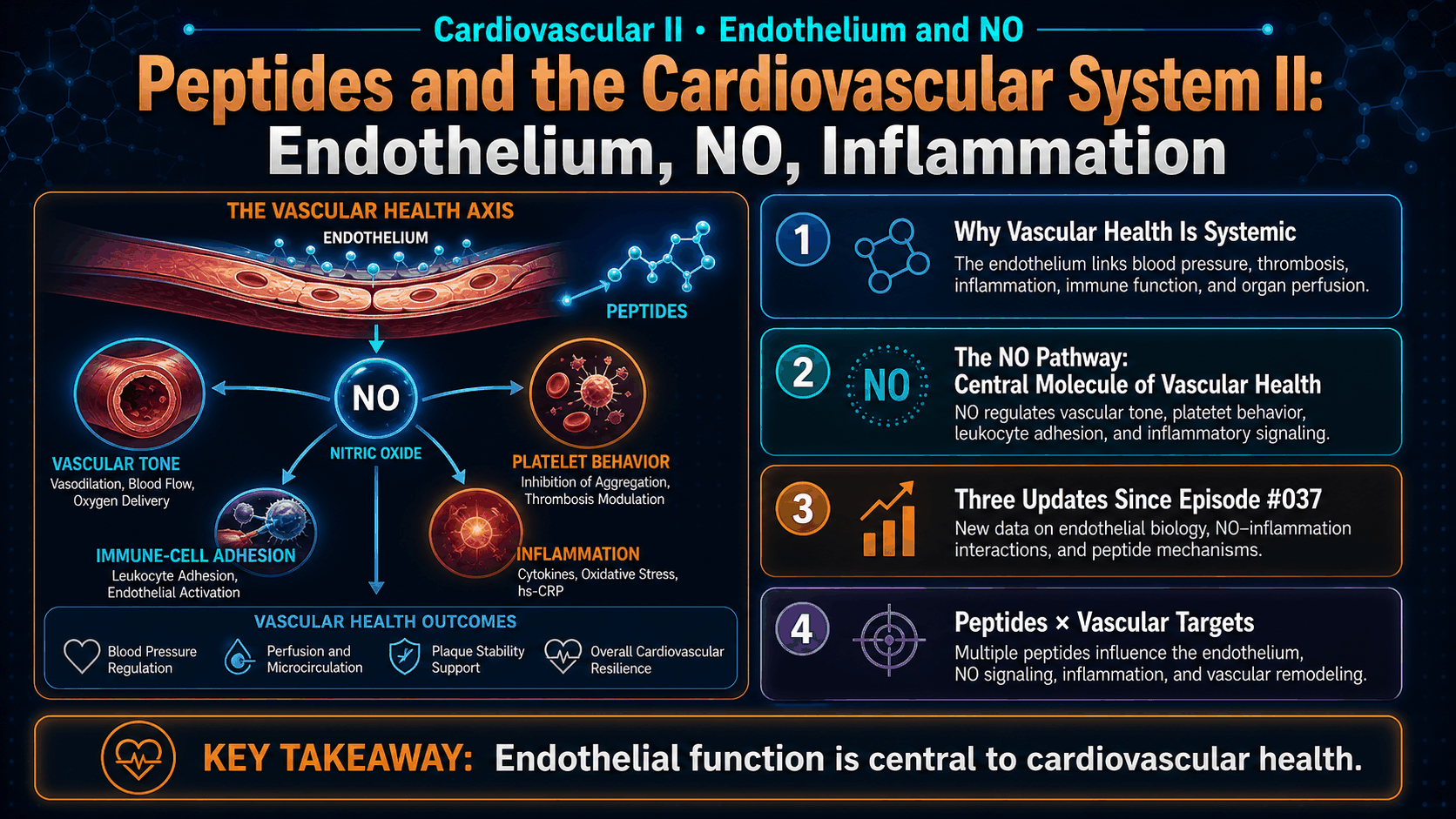
Why Vascular Health Is Systemic
The endothelium is not just a lining. It is an active vascular organ.
The endothelium helps regulate vascular tone, platelet behavior, immune-cell adhesion, clotting balance, inflammation, and blood-flow adaptation. When endothelial function declines, the risk of atherosclerosis, hypertension, erectile dysfunction, kidney vascular stress, and cardiovascular disease can rise.
The NO Pathway: Central Molecule of Vascular Health
Nitric oxide, or NO, is one of the central molecules of endothelial health. It helps vessels relax, reduces platelet aggregation, and supports anti-inflammatory vascular signaling.
L‑arginine
Amino-acid substrate from diet and endogenous metabolism.
eNOS
Endothelial nitric oxide synthase. BPC‑157 is discussed in relation to eNOS signaling.
Nitric oxide
NO supports vasodilation, anti-aggregation, and vascular homeostasis.
Vessels relax
Lower vascular tone, less platelet aggregation, and less immune-cell adhesion.
 Sponsored / AffiliatePeptide ReGenesis · Peptide education, protocols, and wellness-focused resources
Three Updates Since Episode #037
Insulin resistance → endothelium
Insulin resistance can impair endothelial signaling and reduce NO availability. Improving metabolic health through nutrition, exercise, sleep, weight management, and medical care indirectly supports vascular function.
Inflammaging → atherosclerosis
Chronic age-related inflammation contributes to endothelial dysfunction, immune-cell adhesion, foam-cell formation, and plaque biology. BPC‑157 is discussed in anti-inflammatory contexts, but it is not established atherosclerosis therapy.
ED as an early vascular signal
Erectile dysfunction can be an early sign of systemic endothelial dysfunction. This links urology and cardiology through the same vascular network.
Peptides × Vascular Targets
Endothelium and NO signaling
BPC‑157 is discussed in relation to eNOS signaling, nitric oxide regulation, endothelial protection, and inflammatory cytokine modulation. Animal ischemia-reperfusion models show interesting signals, but human cardiovascular outcome trials are lacking.
Cerebral blood-flow context
Semax is discussed around cerebral circulation, neurotrophic signaling, and neuroinflammation. It may have regional neurologic clinical contexts, but it is not a substitute for stroke emergency care or standard neurology treatment.
Angiogenesis and repair
TB‑500-related discussions often focus on angiogenesis, tissue remodeling, and progenitor-cell activity in preclinical models. This remains a research direction, not a clinical heart-repair protocol.
Circadian rhythm and nighttime BP
Epitalon is discussed in relation to pineal rhythm and melatonin context. Circadian rhythm may affect nighttime blood pressure patterns, but Epitalon is not antihypertensive therapy.
 Sponsored / AffiliatePeptide University · Peptide learning resources and educational programs
Inflammaging and Atherosclerosis
Atherosclerosis is not simply “fat deposited in the arteries.” It is also an inflammatory vascular process.
Endothelial dysfunction
The vessel wall becomes more reactive, less protective, and more permissive to inflammatory signaling.
Monocyte adhesion
Immune cells adhere to the endothelium and enter the vascular wall.
Foam-cell formation
Inflammatory and lipid processes combine, contributing to plaque biology.
Plaque progression and rupture risk
Inflammation can contribute to plaque instability, but peptide discussions are not a substitute for proven cardiology prevention.
The Cardiovascular Pyramid
Highest-evidence basics
- Aerobic exercise and zone‑2 conditioning.
- Mediterranean or whole-food plant-forward diet.
- No smoking or nicotine exposure.
- Blood pressure, LDL, glucose, and weight management.
- Stress and sleep regulation.
Nutrients and risk context
- Omega‑3 when appropriate.
- Vitamin D when deficient or clinically indicated.
- Nitrate-rich foods or L‑arginine context.
- CoQ10 discussion in selected contexts.
- Routine marker tracking with clinicians.
Adjunctive, lower-evidence layer
- BPC‑157: eNOS and inflammatory-cytokine context.
- Semax: cerebral circulation/neurologic context.
- Epitalon: circadian rhythm and nighttime BP context.
- TB‑500: preclinical repair and angiogenesis discussion.
Two Common Myths
Myth: BPC‑157 can restore the heart after a heart attack and replace cardiology procedures.
Fact: Animal model signals are not human heart-attack treatment. Chest pain, suspected heart attack, or stroke/TIA symptoms require emergency care.
Myth: Normal cholesterol means healthy vessels.
Fact: Vascular risk includes LDL, inflammation, blood pressure, glucose, endothelial function, smoking, stress, sleep, kidney function, and family history.
Frequently Asked Questions
Can peptides replace statins or antiplatelet therapy?
No. Peptides should not replace statins, antiplatelet therapy, anticoagulation, blood-pressure therapy, or cardiology procedures.
Is BPC‑157 proven to treat atherosclerosis?
No. It is discussed around inflammation and endothelial mechanisms, mainly from preclinical and mechanistic perspectives.
Why is nitric oxide important?
NO helps regulate vascular tone, platelet behavior, immune-cell adhesion, and endothelial function.
What should be checked before any cardiovascular peptide discussion?
Blood pressure, LDL/ApoB context, glucose, hs‑CRP, kidney function, medication list, history of clotting, arrhythmia, heart attack, stroke/TIA, and cardiology risk profile.
When is this an emergency?
Chest pain, shortness of breath, fainting, stroke-like symptoms, severe new weakness, facial droop, speech trouble, or sudden severe headache require urgent medical care.
Key Takeaways
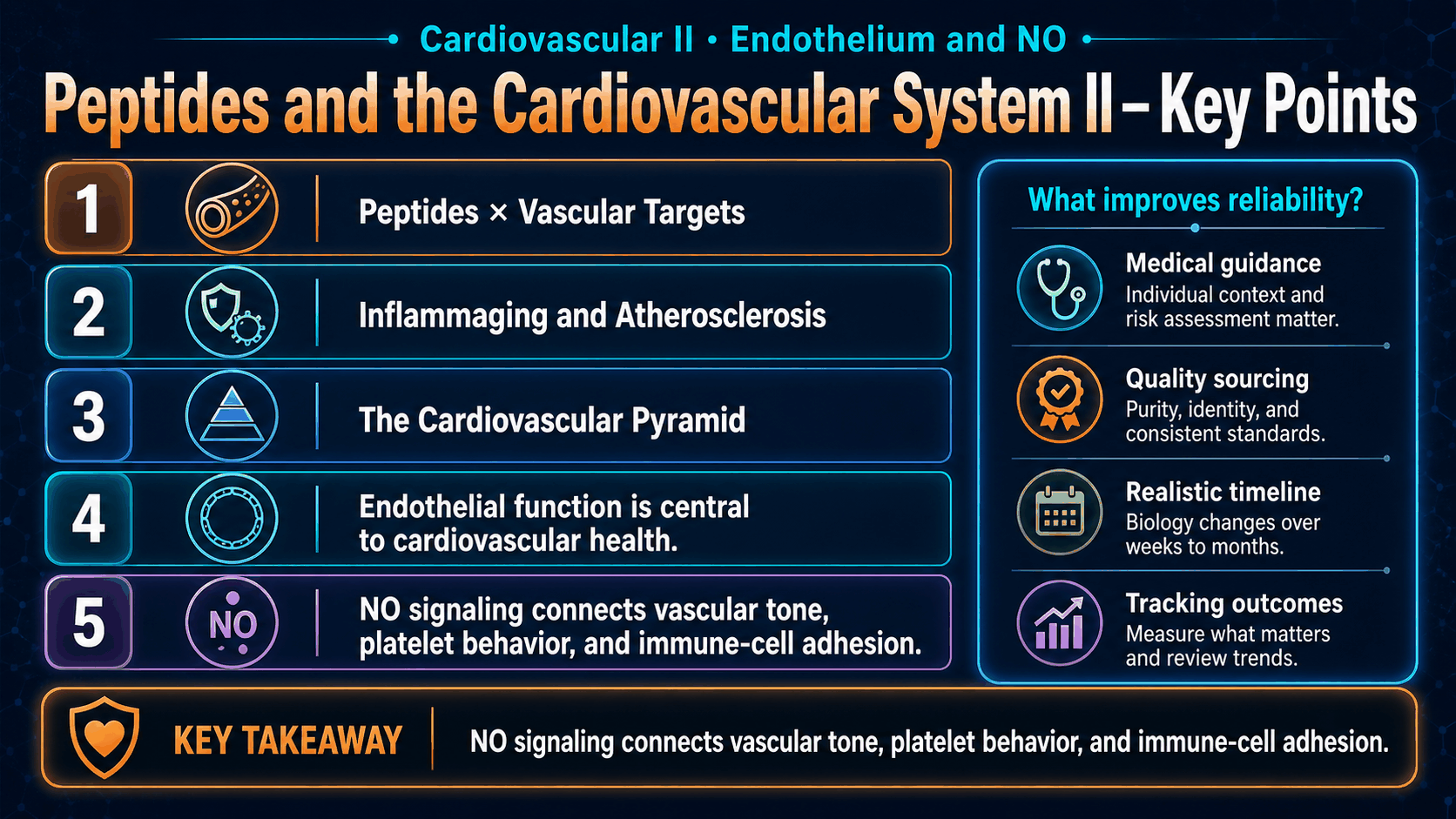
- Endothelial function is central to cardiovascular health.
- NO signaling connects vascular tone, platelet behavior, and immune-cell adhesion.
- Insulin resistance and inflammaging can damage endothelial function.
- BPC‑157, Semax, TB‑500, and Epitalon are discussed through different vascular-related mechanisms, but none replace cardiology care.
- hs‑CRP can reflect inflammatory risk context, but it is only one marker.
- In established disease, evidence-based therapy and clinician oversight come first.