
Why Oncology Is Different
Oncology is the topic where the cost of a wrong assumption is highest.
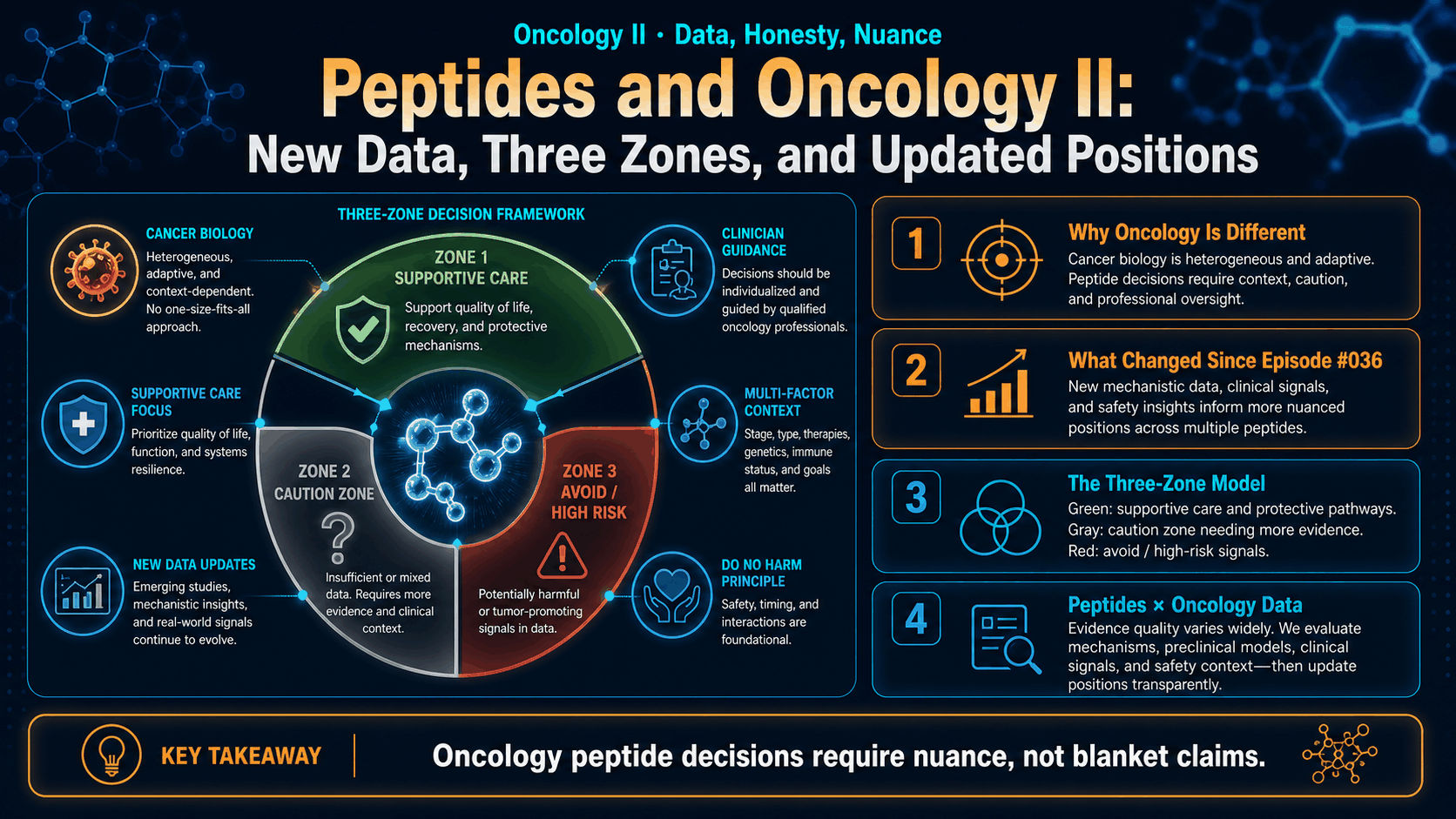
Peptides often touch pathways that may matter in cancer biology: growth signaling, angiogenesis, immune activation, tissue remodeling, inflammation, stem-cell behavior, and telomerase-related discussions. That does not mean every peptide is dangerous in every cancer-history context — but it does mean the decision cannot be casual.
What Changed Since Episode #036
Immunotherapy makes the picture more complex
Checkpoint inhibitors changed oncology. Thymosin alpha‑1 is discussed in adjunctive immune contexts, but this belongs inside clinical protocols or oncologist-supervised care — never self-treatment.
BPC‑157 needs nuance
During active malignant disease, angiogenesis-related concerns place BPC‑157 in the red-zone conversation. In remission, the question is more nuanced and depends on tumor type, time since remission, and oncologist input.
The gray zone is real
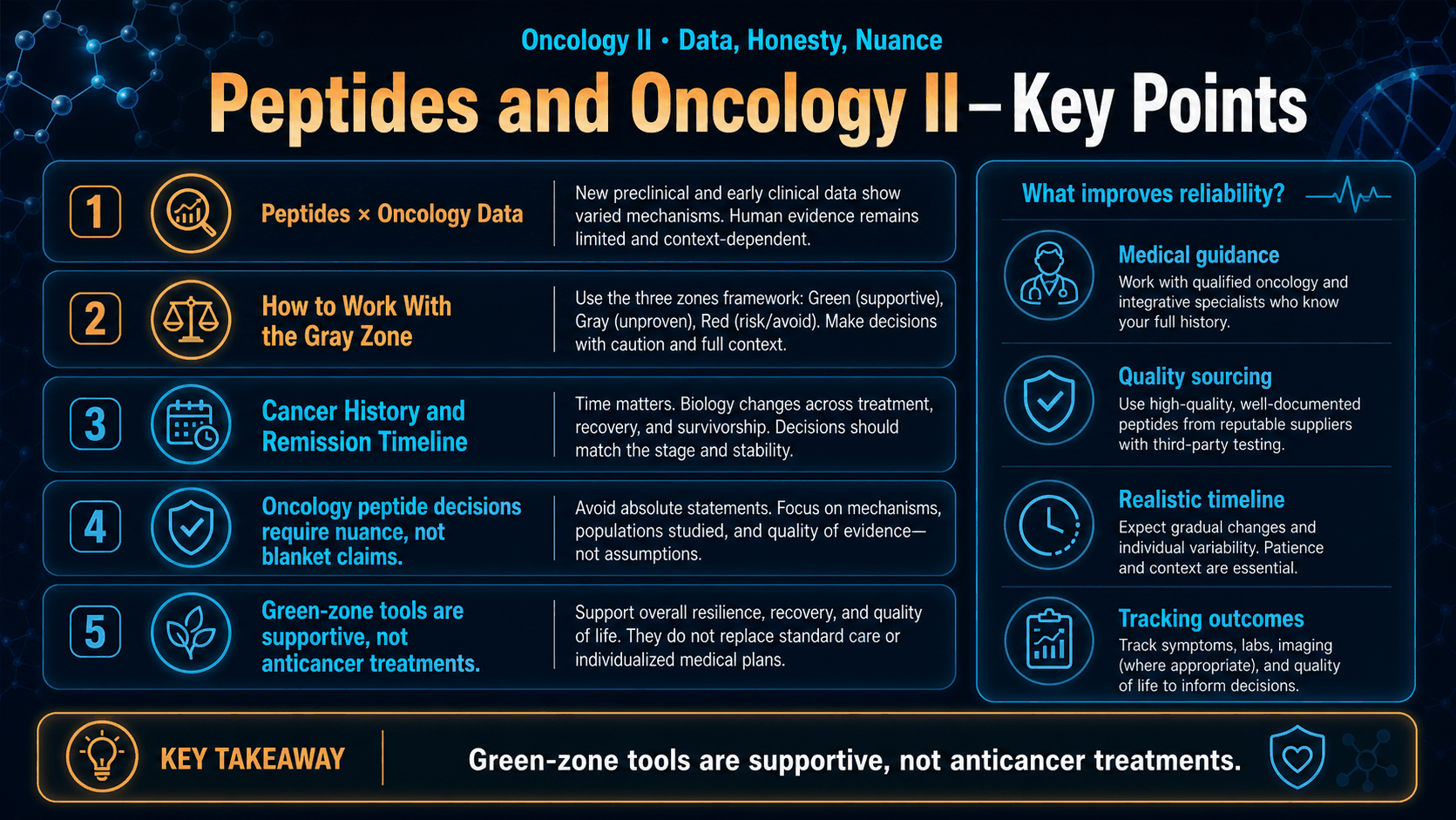
“Everything is forbidden” is not precise. “Everything is allowed in remission” is dangerous. The responsible answer is case-by-case oncology review.
 Sponsored / AffiliateMito Red Light · Red light therapy devices for recovery and wellness routines
The Three-Zone Model
🟢 Green zone
- Glycine — sleep-quality support context.
- Oral collagen I+III — protein support context.
- Omega‑3 — inflammation and cachexia-support discussion.
- Topical GHK‑Cu — skin-support context with minimal systemic exposure.
- Magnesium and vitamin D when clinically indicated.
- Thymosin α1 only when part of oncology protocol.
🟡 Yellow zone
- BPC‑157 in remission.
- Thymosin α1 outside immunotherapy protocols.
- Semax / Selank where oncology-specific data are limited.
- Thymalin in hematologic cancer history.
- Glycine in pancreatic-cancer context.
🔴 Red zone
- GH secretagogues during active cancer.
- BPC‑157 during active tumor due to angiogenesis concern.
- TB‑500 during active cancer due to remodeling/stem-cell concerns.
- Epitalon where telomerase concern is relevant.
- Any peptide hidden from the oncologist.
Peptides × Oncology Data
Most oncology-relevant peptide discussion
Thymosin alpha‑1 has been studied in immune-support and oncology-adjacent contexts, including adjunctive discussions around immunotherapy. But this belongs in protocols, trials, or oncologist-supervised care.
Dual picture
In active cancer, angiogenesis concerns make it inappropriate. In GI-injury support contexts, it is theoretically interesting but not established in oncology patients. In remission, it is a case-by-case question.
Red-zone concern
IGF‑1 signaling is growth-related in many malignancy contexts. Raising IGF‑1 through secretagogues may be theoretically problematic, especially in hormone-sensitive or active cancers.
Supportive nutrient context
Omega‑3 is better framed as a supportive nutrient discussed around inflammation, nutritional status, and cachexia context. It is not anticancer treatment.
 Sponsored / AffiliateIntegrative Peptides · Practitioner-oriented peptide and wellness education
How to Work With the Gray Zone
Define the actual clinical zone
Active cancer or remission? Which tumor type? Which treatment is ongoing? What is the recurrence risk?
Ask the oncologist a specific question
Do not ask, “Can I use peptides?” Ask about the exact product, route, mechanism, concern, and your personal cancer history.
Start with the green zone
Quality-of-life tools such as sleep support, omega‑3, magnesium, topical skin support, and nutrition may be more appropriate first-layer discussions.
Cancer History and Remission Timeline
Maximum caution
Green-zone support only unless the oncologist explicitly approves a specific tool.
Gray zone may be discussable
Some yellow-zone items may be discussable, depending on tumor type, therapy, recurrence risk, and surveillance plan.
Context may be softer
Some restrictions may become less strict, but GH secretagogues, Epitalon, and TB‑500 still require oncology review.
Red zone stays red
Active cancer, hormone-sensitive tumor pathways, immune therapy, and growth signaling require strict medical oversight.
Special high-caution cases
- Hormone-sensitive tumors such as ER+ breast cancer or prostate cancer.
- Lymphomas and leukemias: immune peptides only with hematologist/oncologist guidance.
- Neuroendocrine tumors: GH secretagogues are especially problematic.
- Any unclear mass, unexplained weight loss, bleeding, lymph-node change, or suspicious symptom requires evaluation.
Two Common Myths
Myth: Peptides strengthen immunity, so they should help with cancer.
Fact: Cancer immunity is not simply “stronger is better.” Tumors evade immune surveillance through complex mechanisms. Non-specific immune stimulation can be unpredictable.
Myth: Seven years of remission means all peptide restrictions are gone.
Fact: Long remission changes risk context, but it does not erase tumor biology, hormone-sensitive risk, surveillance needs, or the need to discuss growth-related pathways with oncology.
Frequently Asked Questions
Can peptides treat cancer?
No. This article does not present peptides as cancer treatment, immunotherapy replacement, chemotherapy support protocol, or anticancer therapy.
Is BPC‑157 safe after cancer?
It depends on the cancer type, remission duration, recurrence risk, and oncologist’s view. It belongs in the yellow-zone conversation, not a blanket “yes.”
Why are GH secretagogues risky?
They may raise GH/IGF‑1 signaling, which is growth-related in many malignancy contexts. This is especially concerning in active or hormone-sensitive cancer contexts.
What is the safest support layer?
Often the green zone: sleep support, nutrition, omega‑3 context, magnesium, vitamin D when indicated, topical skin support, and clinician-approved quality-of-life tools.
Should the oncologist know about supplements and peptides?
Yes. Especially during active treatment, remission surveillance, immunotherapy, hormone therapy, or targeted therapy.
Key Takeaways
- Oncology peptide decisions require nuance, not blanket claims.
- Green-zone tools are supportive, not anticancer treatments.
- Yellow-zone tools require oncologist-specific discussion.
- Red-zone tools should not be used in active cancer contexts.
- Remission duration matters, but tumor type matters too.
- Hormone-sensitive and hematologic cancers require special caution.
- No peptide should be hidden from the oncology team.