
Why Sleep Became the Central Theme
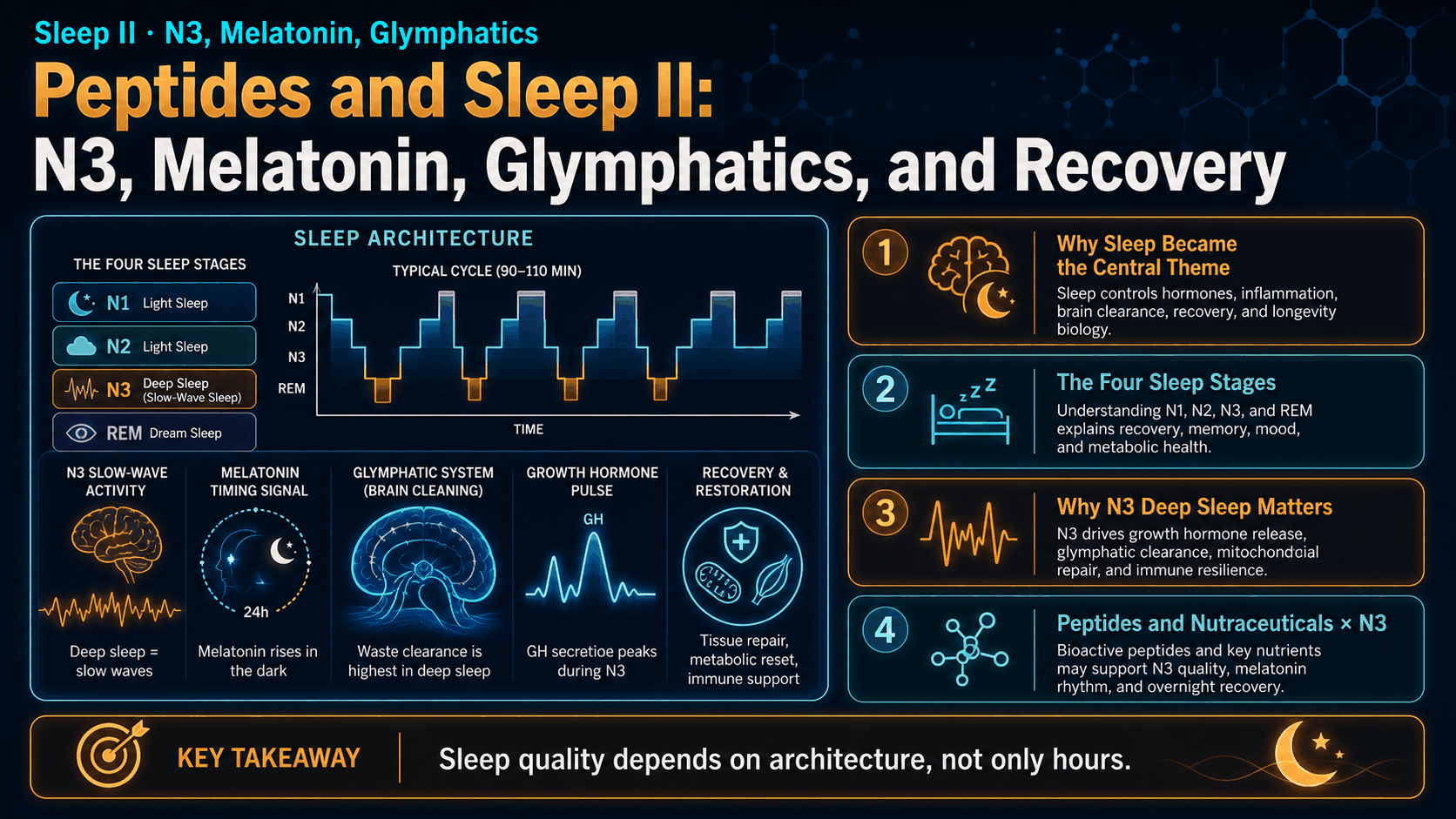
Sleep connects hormones, immunity, brain clearance, recovery, stress, and metabolism.
Across the peptide series, sleep keeps returning: growth hormone pulses, glymphatic clearance, post-viral recovery, neuroinflammation, cortisol rhythm, melatonin, and circadian repair. The updated view is simple: “more sleep” is not always enough. The structure of sleep matters.
The Four Sleep Stages
Falling asleep
Transition stage with easy awakenings, muscle twitches, and initial slowing of heart rate and temperature.
Light sleep
Sleep spindles and K-complexes appear. Memory processing and body-temperature decline are relevant here.
Deep sleep
The main target: growth-hormone pulse, glymphatic clearance, immune rhythm support, and physical recovery.
Dream sleep
REM supports emotional processing, procedural memory, creative association, and intense brain activity.
 Sponsored / AffiliateIntegrative Peptides · Practitioner-oriented peptide and wellness education
Why N3 Deep Sleep Matters
Someone can spend eight hours in bed and still wake up tired if deep sleep is low, fragmented, or suppressed by alcohol, caffeine, stress, sleep apnea, or poor circadian timing.
Recovery pulse
A major part of daily growth-hormone secretion is linked with early-night slow-wave sleep. This is why GH-secretagogue discussions focus on N3.
Glymphatic activity
Deep sleep is discussed in relation to glymphatic clearance, beta-amyloid removal, and long-term brain-health support.
Nightly immune rhythm
Deep sleep is connected with immune regulation, cytokine timing, and immune memory formation.
Tissue recovery
Training adaptation, musculoskeletal recovery, and metabolic restoration all depend on sleep architecture, not just hours.
Peptides and Nutraceuticals × N3
| Tool | Mechanism discussed | Possible N3 relevance | Evidence / caution |
|---|---|---|---|
| Glycine | May support body-temperature drop and sleep quality. | N2/N3 support context. | Human sleep-quality data; generally discussed as a basic support tool. |
| Ipamorelin | GH-secretagogue discussion linked with N3 timing. | Recovery and GH-pulse context. | Advanced layer; clinician guidance and glucose/IGF-1 context matter. |
| Epitalon | Circadian and melatonin-context discussion. | Circadian support context. | Limited/specialized data; not a sleeping pill. |
| Magnesium glycinate | Reduced nighttime excitability and NMDA context. | May support depth and fewer awakenings. | Common sleep-support tool; individual tolerance matters. |
| Melatonin | Chronobiological signal. | Helps signal biological night. | Timing and context matter; more is not always better. |
| L-theanine | Relaxation and alpha-wave discussion. | Subjective calm / sleep quality context. | Supportive, not a fix for underlying sleep disorders. |
| Alcohol | May speed sleep onset through sedation. | Can disrupt deep sleep and REM later. | Strong reason to avoid as a sleep tool. |
| Late caffeine | Adenosine-receptor blockade. | Can reduce sleep depth and delay sleep. | Timing is critical. |
 Sponsored / AffiliateApollo Peptide Sciences · Research-focused peptide science and molecular data
Common Sleep Problems and Support Strategies
Difficulty falling asleep
Often linked with evening stress, sympathetic activation, late light, late exercise, or caffeine. Selank is discussed around stress-axis regulation; magnesium around nighttime excitability. Light and routine control come first.
Light sleep / low N3
Possible drivers include stress, alcohol, warm room, untreated sleep apnea, inconsistent timing, and magnesium status. Glycine is one of the more practical sleep-quality tools.
Circadian disruption
Shift work, irregular sleep timing, late light, and non-dipper blood-pressure patterns may reflect circadian misalignment. Melatonin is a timing signal, not general sedation.
Early awakenings
May occur with aging, stress, depression, anxiety, alcohol, apnea, or circadian shifts. Persistent awakenings need evaluation, not only supplements.
Full Night Recovery Framework
Behavior before peptides
- Consistent bedtime and wake time.
- Dim light and blue-light control in the evening.
- Cool bedroom temperature.
- No notifications or disruptive noise.
- Avoid alcohol close to bedtime.
- Avoid late caffeine and intense late-night exercise.
Nutraceutical and timing support
- Glycine for temperature and sleep-quality context.
- Magnesium glycinate for nighttime excitability context.
- Melatonin only when circadian timing is the issue.
- Selank discussion when evening stress/anxiety is the main trigger.
Clinician-guided peptide discussion
- Ipamorelin or GH-secretagogue discussion requires safety context.
- Glucose, IGF‑1, cancer history, and medical risk matter.
- Epitalon is discussed around circadian rhythm and melatonin context.
- Advanced tools should not compensate for untreated apnea, alcohol, or late caffeine.
Two Common Myths
Myth: Ipamorelin will improve sleep by itself if taken at night.
Fact: It is discussed around the GH pulse linked with N3. If N3 is poor, the return may be weak because the sleep architecture itself is not optimized.
Myth: Melatonin is a sleeping pill, so higher doses are better.
Fact: Melatonin is mainly a biological timing signal. More is not always better, timing matters, and persistent insomnia needs evaluation.
Frequently Asked Questions
Is N3 more important than total sleep time?
Both matter. Total sleep time creates opportunity, but deep-sleep quality strongly influences recovery, glymphatic activity, and growth-hormone pulse context.
Can peptides fix sleep apnea?
No. Sleep apnea requires medical evaluation and appropriate treatment. Supplements or peptides should not be used to bypass apnea care.
Is melatonin safe for everyone?
No tool is universal. Melatonin can interact with medications and may not address the cause of insomnia. Timing, dose, age, and clinical context matter.
Are wearables accurate for N3?
Wearables are useful for trends, not perfect sleep-stage diagnosis. They are not a substitute for polysomnography when a sleep disorder is suspected.
What should be checked first?
Sleep schedule, caffeine/alcohol timing, light exposure, stress, medications, apnea risk, restless legs, mood symptoms, and medical conditions.
Key Takeaways
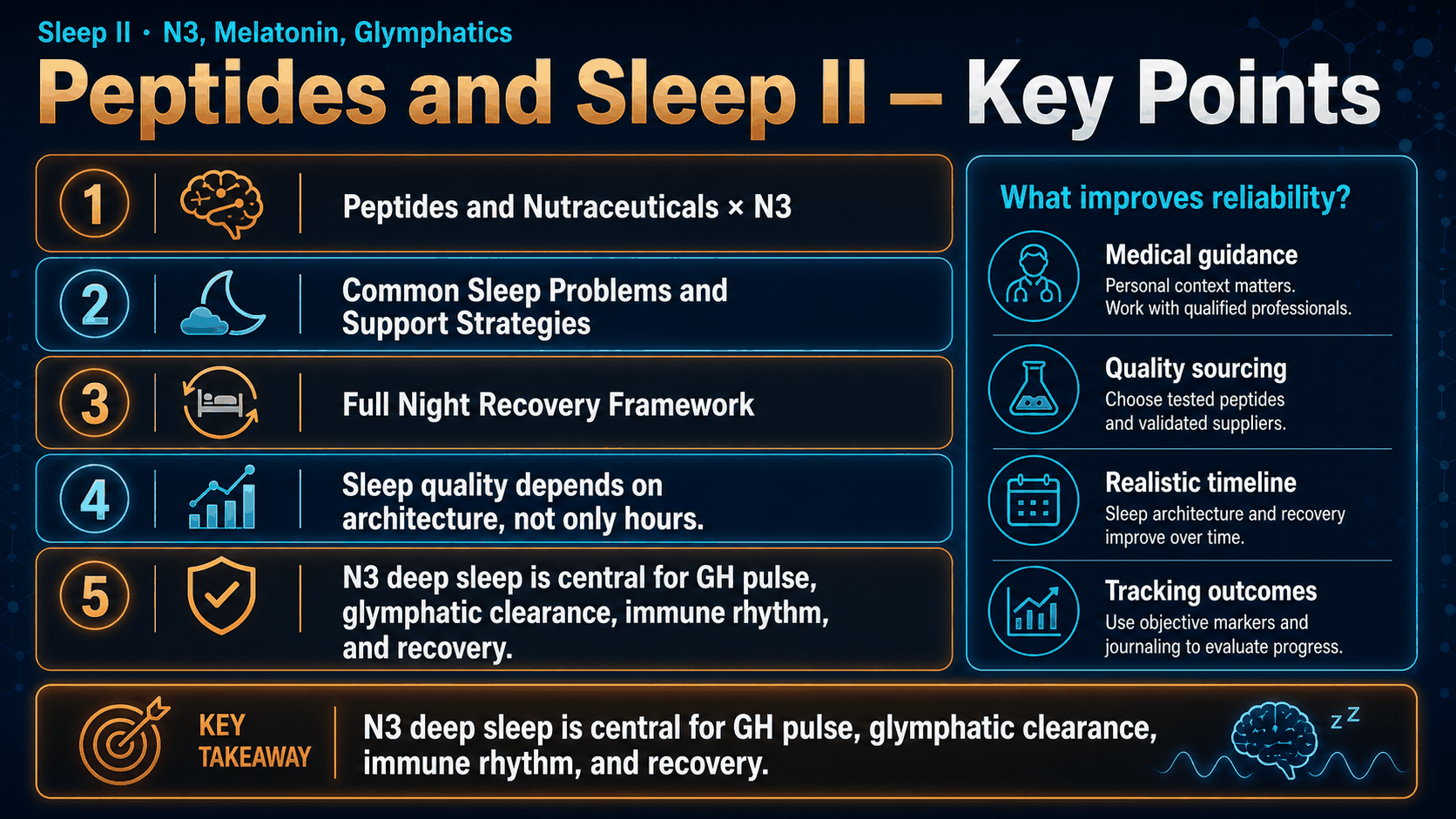
- Sleep quality depends on architecture, not only hours.
- N3 deep sleep is central for GH pulse, glymphatic clearance, immune rhythm, and recovery.
- Glycine and magnesium belong in the basic sleep-support layer.
- Melatonin is a timing signal, not a general sleeping pill.
- Ipamorelin and Epitalon belong in the advanced, clinician-guided discussion layer.
- Untreated sleep apnea, late caffeine, alcohol, and poor light timing can overpower most advanced tools.