
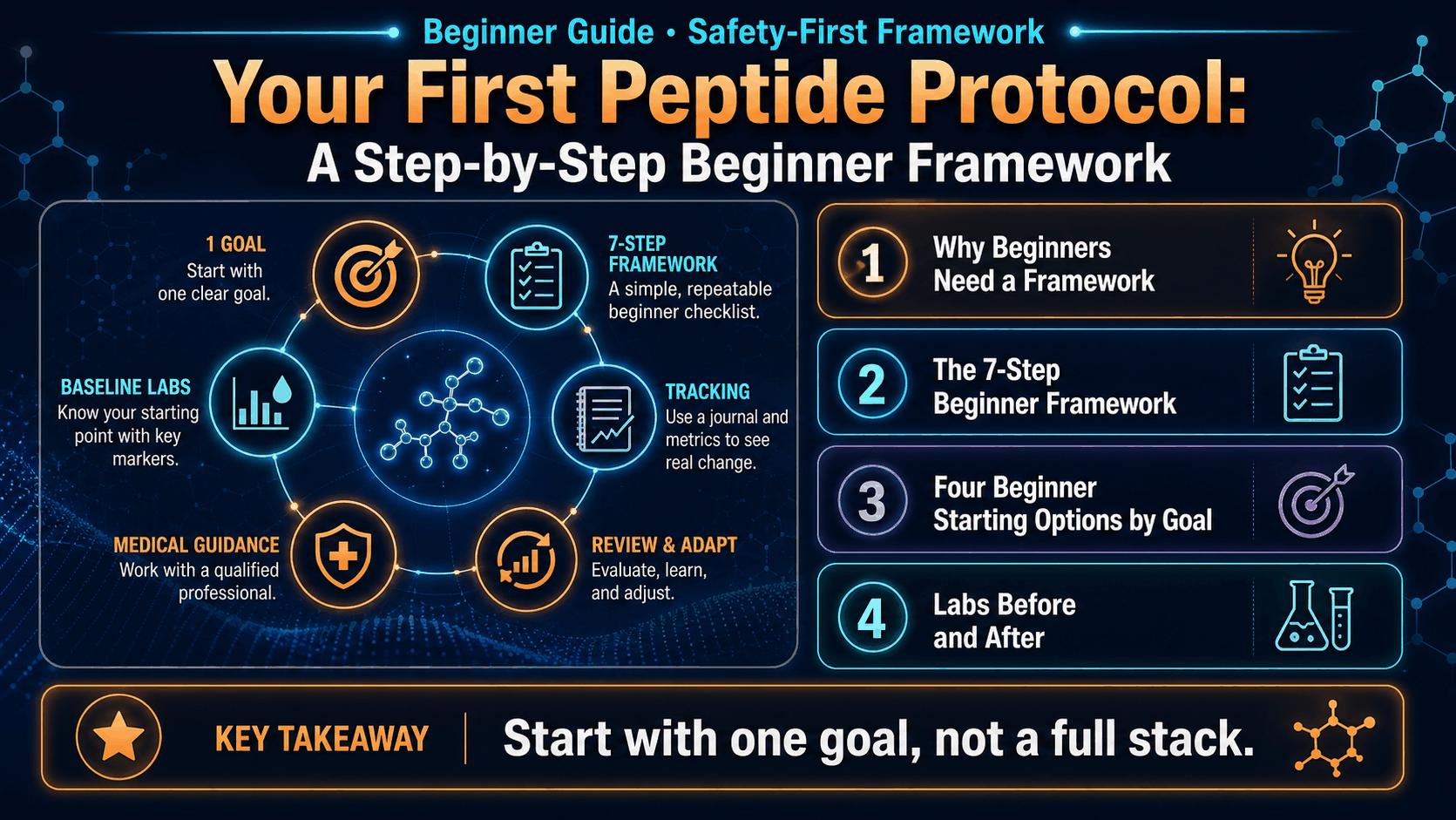
Why Beginners Need a Framework
The biggest beginner mistake is not “starting too small.” It is starting with too many variables.
When several peptides, supplements, lifestyle changes, and training changes begin at the same time, you cannot tell what helped, what did nothing, and what caused a side effect. A first protocol should be deliberately simple.
The 7-Step Beginner Framework
Define one specific goal
Choose one primary outcome: joint comfort, sleep, cognition, recovery, skin, or inflammation tracking. One goal makes the result interpretable.
Get baseline labs
Baseline markers create a “before” picture. Testing should be selected with a clinician, especially if chronic disease, medications, hormone issues, autoimmune disease, or cancer history are involved.
Choose one beginner starting option
Pick the option that matches the goal. Avoid stacking several peptides from day one. Start narrow and evaluate clearly.
Prepare handling and storage basics
Use sterile supplies, appropriate storage, clear labels, and product-specific instructions. Do not use products with unclear identity or questionable quality.
Confirm concentration and instructions
Concentration and dosing errors are common. Do not guess. Use pharmacy, clinician, or product-label instructions and write identity, concentration, dates, and discard window clearly.
Learn administration from a qualified professional
This article is not injection training. If an injectable product is prescribed, learn proper technique from a clinician, nurse, pharmacist, or authorized trainer.
Track results and review
Use a weekly journal: symptoms, sleep, energy, side effects, training, stress, illness, and adherence. Repeat relevant markers at the review window.
 Sponsored / AffiliatePeptide ReGenesis · Peptide education, protocols, and wellness-focused resources
Four Beginner Starting Options by Goal
Labs Before and After
Baseline markers
- CBC with differential.
- ALT and AST for liver enzyme context.
- Creatinine and BUN for kidney-function context.
- hs-CRP for systemic inflammation trend.
- TSH for thyroid-screening context.
- Goal-specific markers selected with a clinician.
- IGF-1 if GH-axis products are being discussed.
Review markers
- Repeat the same key markers.
- Compare against baseline, not memory.
- Document side effects and timing.
- Repeat subjective scores from Day 0.
- Review body composition if relevant.
- Decide: continue, pause, adjust, or stop.
 Sponsored / AffiliateMito Red Light · Red light therapy devices for recovery and wellness routines
Safe Administration Concepts — Not a How-To
Many prescribed injectable products use small needles and may be minimally uncomfortable when handled correctly. But “minimally uncomfortable” does not mean “safe to improvise.”
Safety checklist
- Verify product identity, label, concentration, expiration, and storage.
- Use sterile single-use supplies only.
- Never reuse needles or syringes.
- Do not use damaged, cloudy, contaminated, expired, or unclear products.
- Learn technique from qualified professionals.
- Document product, date, reaction, and any symptoms.
- Stop and seek help with rash, swelling, breathing difficulty, fever, severe pain, or systemic symptoms.
Two Common Myths
Myth: I should start with a full stack right away.
Fact: Starting several products together makes interpretation impossible. One goal and one starting option is smarter.
Myth: More is better.
Fact: More can increase side effects, obscure results, and push markers outside safe ranges. Work within professional guidance and safety monitoring.
Frequently Asked Questions
What is the best first peptide?
There is no universal best first peptide. The right starting point depends on the goal, health status, medications, legal access, and clinical supervision.
Can I start several peptides at once?
It is not ideal for beginners. Multiple variables make results and side effects difficult to interpret.
Do I really need labs?
Baseline labs are the difference between guessing and tracking. Marker choice should be individualized with a clinician.
Is injection technique covered here?
No. This article only covers safety concepts. Technique should be taught by a qualified professional.
When should a protocol stop?
Stop and reassess with concerning symptoms, worsening safety markers, unclear product identity, contamination concerns, or lack of benefit after an appropriate review window.
Key Takeaways
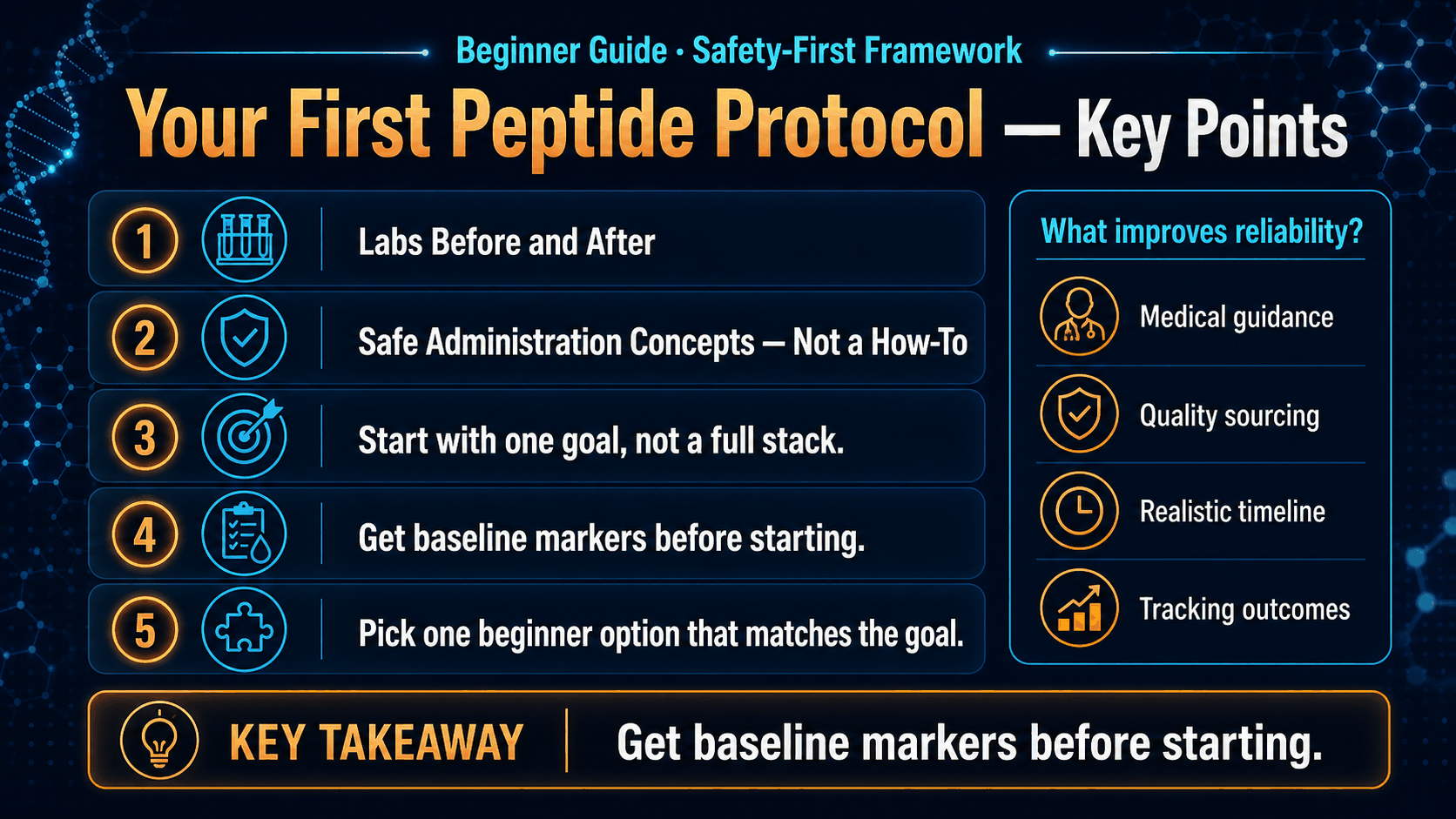
- Start with one goal, not a full stack.
- Get baseline markers before starting.
- Pick one beginner option that matches the goal.
- Use only clear product labeling, sterile handling, and professional instructions.
- Do not improvise injectable administration.
- Track weekly and repeat relevant markers at the review window.
- A smart protocol is one you can evaluate safely.