
Why Aging Science Changed
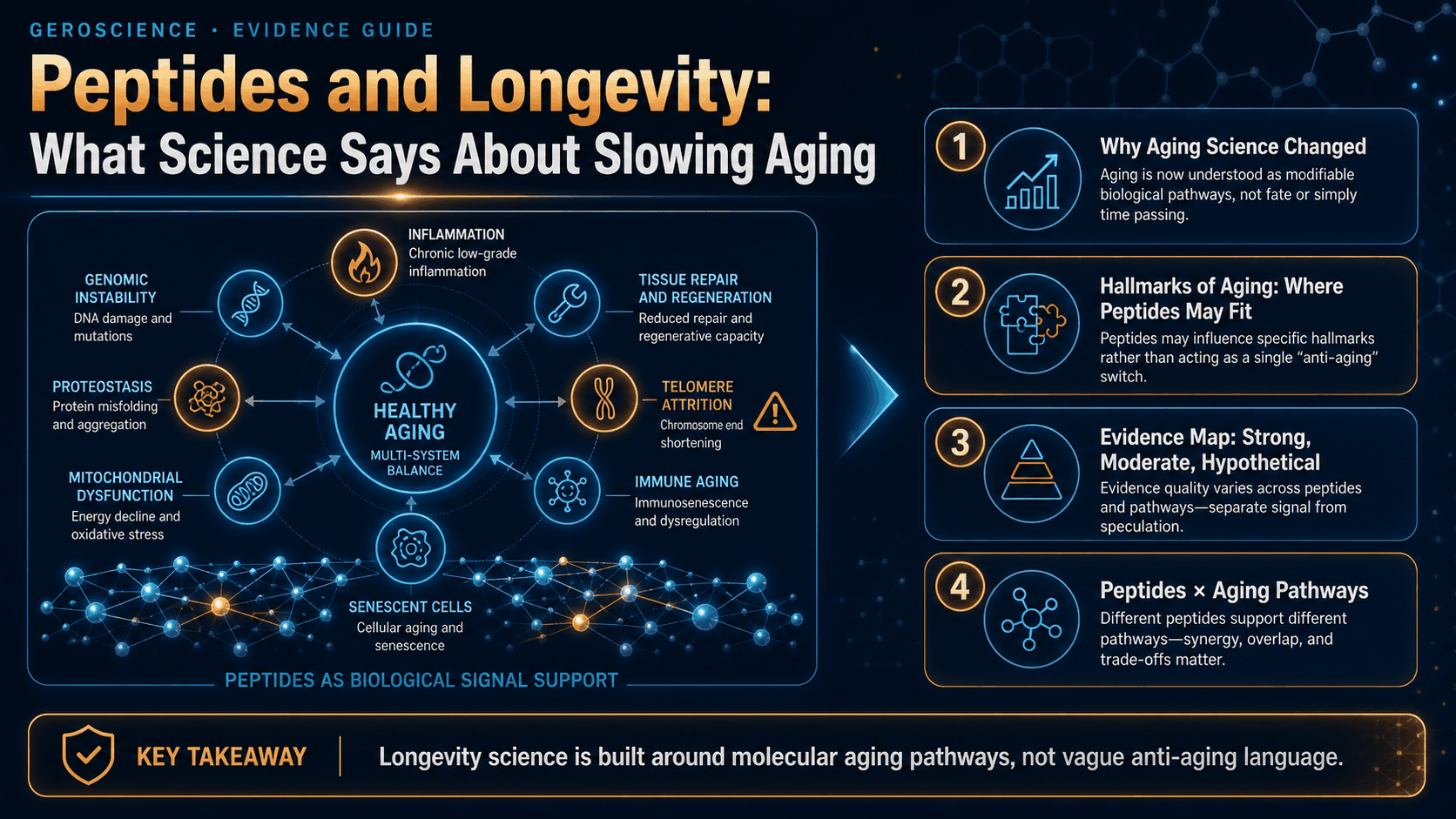
Modern geroscience treats aging as a set of measurable biological processes, not just vague “wear and tear.”
In 1993, Cynthia Kenyon’s work in C. elegans helped popularize the idea that lifespan could be strongly influenced by specific biological pathways. Later, the “Hallmarks of Aging” framework gave researchers a shared map: genomic instability, telomeres, nutrient sensing, mitochondrial dysfunction, senescence, chronic inflammation, and more.
Hallmarks of Aging: Where Peptides May Fit
Genomic Instability
GHK-Cu is discussed in relation to DNA repair gene expression and transcriptional effects.
Telomere Attrition
Epitalon is often discussed around telomerase in vitro, but human clinical proof remains limited.
Epigenetic Alterations
GHK-Cu is discussed as potentially shifting gene-expression profiles in a more youthful direction.
Loss of Proteostasis
Autophagy helps clear cellular waste. Fasting and sleep rhythm are stronger foundations than peptide claims here.
Nutrient Sensing
mTOR, AMPK, and sirtuins are major longevity sensors. Time-restricted eating and exercise remain central.
Mitochondrial Dysfunction
GH/IGF-1 axis intersects with muscle and mitochondrial biology, but context and monitoring matter.
Cellular Senescence
BPC-157 is sometimes discussed through inflammatory cytokine modulation, not as a proven senolytic.
Stem-Cell Exhaustion
TB-500 is discussed around progenitor-cell activity and tissue remodeling, mostly in preclinical contexts.
Chronic Inflammation
Inflammaging may be the most relevant peptide-adjacent longevity pathway for BPC-157 and TB-500 discussions.
 Sponsored / AffiliateTeleWellnessMD · Telehealth wellness consultations and health optimization support
Evidence Map: Strong, Moderate, Hypothetical
Inflammaging
BPC-157, TB-500, omega-3, and anti-inflammatory nutrition are discussed around IL-6, TNF-alpha, NF-kB, and hs-CRP trends. This is still not proof of lifespan extension.
Neuroendocrine Rhythm
Epitalon is often framed around pineal rhythm and melatonin context. Sleep and circadian consistency remain the high-impact foundation.
Telomeres
Telomerase activation in vitro is not the same as clinically meaningful telomere extension or longer human lifespan.
GH / IGF-1 Axis
GH-axis support may relate to sarcopenia and recovery, but excessive IGF-1, insulin resistance, sleep disruption, and cancer-risk context require caution.
Peptides × Aging Pathways
| Peptide / intervention | Aging pathway | Mechanism discussed | Evidence level |
|---|---|---|---|
| BPC-157 | Inflammation / inflammaging | TNF-alpha, IL-6, NF-kB and inflammatory signaling discussions | ★★★★☆ Preclinical / mechanistic |
| GHK-Cu | Genomic instability · Epigenetics | DNA repair gene expression and transcriptional profile discussions | ★★★★☆ Gene-expression data |
| Epitalon | Telomeres · Neuroendocrine rhythm | Telomerase discussion in vitro · melatonin/circadian rhythm context | ★★★☆☆ Melatonin context stronger; telomeres debated |
| TB-500 | Stem-cell exhaustion · Inflammation | Progenitor-cell activity, tissue remodeling, fibrosis and NF-kB discussions | ★★★☆☆ Mostly preclinical |
| Thymalin / Thymosin α1 | Immune aging | T-cell and NK-cell support discussions; thymic-function context | ★★★☆☆ Regional clinical literature |
| Semax | Neurodegeneration / neuroinflammation | BDNF, neurotrophic signaling, neuroprotection discussions | ★★★☆☆ Neurologic context, not lifespan proof |
| Ipamorelin | Mitochondrial function · Sarcopenia | GH/IGF-1 axis, muscle maintenance, recovery and metabolic context | ★★★☆☆ IGF-1 measurable; longevity proof absent |
| Intermittent fasting | mTOR · AMPK · Autophagy | mTOR down, AMPK up, autophagy support and metabolic switching | ★★★★★ Stronger evidence base than most peptide claims |
 Sponsored / AffiliateUlta Lab Tests · Lab testing for hormones, inflammation, and wellness
What Peptides Definitely Do Not Prove Yet
No peptide in this series has shown human lifespan extension in high-quality randomized controlled trials. Animal data and cellular data are not the same as human mortality outcomes.
The honest wording is: peptides may influence some aging-related pathways. Whether those changes translate into longer life in humans is still unknown.
The Longevity Pyramid
Lifestyle with the strongest evidence
- Aerobic exercise and VO2max support.
- Resistance training for muscle and insulin sensitivity.
- Sleep 7–8 hours and circadian consistency.
- Mediterranean or whole-food plant-forward diet.
- Time-restricted eating where appropriate.
Supportive, not magical
- Omega-3 for cardiovascular and inflammatory context.
- Vitamin D when deficient or clinically appropriate.
- Magnesium for sleep and metabolic enzyme support.
- Protein adequacy for muscle preservation.
Only after the base is built
- Epitalon: pineal/melatonin rhythm discussion.
- Thymalin/thymosin context: immune-aging discussion.
- BPC-157: inflammaging, joints, gut-barrier discussion.
- GH secretagogues: sarcopenia and IGF-1 context.
- Topical GHK-Cu: skin and gene-expression discussion.
Two Common Myths
Myth: Peptides are a biohacker alternative to a healthy lifestyle.
Fact: Peptides may affect some of the same pathways as exercise, nutrition, and sleep — but more narrowly. They do not replace the basics.
Myth: If the mechanisms are real, lifespan extension is basically proven.
Fact: Medicine is full of examples where a real mechanism did not produce the expected clinical outcome. Mechanism does not equal lifespan extension.
Frequently Asked Questions
Do peptides extend human lifespan?
No peptide discussed here has proven human lifespan extension in high-quality randomized controlled trials.
Which peptide pathway is most relevant to longevity?
Inflammaging is one of the most relevant peptide-adjacent pathways, especially for BPC-157/TB-500 discussions, but it is not proof of longer life.
Is Epitalon proven to lengthen telomeres in humans?
Strong human proof is lacking. Telomerase and telomere claims should be framed as early or debated, not established anti-aging therapy.
Is GHK-Cu more evidence-based?
GHK-Cu has interesting gene-expression and skin-related data, but gene-expression effects are not the same as proven lifespan extension.
What should come before peptides?
Exercise, sleep, nutrition, body composition, blood pressure, glucose control, inflammation control, and clinically guided risk reduction.
Key Takeaways
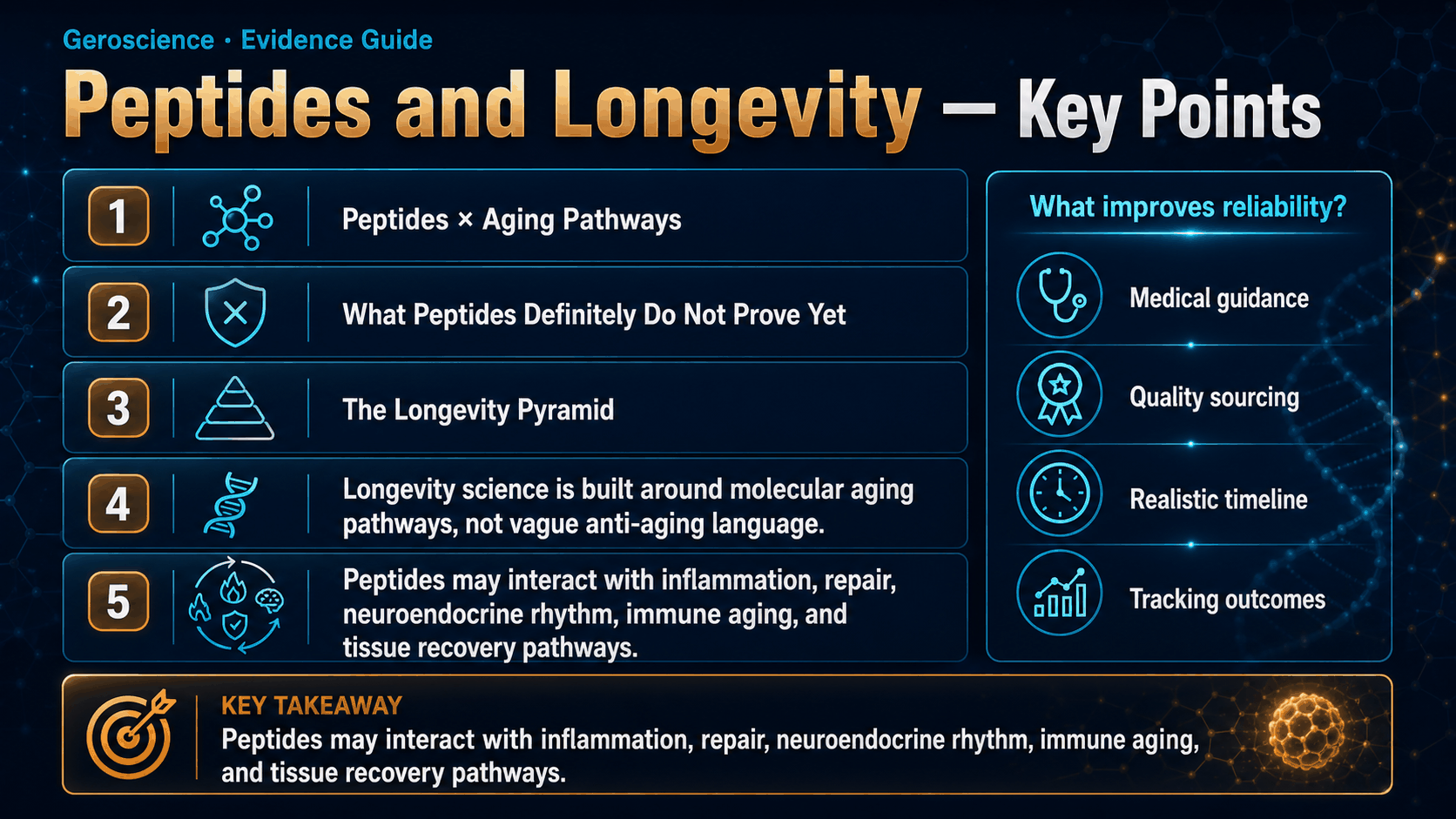
- Longevity science is built around molecular aging pathways, not vague anti-aging language.
- Peptides may interact with inflammation, repair, neuroendocrine rhythm, immune aging, and tissue recovery pathways.
- No peptide has proven human lifespan extension in high-quality RCTs.
- Inflammaging may be the most realistic peptide-adjacent longevity angle.
- Epitalon telomere claims should be stated carefully.
- GHK-Cu gene-expression data are interesting but not lifespan proof.
- The longevity pyramid starts with lifestyle, then nutrients, then carefully selected peptide discussions.