
Why Periodization Matters
Training changes by phase. Recovery tools should change with it.
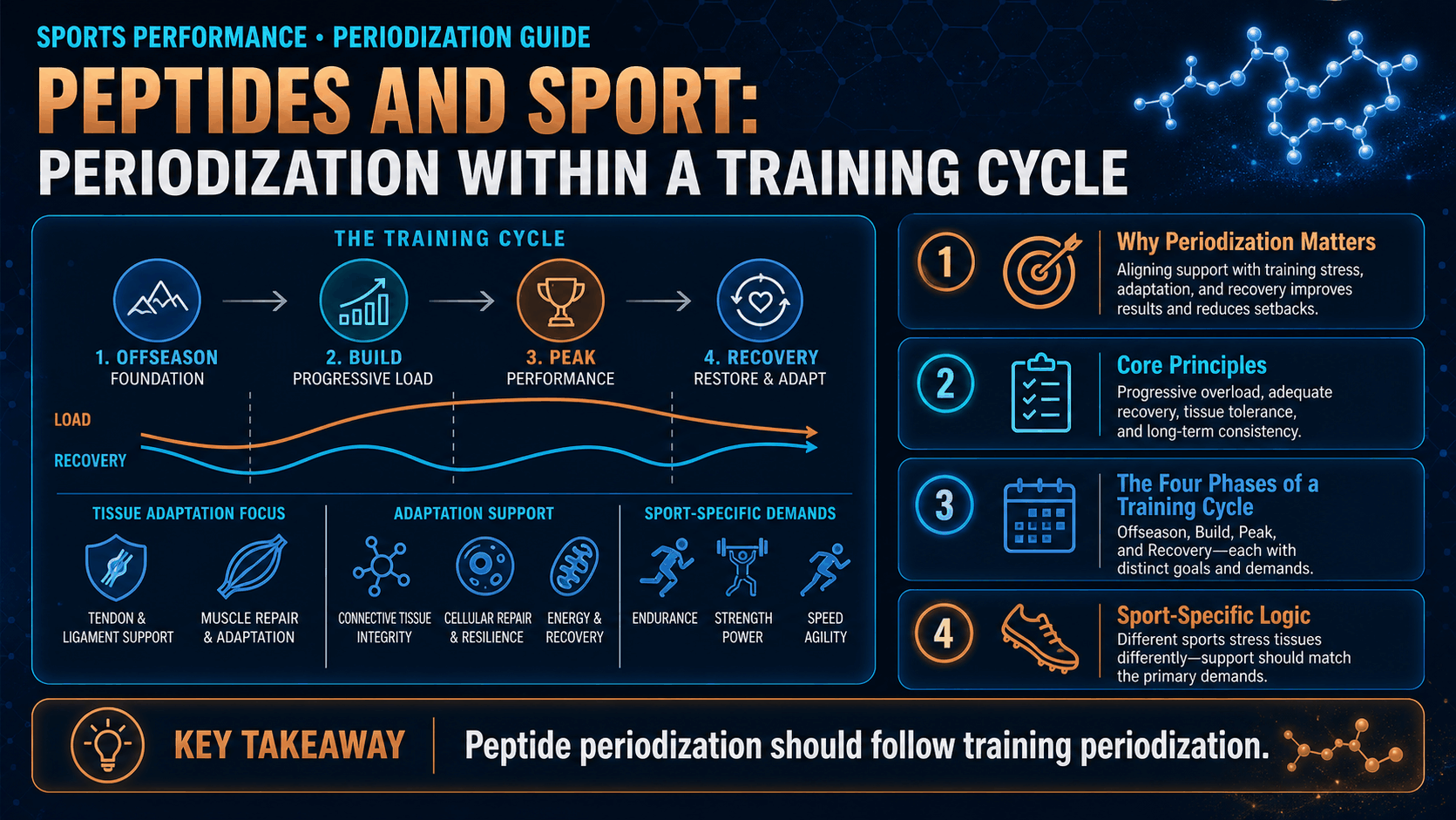
Offseason is for building capacity and addressing accumulated tissue stress. Preseason is for converting capacity into intensity. Season is for maintaining readiness and avoiding unnecessary experimentation. Post-season recovery is for deloading, sleep normalization, and reassessment.
Core Principles
Recovery capacity comes first
GH-axis discussions make the most sense only when sleep, nutrition, and training consistency are already strong.
Tissue stress is phase-specific
Tendons, fascia, joints, and connective tissue often need support before pain becomes an injury.
Competition is not experiment time
New compounds, unclear sources, and untested timing are risky during a season or before an event.
Deload is a real intervention
No peptide can compensate for chronic overload if the athlete refuses to reduce training stress.
 Sponsored / AffiliateIntegrative Peptides · Practitioner-oriented peptide and wellness education
The Four Phases of a Training Cycle
🌱 Offseason
This is the main window for building capacity, improving sleep, addressing chronic pain, and rebuilding connective tissue.
- Build training base and body composition.
- Address tendon and joint issues with sports-medicine guidance.
- Use nutrition and recovery foundations aggressively.
- Retest baseline markers before the next cycle.
⚡ Preseason
Training intensity rises, so intervention complexity should usually decrease. The goal is readiness without overloading the system.
- Monitor soreness, tendons, sleep, and performance.
- Avoid adding unfamiliar compounds.
- Keep connective-tissue nutrition consistent.
- Protect sleep as intensity rises.
🔥 Season
During competition, minimalism matters. Safety, recovery, return-to-play evaluation, and anti-doping compliance come first.
- Do not experiment close to competitions.
- Do not mask pain to return too early.
- Prioritize sleep, nutrition, and medical assessment.
- Document injuries and recovery status.
🌙 Recovery
Post-season recovery is the reset window: deload, tissue assessment, sleep repair, travel recovery, and new baseline testing.
- Reduce training load.
- Assess accumulated injuries.
- Normalize circadian rhythm and sleep depth.
- Prepare for the next offseason block.
Sport-Specific Logic
Strength Sports
Examples: powerlifting, bodybuilding, Olympic lifting.
The main issues are heavy-load tendon stress, joint irritation, hypertrophy blocks, and recovery from high mechanical tension.
- Offseason is the main building window.
- Connective tissue often limits progress.
- Do not confuse heavier training with better recovery.
Endurance Sports
Examples: running, cycling, swimming, triathlon.
The main issues are repetitive-load injuries: Achilles, patellar tendon, plantar fascia, hip stress, and chronic fatigue.
- Overuse monitoring matters.
- Recovery must match volume.
- Energy availability and sleep are central.
Team Sports and Combat
Examples: football, hockey, MMA, wrestling.
The main issues are contact injuries, acute tissue damage, concussion risk, psychological readiness, and safe return-to-play decisions.
- Medical assessment comes first after injury.
- Do not accelerate return if tissue is not ready.
- Season requires minimalism and consistency.
 Sponsored / AffiliatePeptide ReGenesis · Peptide education, protocols, and wellness-focused resources
Daily Timing Framework
Instead of thinking in “stacks,” think in biological windows. This is timing logic, not a dosing plan.
Overtraining: Peptides Do Not Fix Excess Load
Overtraining happens when adaptation cannot keep up with stress. Signs may include falling performance, chronic fatigue, frequent illness, low libido, poor sleep, mood changes, and elevated resting heart rate.
Exit framework
- Reduce training load substantially.
- Remove high-intensity sessions temporarily.
- Prioritize sleep, calories, hydration, and stress reduction.
- Address pain with sports medicine or physical therapy.
- Track resting heart rate, sleep, mood, and performance.
- Use labs when symptoms are prolonged or severe.
Two Common Myths
Myth: GH secretagogues should be used year-round because longer means more muscle.
Fact: Continuous use is not automatically better. Receptor adaptation, IGF-1 monitoring, sleep, insulin sensitivity, and long-term risk all matter. Periodization and breaks may be safer than escalation.
Myth: BPC-157 before a competition will improve performance immediately.
Fact: BPC-157 is not an acute ergogenic. Discussions around it usually involve inflammation, tissue repair, and recovery over days or weeks — not a same-day performance boost.
Frequently Asked Questions
Should peptide strategies change by season?
Yes, the discussion should change because training stress, recovery capacity, injury risk, and competition demands change.
Is the offseason the best recovery window?
Often yes. It is usually the best time to address chronic issues because competitive pressure is lower.
Can peptides replace deloading?
No. Overtraining requires load reduction. Recovery products cannot overcome ongoing excessive stress.
What should athletes check before using any peptide product?
Anti-doping rules, federation rules, medication status, product quality, contamination risk, and medical supervision.
What is the safest foundation?
Sleep, nutrition, progressive training, adequate deloading, injury evaluation, and consistent monitoring.
Key Takeaways
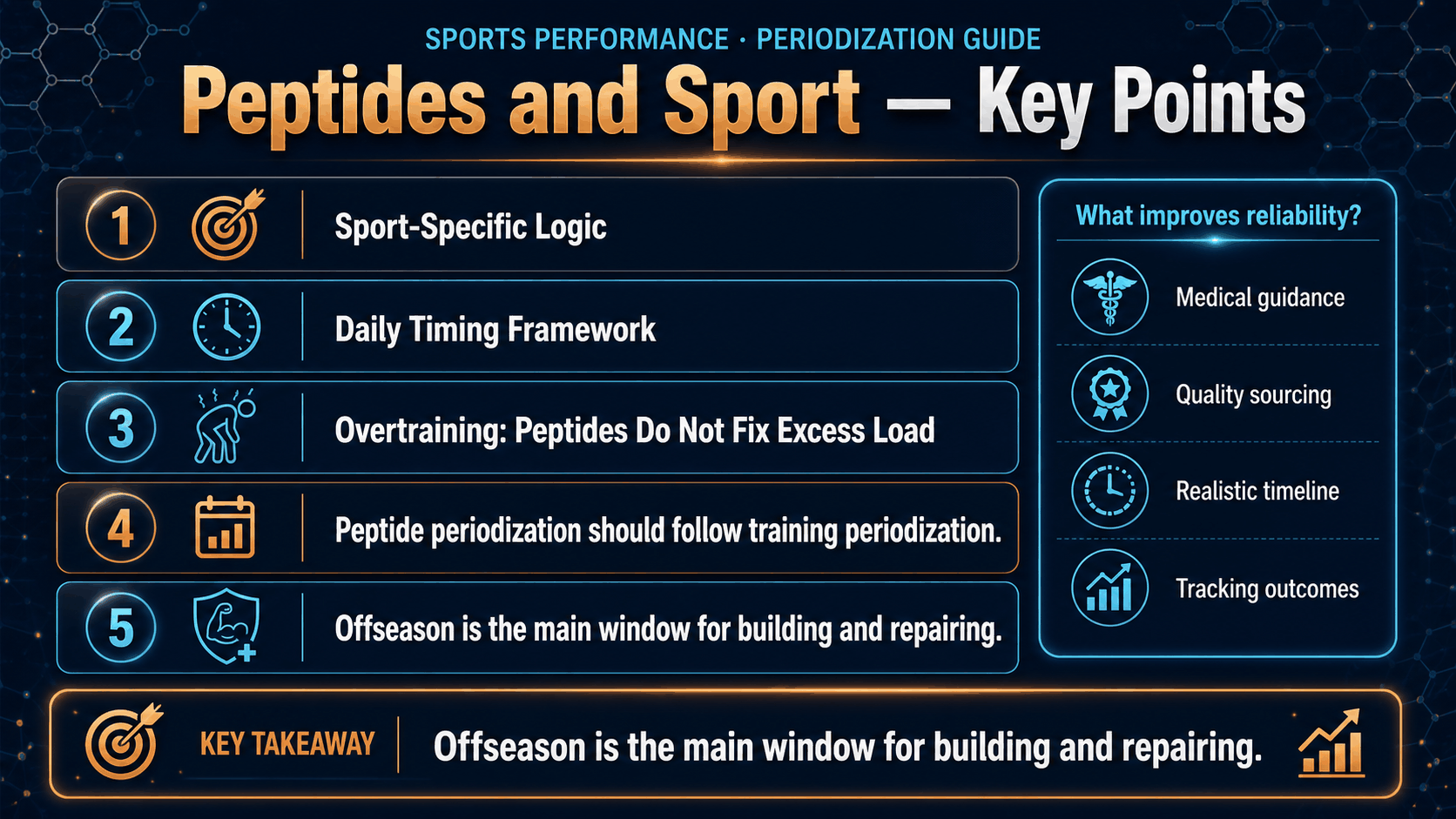
- Peptide periodization should follow training periodization.
- Offseason is the main window for building and repairing.
- Preseason requires fewer experiments as intensity rises.
- Season is about minimalism, safety, and return-to-play decisions.
- Recovery blocks are not optional; they are part of performance.
- Overtraining cannot be solved without reducing load.
- Anti-doping compliance and medical oversight are essential for athletes.