
Why Autoimmune Disease Is Different
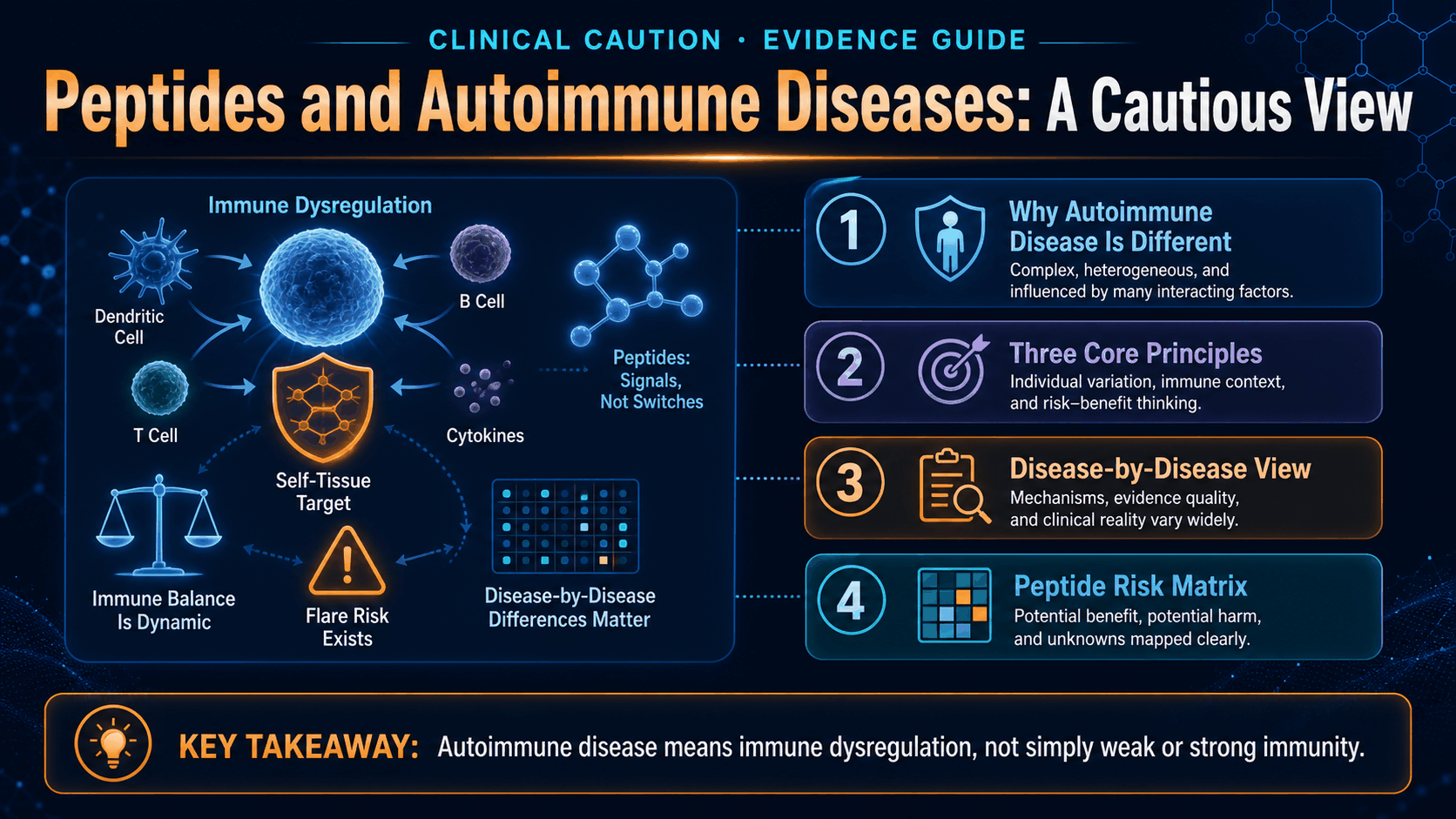
In autoimmune disease, the immune system is not simply “weak” or “strong.” It is dysregulated.
That distinction matters. A compound described as “immune supporting” or “anti-inflammatory” may sound helpful, but autoimmune biology is not a simple on/off switch. Immune stimulation may worsen tissue-directed attack, while broad inflammation reduction may interfere with compensatory or protective responses.
Three Safety Principles
1. Do Not Self-Modulate Immunity
Thymalin, thymosin alpha-1, GH secretagogues, and other immune-active compounds can change immune signaling in ways that may be unpredictable in autoimmune disease.
2. Do Not Replace Standard Care
RA, SLE, MS, and Hashimoto’s have established diagnostic and treatment pathways. Peptides should never delay or replace disease-modifying treatment.
3. Specialist Oversight Is Essential
Rheumatologists, neurologists, and endocrinologists interpret disease activity, medications, lab trends, flare risk, infection risk, and organ involvement.
 Sponsored / AffiliatePeptide ReGenesis · Peptide education, protocols, and wellness-focused resources
Disease-by-Disease Review
Rheumatoid Arthritis
Mechanism
RA involves autoimmune joint inflammation. Th17 cells, TNF-alpha, IL-6, synovial inflammation, and progressive cartilage and bone damage may be involved.
Peptide context
BPC-157 is theoretically discussed because of inflammatory pathways, but it is not a DMARD replacement and lacks established clinical proof in RA.
Systemic Lupus Erythematosus
Mechanism
SLE is systemic and can affect kidneys, skin, joints, blood, vessels, brain, and other organs. Immune activity may fluctuate unpredictably.
Peptide context
Immune-active peptides should not be used independently. Disease activity, medications, infection risk, blood counts, kidney status, and clotting risk matter.
Multiple Sclerosis
Mechanism
MS involves autoimmune demyelination and neurodegeneration. Disease-modifying therapies often suppress or modulate immune pathways.
Peptide context
Semax may be discussed only as neurologic support, not immune treatment. Immune peptides may interact unpredictably with MS therapies.
Hashimoto’s Thyroiditis
Mechanism
Hashimoto’s involves autoimmune thyroid injury with antibodies such as anti-TPO or anti-thyroglobulin in many patients, and thyroid function may decline.
Peptide context
There is no established peptide that reverses Hashimoto’s. Thymosin alpha-1 and thymalin are biologically double-edged in this context.
Peptides × Autoimmune Conditions Matrix
This matrix is educational, not a treatment recommendation. Green means lower systemic immune concern or potentially discussable. Yellow means specialist-only discussion. Red means do not use independently.
| Peptide / compound | RA | SLE | MS | Hashimoto’s |
|---|---|---|---|---|
| BPC-157 | ⚠ Rheumatologist only | ⛔ No self-use | ⚠ Neurologist only | ⚠ Endocrinologist only |
| Thymalin | ⛔ Flare concern | ⛔ Avoid self-use | ⛔ Avoid self-use | ⛔ Caution |
| Thymosin α1 | ⛔ No self-use | ⛔ Avoid self-use | ⛔ Avoid self-use | ⛔ Specialist only |
| Semax | ⚠ Not immune treatment | ⚠ Caution | ✓ Neuro context with neurologist | ✓ Not immune-directed |
| Selank | ✓ Not immune-directed | ⚠ Caution | ✓ Not immune-directed | ✓ Not immune-directed |
| Epitalon | ⚠ Limited context | ⛔ No self-use | ⚠ Neurologist only | ⚠ Caution |
| Topical GHK-Cu | ✓ Topical only | ✓ Topical only | ✓ Topical only | ✓ Topical only |
| Collagen I+III | ⚠ Food-protein context | ✓ Food protein | ✓ Food protein | ✓ Food protein |
| UC-II / type II collagen | ⚠ Discuss with rheumatologist | ⛔ No self-use | ⚠ Caution | ✓ Not thyroid-directed |
| GH secretagogues | ⚠ Active inflammation? | ⛔ No self-use | ⛔ No self-use | ⚠ Thyroid context matters |
 Sponsored / AffiliateMito Red Light · Red light therapy devices for recovery and wellness routines
Lower-Risk Supportive Categories
Topical GHK-Cu
Cosmetic topical use has minimal systemic immune relevance compared with injectable or systemic immune-active peptides.
Collagen I+III
Oral collagen I+III is generally a food-protein category, not an immune therapy, though product quality and allergies still matter.
Glycine and Magnesium
These are nutrient-support categories, not peptide immune interventions.
Omega-3
Omega-3s are commonly discussed as nutrition support, but they still need context with anticoagulants, surgery, and medical conditions.
Two Common Myths
Myth: BPC-157 is anti-inflammatory, so it must help autoimmune inflammation.
Fact: Autoimmune inflammation is not the same as ordinary inflammation. RA, SLE, MS, and Hashimoto’s involve complex immune dysregulation. Lowering an inflammatory marker does not automatically improve autoimmune disease, and animal data do not equal clinical proof.
Myth: Thymalin or thymosin alpha-1 can “normalize” immunity in Hashimoto’s.
Fact: Immune normalization is not a simple switch. In autoimmune disease, immune activation can worsen tissue-directed attack. Immune-active peptides belong in specialist-led discussion, not self-experimentation.
Frequently Asked Questions
Can BPC-157 treat rheumatoid arthritis?
No. It is theoretically discussed because of inflammatory pathways, but it is not an established RA treatment and does not replace DMARDs, biologics, or rheumatology care.
Are immune peptides safe in lupus?
Immune-active peptides should not be used independently in SLE. Lupus can involve organs, clotting risk, infections, and complex medications.
Can Semax help multiple sclerosis?
Semax is sometimes discussed in neurologic-support contexts, but MS treatment is specialist-led and disease-modifying therapy should not be replaced.
Can peptides reverse Hashimoto’s?
No peptide is established to reverse Hashimoto’s. Thyroid hormone replacement, monitoring, and endocrinology care remain central when hypothyroidism is present.
What is safest to avoid?
Avoid self-use of systemic immune-active peptides, especially thymalin, thymosin alpha-1, GH secretagogues, or experimental injectables, unless a specialist is directly supervising.
Key Takeaways
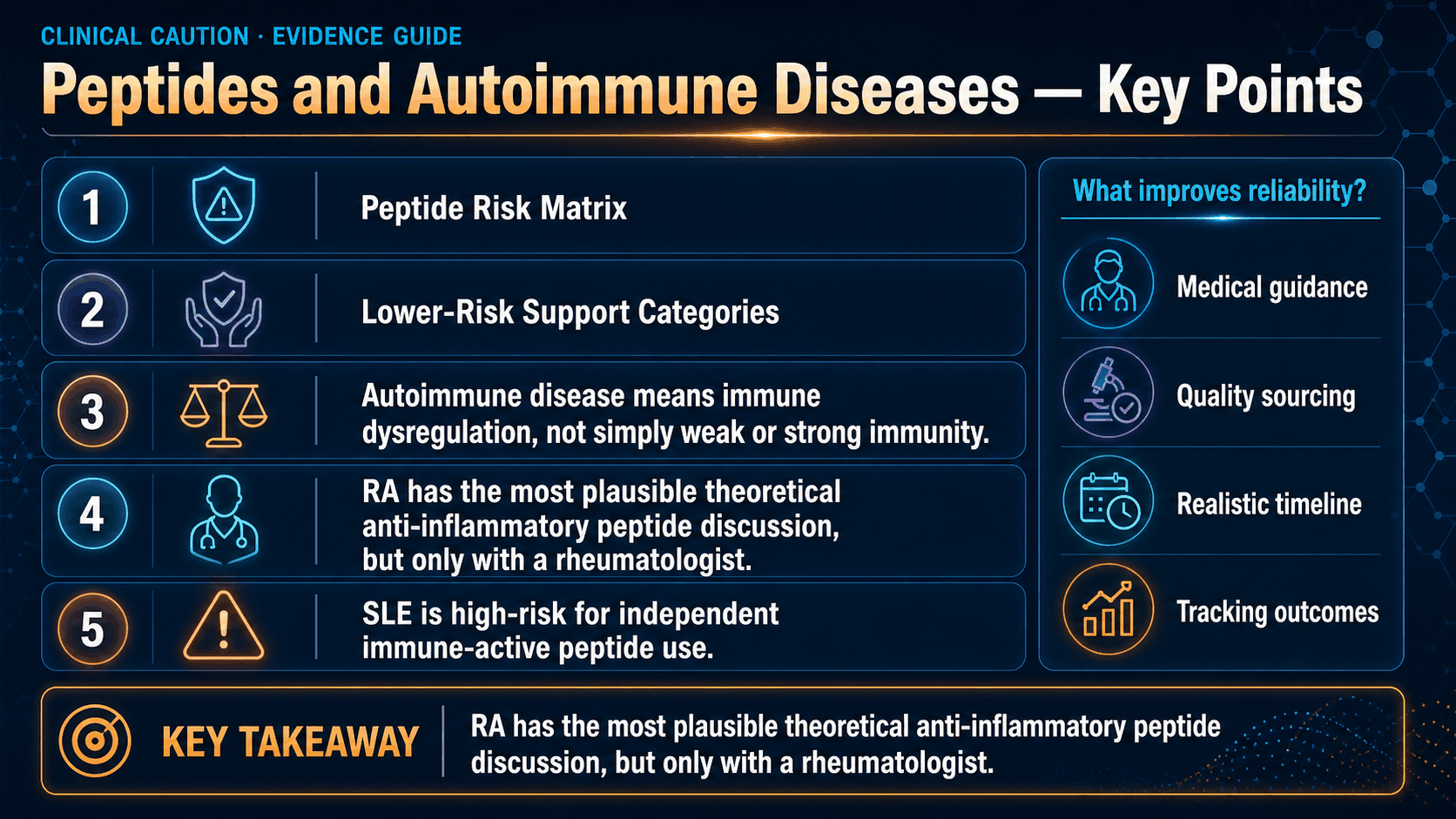
- Autoimmune disease means immune dysregulation, not simply weak or strong immunity.
- RA has the most plausible theoretical peptide discussion, but only with rheumatologist oversight.
- SLE is a high-caution category where immune-active peptides should not be used independently.
- MS peptide discussions belong under neurologist supervision and should not replace disease-modifying therapy.
- Hashimoto’s immune-peptide discussions require endocrinology oversight.
- Topical GHK-Cu, food-protein collagen, glycine, magnesium, and omega-3 are lower-risk supportive categories, not autoimmune treatments.
- Do not use peptide claims to delay standard autoimmune diagnosis or care.