Why Semax and Selank Are Different
Semax and Selank are not simply “brain boosting drops.”
They are regionally developed peptide medicines with specific clinical histories and limits. They are widely discussed in nootropic communities because they sit at the intersection of neurobiology, stress regulation, cognition, and clinical pharmacology.
Evidence and Product Limits
Regional evidence base
The Semax/Selank literature is concentrated in Russian and regional sources. Claims should be interpreted carefully, especially when applied to wellness or self-experimentation.
Labels are not proof
Do not assume that an online product labeled “Semax” or “Selank” has the same identity, purity, concentration, storage stability, or evidence base as a regulated medicinal product.
Origin and Clinical Context
ACTH fragment analogue
Semax is a synthetic analogue of the ACTH(4-7) fragment extended with Pro-Gly-Pro. It is usually discussed in the context of neuroprotection, cerebral blood-flow context, post-stroke recovery, traumatic brain injury, and cognitive impairment.
Tuftsin-related analogue
Selank is a synthetic analogue related to tuftsin, also extended with Pro-Gly-Pro. It is usually discussed as a nootropic-anxiolytic compound: a stabilizing peptide for cognition under stress.
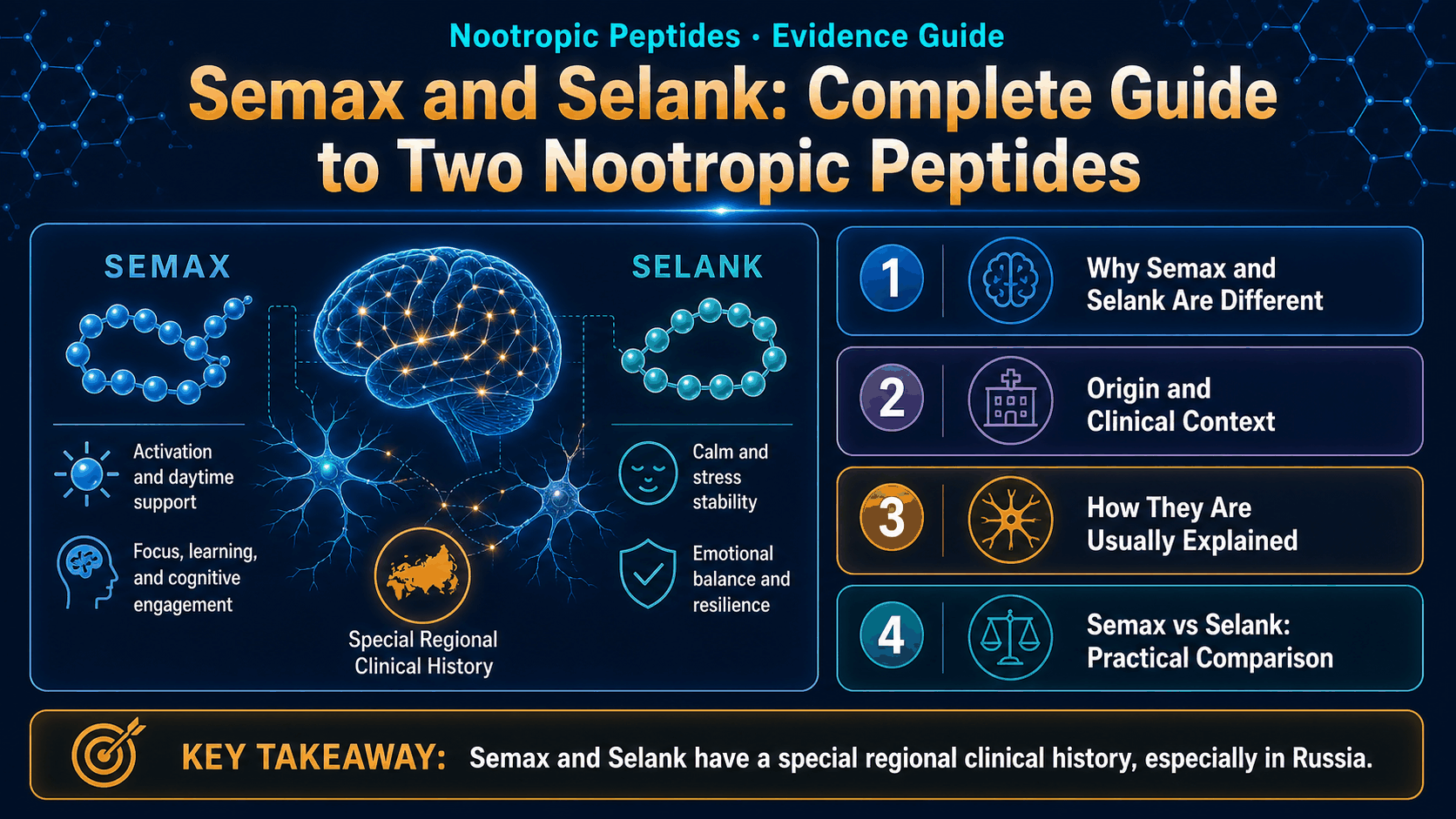
How They Are Usually Explained
Activation and neuroprotection
Semax is generally described as more activating. Proposed mechanisms include modulation of neurotrophic factors such as BDNF, cerebral blood-flow context, and neuroprotective pathways under ischemic or stress-related conditions.
- Often discussed for mental fatigue or “brain fog.”
- May feel stimulating in sensitive users.
- Usually framed as a daytime compound.
Stabilization and anxiety modulation
Selank is generally described as more stabilizing. Proposed mechanisms include GABAergic modulation, stress-response pathways, and neurotrophic signaling without the classic sedative framing of benzodiazepines.
- Often discussed when anxiety interferes with cognition.
- Not positioned as a simple sedative.
- Individual response still varies.
Semax vs Selank: Practical Comparison
| Parameter | Semax | Selank |
|---|---|---|
| Action class | More activating | More stabilizing |
| BDNF discussion | Often described as stronger/directer | Often discussed through stress modulation |
| Anxiety | May be neutral or activating | Main target area |
| Cortisol | Not the main target | Stress-axis context |
| Blood flow | Cerebral-flow context | Not the main focus |
| Timing | Usually daytime | More flexible, context-dependent |
| Best-fit discussion | Mental fatigue, clarity, neurological recovery contexts | Anxiety, stress, cognitive interference |
| Caution | Anxiety, insomnia, overstimulation | Apathy without anxiety, unrealistic expectations |
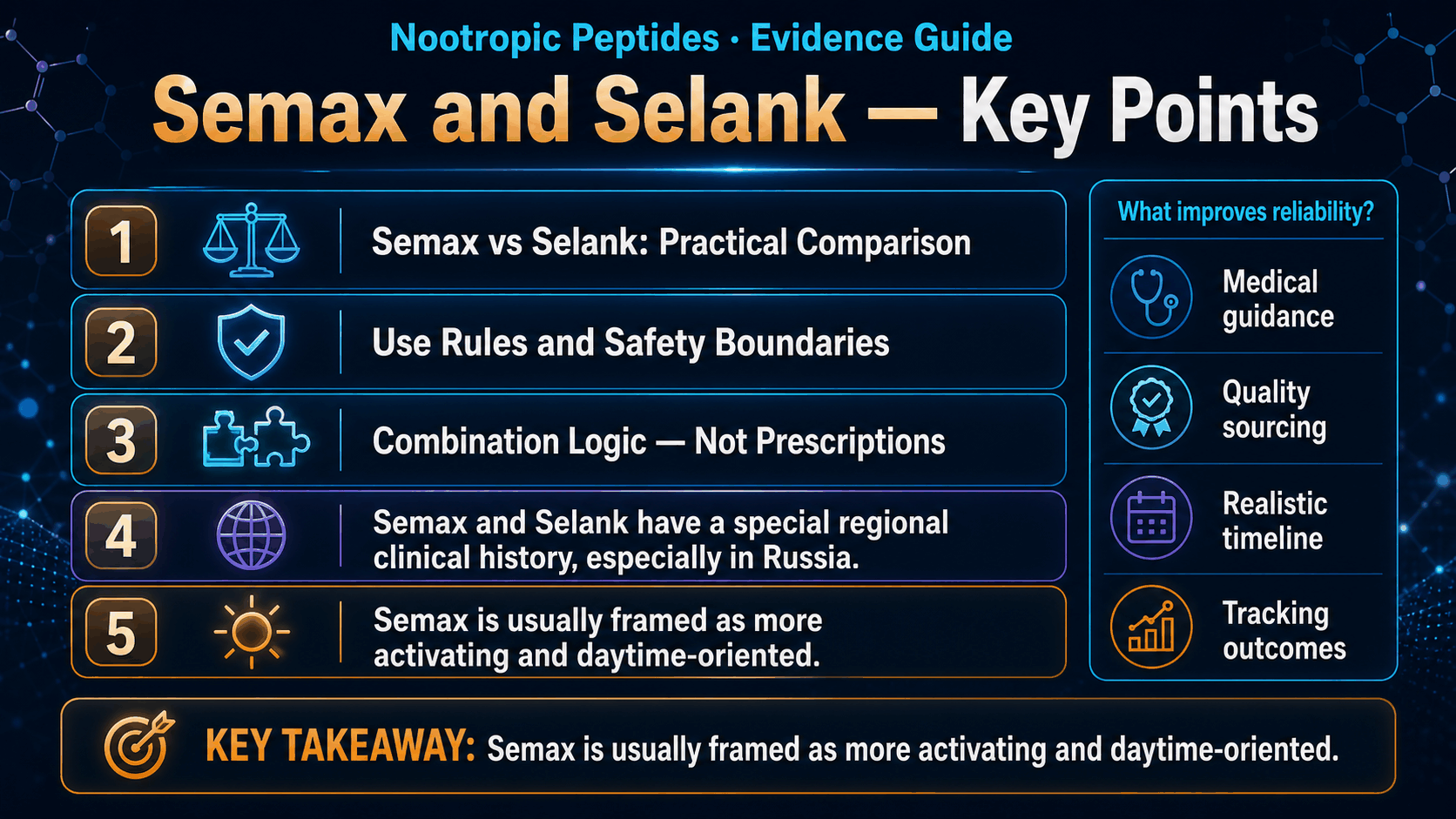
Use Rules and Safety Boundaries
Responsible framing
Usually discussed as an intranasal solution in regions where it is regulated. Because it may be activating, evening use may worsen sleep in sensitive people. Product identity and concentration matter.
Responsible framing
Usually discussed as an intranasal solution in regulated contexts. Often framed for anxiety-related symptoms and stress-related cognitive impairment. It should not replace psychiatric care when symptoms are severe.
Combination Logic — Not Prescriptions
Activation vs anxiety interference
Semax-type logic is task activation and clarity. Selank-type logic is reducing anxiety interference when pressure is high. Risk: overusing stimulation while ignoring sleep and burnout.
Foundations still matter
The strongest foundation is still exercise, sleep, blood pressure control, glucose control, social connection, and treatment of depression or sleep apnea.
Medical supervision
Stroke, TIA, and brain injury contexts belong under neurologist supervision. Rehabilitation and standard vascular-risk care come first.
Two Common Myths
“Semax and Selank can be taken continuously because they are safe.”
Fact: Medicinal use usually implies indications, course duration, monitoring, and pauses—not indefinite self-use. Continuous use may reduce benefit, increase side-effect risk, or mask an underlying problem.
“Selank is just a sedative and makes thinking slower.”
Fact: Selank is usually discussed as an anxiolytic-nootropic rather than a simple sedative. The idea is to reduce excessive anxiety without classic cognitive dulling, but personal response varies.
Frequently Asked Questions
Is Semax a stimulant?
It is usually described as more activating, but it is not the same as a classic stimulant drug. Sensitive users may still experience overstimulation or sleep disruption.
Is Selank an anti-anxiety medication?
It is discussed as an anxiolytic-nootropic in regional literature, but it should not replace psychiatric care for severe anxiety, panic, depression, or insomnia.
Can Semax and Selank be used together?
They are often discussed as complementary, but combination use should not be treated as a universal productivity stack. Context and medical risk matter.
Are online Semax and Selank products reliable?
Not necessarily. Product identity, purity, concentration, sterility, storage, and regulatory status may differ from regulated medicinal products.
Key Takeaways
- Semax and Selank have a special regional clinical history, especially in Russia.
- Semax is usually framed as more activating and daytime-oriented.
- Selank is usually framed as more stabilizing and anxiety/stress-oriented.
- Together they are not a magic productivity hack.
- Product identity, concentration, storage, purity, and regulatory status matter.
- Serious neurologic or psychiatric symptoms require medical care, not peptide self-experimentation.
References and Further Reading
These sources are provided to make the page more useful and transparent. They do not turn this article into medical advice.
Sponsored Resources
Some links may be affiliate links. They do not influence the educational content, safety framing, or references on this page.
 Sponsored / AffiliatePeptide ReGenesis · Peptide education and wellness-focused resources
 Sponsored / AffiliateMomentous · Performance nutrition and recovery supplements