
Why Handling Matters
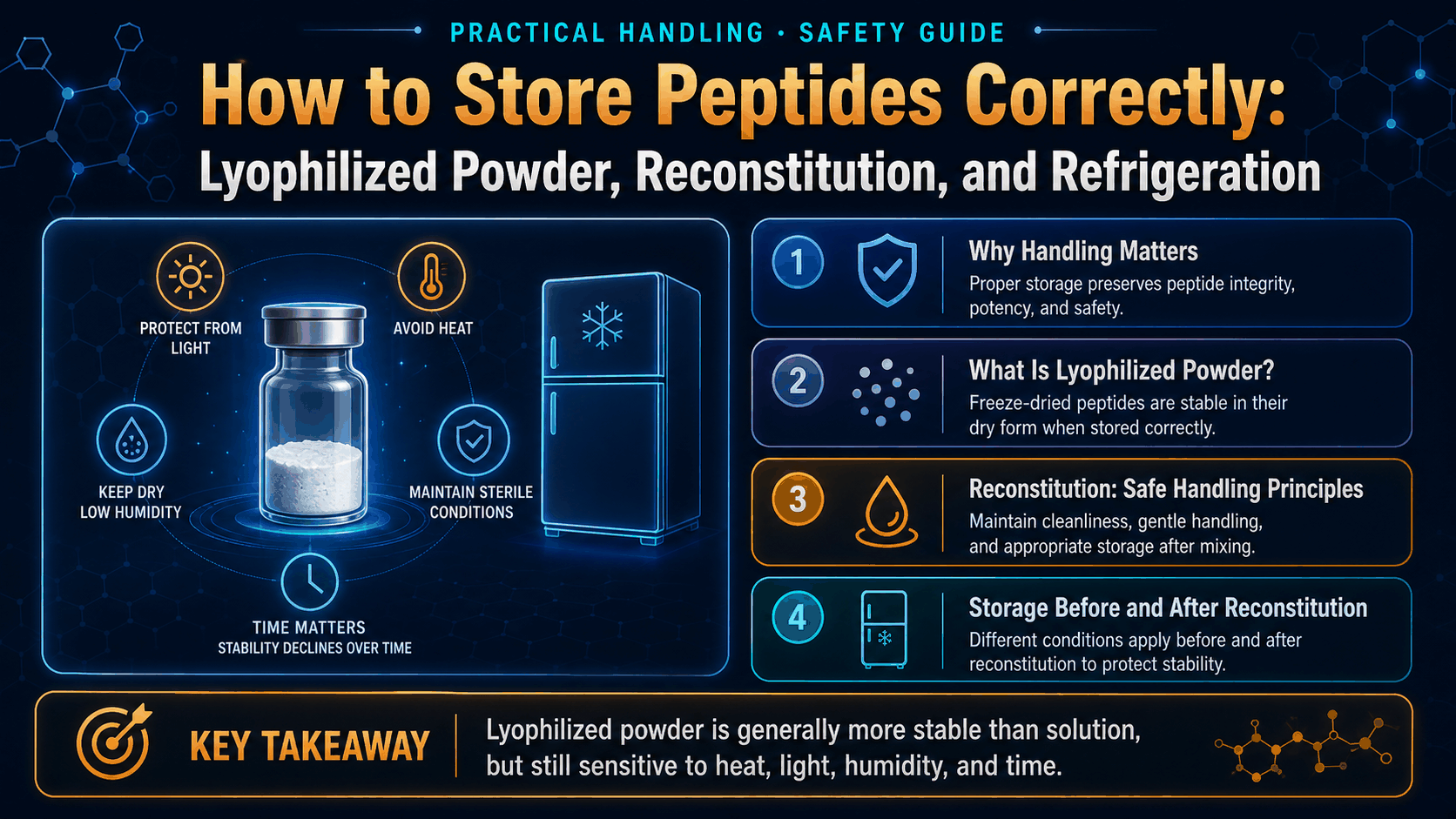
A peptide can be damaged before it is ever used.
Heat, incorrect diluent, aggressive shaking, room-temperature storage, unclear labeling, or poor sterility can affect stability and safety. Many users focus on the molecule and forget the practical details that determine whether the product remains usable.
What Is Lyophilized Powder?
Lyophilization is a freeze-drying process. A frozen solution has water removed under vacuum, leaving a dry powder, cake, or pellet-like material in a vial. This form is often more stable than a liquid solution when stored correctly.
Normal Appearance
White or off-white powder or a cake at the bottom of the vial. Some peptides may have characteristic color.
Not Automatically Bad
Powder that has shifted, cracked, or fallen from the vial wall is not automatically spoiled.
Warning Signs
Unexpected liquid, damaged seal, visible contamination, unusual discoloration, or abnormal odor.
Storage Sensitivity
Heat, light, humidity, and time can still degrade lyophilized material.
 Sponsored / AffiliateMomentous · Performance nutrition and recovery supplements
Reconstitution: Safe Handling Principles
Reconstitution is the step where dry powder is converted into solution. Exact diluent, volume, final concentration, and beyond-use date should come from the product label, pharmacy, or clinician.
Use appropriate sterile diluent
Depending on the product, this may be bacteriostatic water or sterile water for injection. Do not use drinking water or household distilled water.
Confirm concentration
The amount of diluent determines final concentration. Do not guess. Label the vial clearly.
Avoid heat
Hot liquid can damage sensitive peptide structures. Do not heat the vial unless the label specifically instructs otherwise.
Add liquid gently
Gentle handling reduces foaming and mechanical stress. Avoid forceful streams into fragile powder when possible.
Do not shake aggressively
Use gentle swirling or rolling if mixing is needed. Vigorous shaking may create foam and stress sensitive molecules.
Inspect the solution
Do not use a vial with unexpected particles, cloudiness, discoloration, damaged seals, or sterility concerns.
Storage Before and After Reconstitution
| State | Location | Temperature | Stability idea | Important note |
|---|---|---|---|---|
| Unopened lyophilized powder | Freezer | Often −18°C / 0°F | Long-term if label allows | Protect from light and moisture. |
| Unopened lyophilized powder | Refrigerator | +2–8°C | Shorter-term storage | Common for near-term use if label permits. |
| Opened dry vial | Controlled handling area | As directed | Use promptly | Do not treat as unopened stock. |
| Reconstituted solution | Refrigerator | +2–8°C | Depends on diluent and label | Follow beyond-use instructions. |
| Solution in sterile water | Refrigerator | +2–8°C | Usually shorter | No bacteriostatic preservative. |
| Solution at room temperature | Avoid | +20°C+ | Stability risk | Temperature excursions can matter. |
 Sponsored / AffiliatePeptide University · Peptide learning resources and educational programs
Tools and Setup
Sterile syringes and needles
For sterile transfer when appropriate. Use only sterile, single-use supplies. Never reuse needles or syringes.
Appropriate sterile diluent
Bacteriostatic water and sterile water are not interchangeable in every context. Follow product-specific instructions.
Alcohol swabs
For vial-stopper and surface hygiene. Let alcohol dry before puncture or handling.
Storage label or log
Record concentration, reconstitution date, and discard date. This prevents confusion when several vials are present.
Refrigerator thermometer
Cold chain depends on actual temperature. Refrigerator doors fluctuate; a middle shelf is often more stable.
Reminder system
Set a discard-date reminder. Expired or questionable solutions should not be used.
Top 5 Mistakes
Using hot liquid
Heat can damage sensitive peptide structures. Follow recommended temperature conditions.
Shaking the vial
Vigorous agitation can create foam and mechanical stress. Gentle mixing is safer when mixing is needed.
Leaving solution out
Room-temperature exposure can accelerate degradation and raises sterility concerns.
Freezing prepared solution
Freezing is not automatically safe and may affect stability and concentration uniformity.
Using non-sterile water
Distilled or drinking water is not appropriate for sterile peptide handling.
Two Common Myths
Myth: Normal saline is always a good substitute for bacteriostatic water.
Fact: Saline may be sterile, but it is not always the right diluent and usually does not contain a bacteriostatic preservative. Use product-specific diluent instructions.
Myth: Lyophilized powder can stay at room temperature because it is dry.
Fact: Dry usually means more stable, not infinitely stable. Heat, light, humidity, and time can still degrade a lyophilized peptide.
Frequently Asked Questions
Can I use drinking or distilled water?
No. Sterile handling requires the diluent specified by the product, pharmacy, or clinician.
Can I shake the vial to dissolve it faster?
Do not shake aggressively. Gentle swirling or rolling is safer when mixing is needed.
Can I freeze a reconstituted solution?
Do not assume that is safe. Freezing can affect stability, concentration uniformity, and container integrity.
Where should I store reconstituted solution?
Usually in the refrigerator at +2–8°C unless the label says otherwise.
What must be written on the vial?
Final concentration, reconstitution date, discard date, and product identity.
Key Takeaways
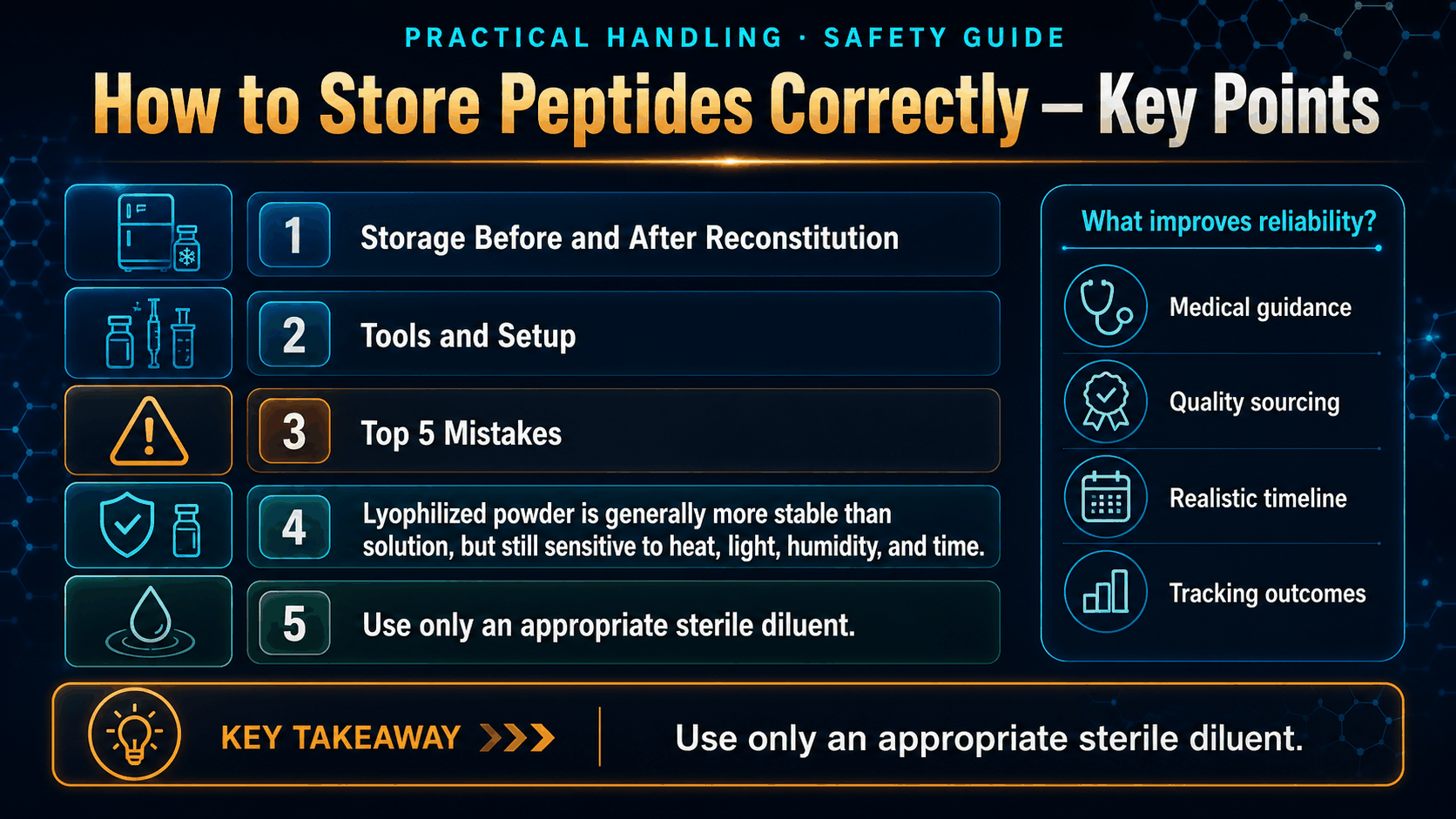
- Lyophilized powder is generally more stable than solution, but still sensitive to heat, light, humidity, and time.
- Use only an appropriate sterile diluent.
- Avoid heat and aggressive shaking.
- Reconstituted solutions are usually refrigerated and should not be assumed freezable.
- Label concentration, reconstitution date, and discard date clearly.
- Questionable, expired, discolored, cloudy, or contaminated vials should not be used.