
What an INCI List Can Tell You
The front of the package sells a promise. The ingredient list shows the structure behind that promise.
INCI stands for International Nomenclature of Cosmetic Ingredients. It standardizes how cosmetic ingredients are named so consumers and regulators can identify what a product contains.
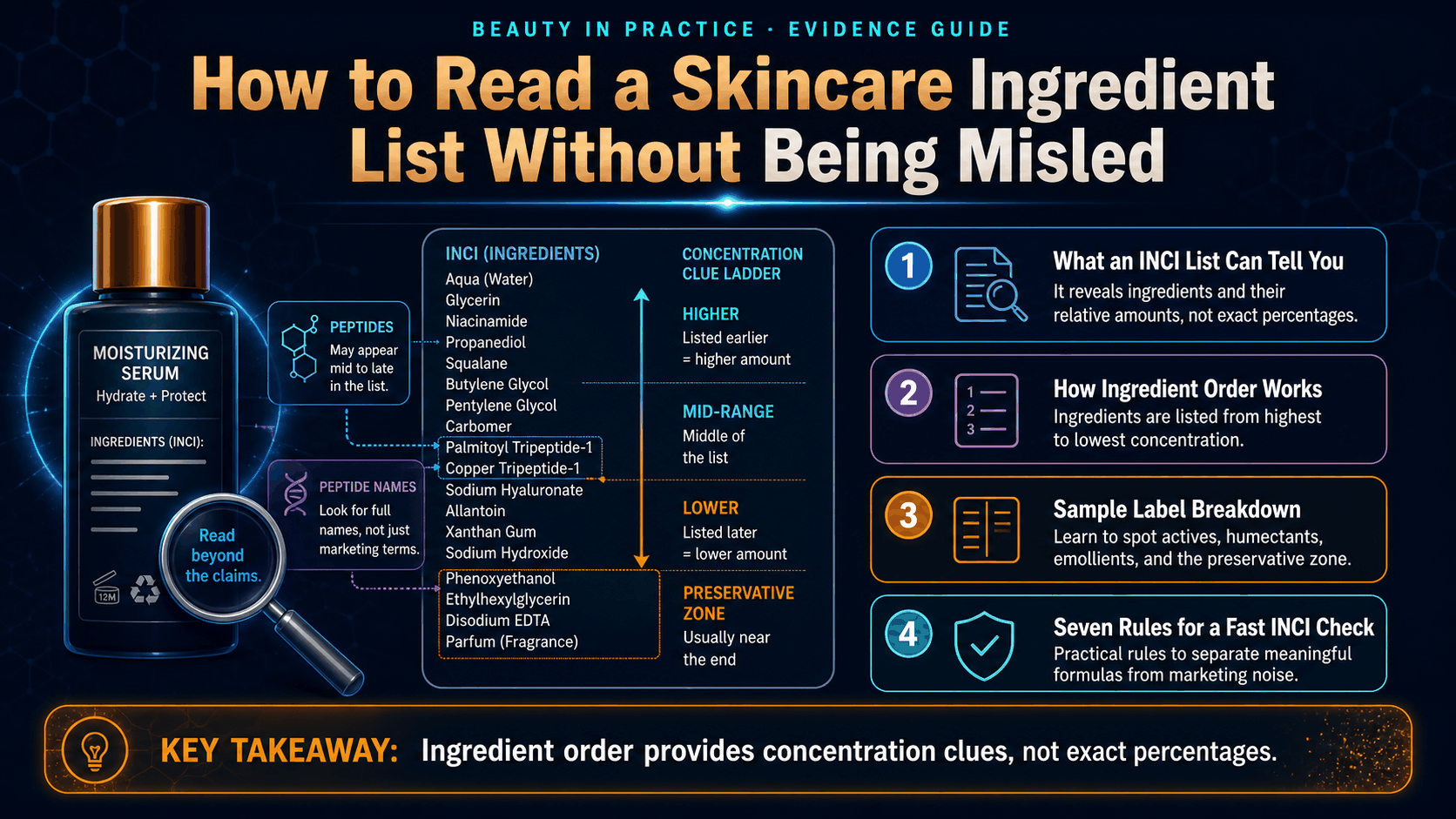
How Ingredient Order Works
Ingredients are generally listed from higher to lower concentration until the low-concentration section of the formula. Ingredients at 1% or less may often appear in any order after those above 1%, depending on the applicable rules.
Preservatives such as phenoxyethanol can help identify the lower-concentration zone, but they are not precise measuring tools. Some ingredients are effective below 1%, while others require much higher levels.
 Sponsored / AffiliateDT Peptides · Peptide research products and laboratory-focused resources
Sample Label Breakdown
Consider a hypothetical “anti-wrinkle peptide serum” with the following ingredient order.
Seven Rules for a Fast INCI Check
Quick Ingredient Reference
| INCI Name | What It Is | Evidence | How to Read It |
|---|---|---|---|
| Copper Tripeptide-1 | GHK-Cu; matrix and repair biology | Promising, product-specific | Earlier placement suggests more, but low levels may still be intentional |
| Palmitoyl Pentapeptide-4 | Matrixyl-type signal peptide | Supportive cosmetic evidence | Look for product or supplier data |
| Palmitoyl Tripeptide-1 + Palmitoyl Tetrapeptide-7 | Common Matrixyl 3000 pairing | Formula-dependent | Both names should appear; blend level matters |
| Acetyl Hexapeptide-8 | Argireline-type peptide | Modest, concentration-dependent | Exact percentage is especially important |
| Hydrolyzed Collagen | Protein fragments for conditioning and hydration | Surface benefits | Not equivalent to a signaling peptide |
| Collagen | Large native protein | Film-forming and moisturizing | Does not rebuild dermal collagen from the surface |
| Niacinamide | Vitamin B3 derivative | Strong evidence | High placement supports a meaningful amount |
| “Peptide Complex” without names | Unclear proprietary description | Cannot be evaluated | Ask for the full INCI list |
 Sponsored / AffiliateUlta Lab Tests · Lab testing for hormones, inflammation, and wellness
Five Marketing Traps
“Peptide Complex”
Without exact INCI names, the blend cannot be evaluated properly.
“Biomimetic Peptide”
Biomimetic is a description, not an ingredient identity.
“Collagen Peptide”
Native and hydrolyzed collagen are not interchangeable with signaling peptides.
“High Concentration” Without a Number
Ingredient order offers clues, but a strong claim needs disclosure or product data.
“Clinically Proven”
Ask what was tested, how many people participated, what the comparator was, and whether the study was published.
The 30-Second Product Check
Two Common Myths
Myth: The longer the ingredient list, the better the product.
Fact: List length does not determine quality. A short formula can be effective, while a long one may be sophisticated or unnecessarily complex.
Myth: Natural ingredients are automatically safer than synthetic ones.
Fact: Safety depends on dose, purity, formulation, irritation potential, and toxicology—not whether marketing calls an ingredient natural.
Frequently Asked Questions
Does ingredient order reveal exact percentages?
No. It provides relative clues, especially near the top, but not precise concentrations.
Is everything after phenoxyethanol below 1%?
Often, but not always. It is a useful clue rather than a universal rule.
Are peptides near the end of the list useless?
No. Some peptides are used at low levels. Effectiveness depends on the formula and supporting data.
Does “clinically proven” guarantee strong evidence?
No. The phrase can refer to very different types of testing.
What should I check first?
The featured active, the first five ingredients, the preservation system, and whether product-specific evidence exists.
Key Takeaways
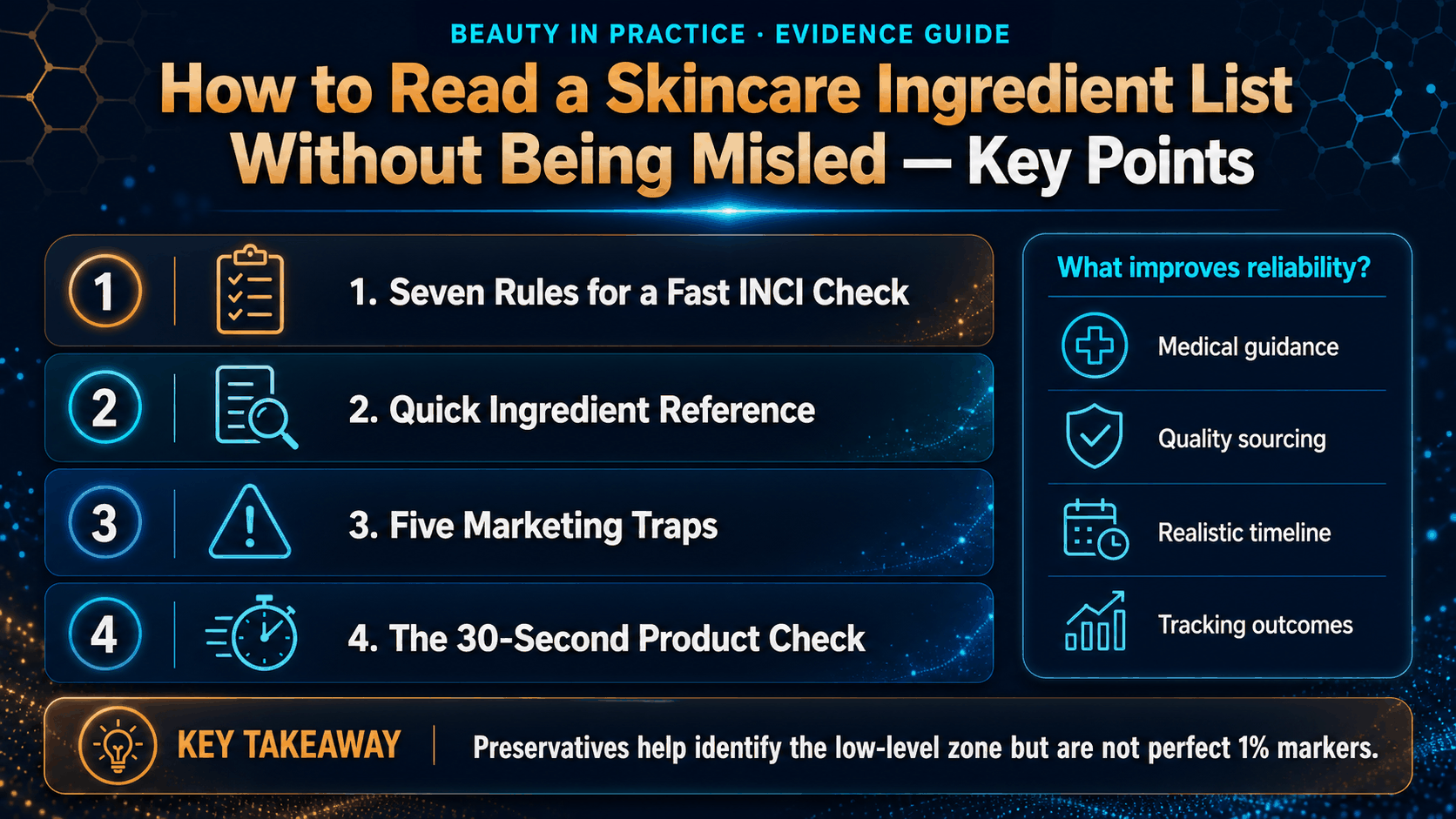
- Ingredient order provides concentration clues, not exact percentages.
- Preservatives help identify the low-level zone but are not perfect 1% markers.
- Exact INCI names matter more than front-label phrases.
- The first five ingredients reveal the base and character of the formula.
- Peptides near the end may still be functional, but the label alone cannot prove the dose.
- “Peptide complex” without identifiable names deserves caution.
- Native collagen hydrates the surface but does not rebuild dermal collagen.