
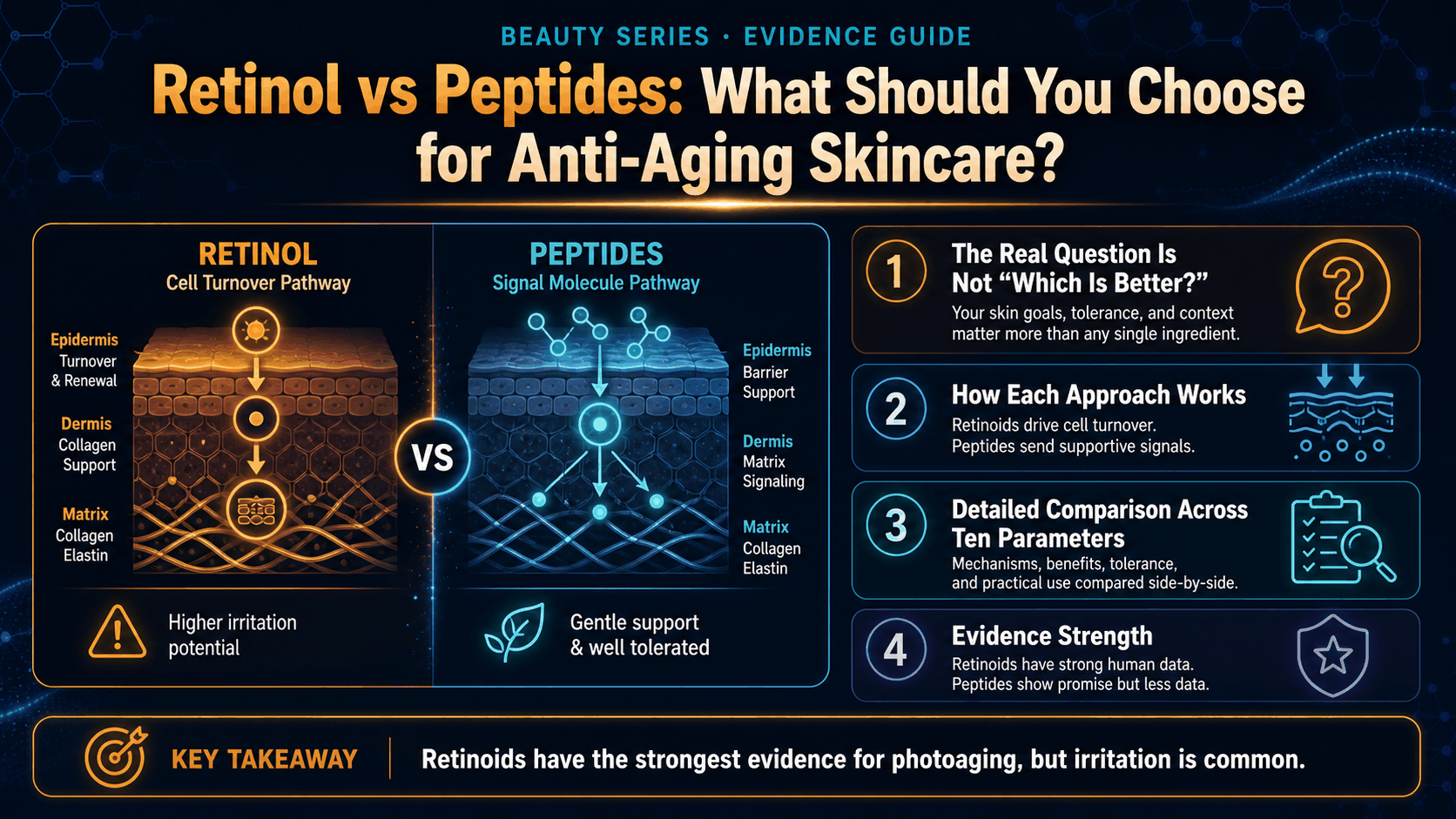
The Real Question Is Not “Which Is Better?”
Retinoids and peptides solve different problems through different biological pathways.
Retinoids are the evidence leader for photoaging, fine lines, texture, and uneven pigmentation. Peptides may offer targeted matrix or signaling effects with better tolerability in many formulas.
How Each Approach Works
Retinol and Retinoids
Retinol is converted toward retinoic acid, which binds nuclear receptors and influences gene transcription in keratinocytes and fibroblasts.
Retinoids can support epidermal turnover, collagen-related pathways, pigmentation control, and photoaging treatment.
Peptides
Different peptides have different targets. GHK-Cu is studied in matrix and repair biology, Matrixyl-type peptides mimic matrix signals, and acetyl hexapeptide products target expression-line appearance.
They do not reproduce the full retinoid receptor cascade and usually cause less peeling or retinoid dermatitis.
 Sponsored / AffiliateUlta Lab Tests · Lab testing for hormones, inflammation, and wellness
Detailed Comparison Across Ten Parameters
| Parameter | Retinol / Retinoids | Peptides |
|---|---|---|
| Evidence base | Large and mature for photoaging | Variable by peptide and product |
| Time to visible change | Several weeks to months | Several weeks to months |
| Typical effect size | Moderate to strong for selected outcomes | Usually modest to moderate |
| Irritation | Common during introduction | Usually less common |
| Sensitive skin | Requires cautious introduction | Often easier to tolerate |
| Sun considerations | Daily sunscreen is essential | Daily sunscreen still recommended |
| Pregnancy | Generally avoided | Review the specific product with a clinician |
| Compatibility | Multiple strong actives may increase irritation | Often broadly compatible, formula-dependent |
| Uneven pigmentation | Better established | Usually less direct |
| Price | Many affordable options | Highly product-dependent |
Evidence Strength
Retinoids
Prescription tretinoin has the strongest evidence for photoaging. Over-the-counter retinol also has supportive data, although effects and conversion are less predictable.
Peptides
Copper peptides, palmitoylated signal peptides, and acetyl hexapeptide products have supportive laboratory and cosmetic studies, but many trials are small or product-specific.
 Sponsored / AffiliateIntegrative Peptides · Practitioner-oriented peptide and wellness education
Who Should Choose What?
New User
A low-strength retinoid may be a reasonable starting point for prevention-focused skincare. Start slowly and prioritize sunscreen and moisturizer.
Sensitive or Rosacea-Prone Skin
Peptides may be easier to introduce. Choose a simple fragrance-free formula and stop if burning or persistent redness develops.
Pregnancy or Breastfeeding
Topical retinoids are generally avoided. Peptide safety is not automatically guaranteed, so every product should be reviewed with the relevant clinician.
Experienced User
A peptide serum may be added in the morning, on recovery nights, or in the same routine when the finished formulas are compatible and tolerated.
A Smart Combined Routine
Two Common Myths
Myth: Retinol is “chemical,” while peptides are natural and therefore safer.
Fact: Retinol is a form of vitamin A, and many cosmetic peptides are synthesized. Safety depends on formulation, dose, toxicology, and evidence—not marketing language.
Myth: Only retinol produces real results.
Fact: Selected peptides have biological activity and supportive cosmetic evidence, but their evidence base is smaller and more product-specific than that of retinoids.
Frequently Asked Questions
Are peptides better than retinol?
Not overall. Retinoids have stronger evidence, while peptides may be gentler and easier to tolerate.
Can retinol and peptides be used together?
Often yes, depending on the finished formulas and the skin’s tolerance.
Which is better for sensitive skin?
Peptides are often easier to tolerate, but fragrance and other ingredients still matter.
Can peptides replace retinoids during pregnancy?
They may be considered, but each product should be reviewed with an obstetric or dermatology clinician.
What matters most in an anti-aging routine?
Daily sunscreen, consistency, barrier support, and choosing products the skin can tolerate.
Key Takeaways
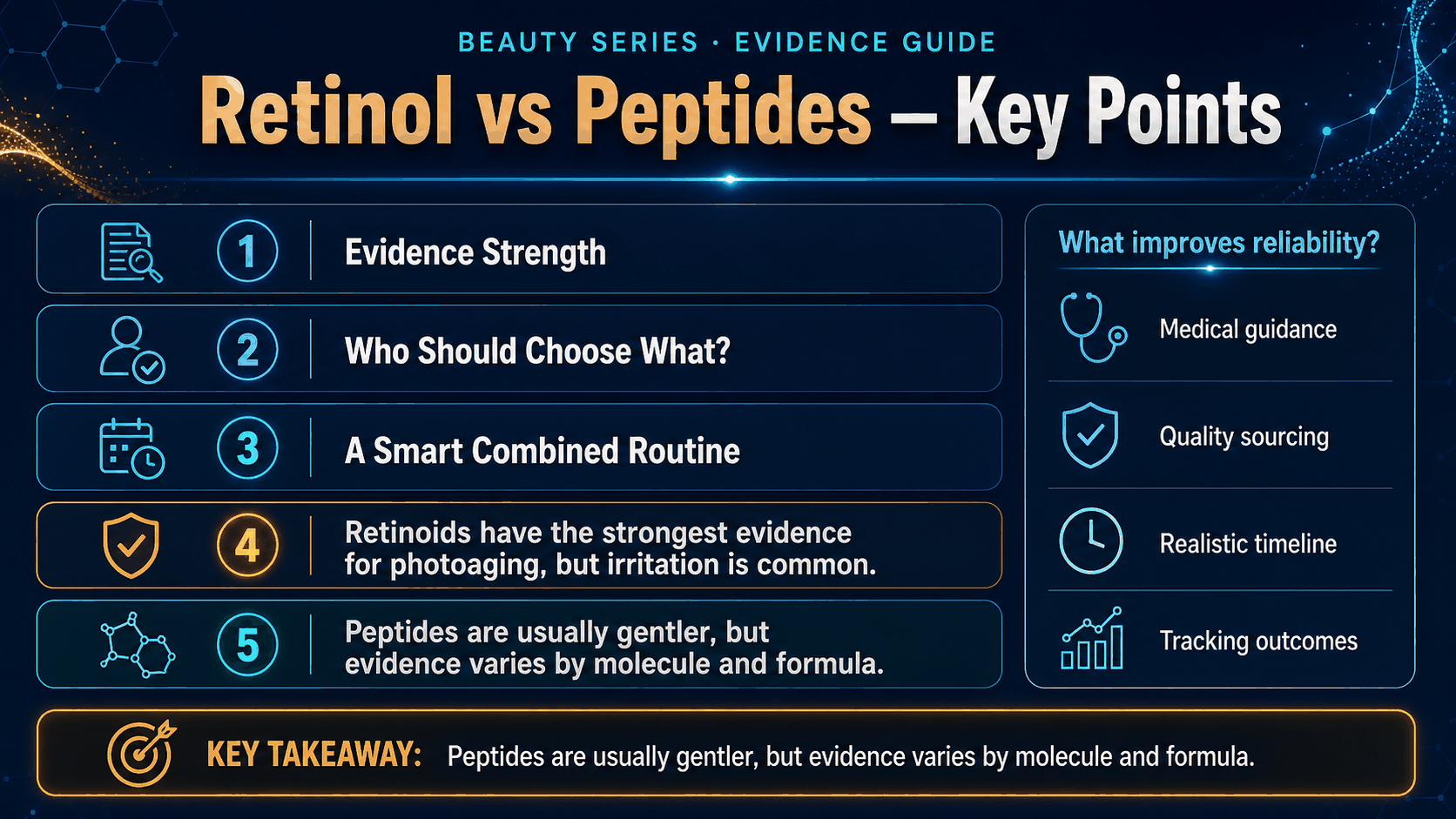
- Retinoids have the strongest evidence for photoaging, but irritation is common.
- Peptides are usually gentler, but evidence varies by molecule and formula.
- Sensitive skin may prefer peptides or a very cautious retinoid approach.
- Topical retinoids are generally avoided during pregnancy.
- Both may fit the same routine when formulas are compatible and tolerated.
- Sunscreen, consistency, and barrier care matter more than complicated stacking.
- Do not combine home microneedling with ordinary cosmetic serums.