
What Is GHK-Cu?
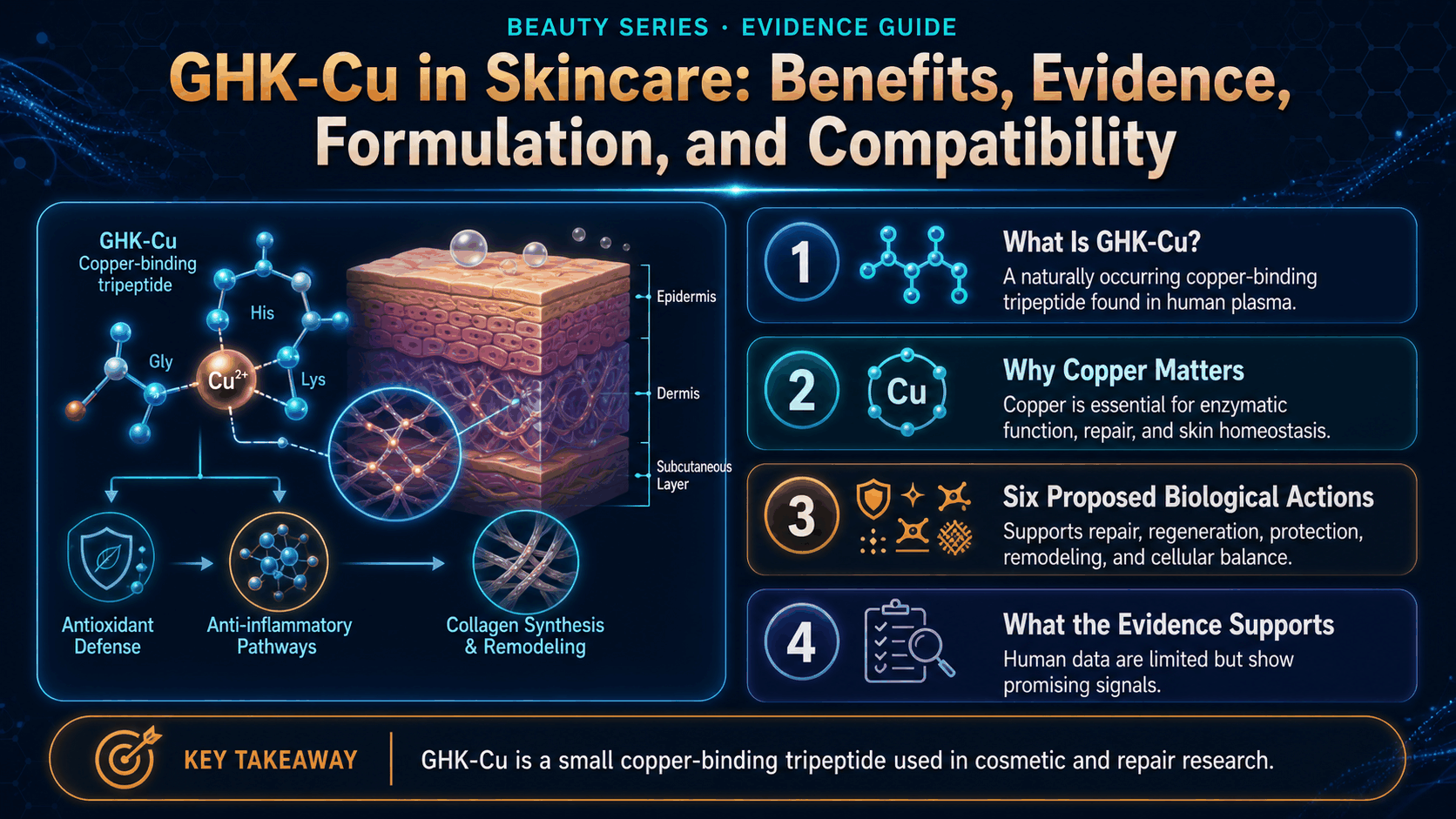
GHK-Cu is a naturally occurring copper-binding tripeptide composed of glycine, histidine, and lysine.
It has been studied for decades in relation to extracellular-matrix remodeling, inflammation, oxidative stress, and tissue repair. In cosmetic products, it usually appears on the ingredient list as Copper Tripeptide-1.
Why Copper Matters
Copper is a cofactor for enzymes involved in connective-tissue biology, including lysyl oxidase, which contributes to collagen and elastin cross-linking. GHK can bind copper and may influence how copper participates in local repair processes.
The complex has a molecular mass of approximately 340 daltons. Its relatively small size may favor topical delivery compared with larger peptides, but penetration still depends on the vehicle, stability, concentration, skin condition, and product design.
 Sponsored / AffiliateIntegrative Peptides · Practitioner-oriented peptide and wellness education
Six Proposed Biological Actions
Collagen and Matrix Support
Laboratory and small clinical studies suggest effects on fibroblasts, procollagen, and extracellular-matrix components.
Matrix Remodeling
Research has examined matrix metalloproteinases and their inhibitors, with the goal of balanced remodeling rather than simply blocking all collagen breakdown.
Oxidative-Stress Biology
Binding copper within a peptide complex may change its reactivity, although finished-product stability remains essential.
Inflammatory Signaling
Preclinical studies report changes in inflammatory mediators, but GHK-Cu is not an established treatment for rosacea, acne, or eczema.
Repair and Nerve-Related Pathways
Experimental work has examined wound repair and nerve-related signaling. Routine cosmetic benefits in sensation or vascular control remain unproven.
Gene-Expression Effects
Cell-based analyses suggest broad transcriptional effects, but this does not prove that a topical serum “rejuvenates thousands of genes” in human skin.
What the Evidence Supports
 Sponsored / AffiliatePeptide ReGenesis · Peptide education, protocols, and wellness-focused resources
How to Evaluate a GHK-Cu Product
| Label or Claim | How to Interpret It | Practical Note | Confidence |
|---|---|---|---|
| Trace amount | May be included mainly for marketing. The INCI list cannot reveal the exact percentage. | Do not assume efficacy | Low |
| Low-dose serum | May provide conditioning or antioxidant benefits, but visible collagen-related effects are uncertain. | Suitable for cautious introduction | Variable |
| Clearly disclosed concentration | More transparent, but percentage alone does not prove stability, penetration, or benefit. | Prefer reputable formulation data | Moderate |
| Very high concentration | Higher is not automatically better. Instability, irritation, or excess free copper are theoretical concerns. | Use caution | Limited |
| “Medical-grade” claim | Often a marketing term rather than a regulated evidence category. | Look for actual studies | Low |
Compatibility With Other Skincare Actives
GHK-Cu + Niacinamide
Often compatible. Niacinamide supports barrier function and uneven tone, while copper peptides target different pathways.
GHK-Cu + Hyaluronic Acid
A common combination. Hyaluronic acid supports hydration, while copper peptides are used for repair and matrix-related claims.
GHK-Cu + Microneedling
Do not improvise at home. Microneedling increases penetration and infection risk. Only sterile, procedure-appropriate products should be used.
GHK-Cu + Low-pH Vitamin C
Strongly acidic L-ascorbic-acid products may affect stability or increase irritation. Separating morning and evening use is practical.
GHK-Cu + AHA/BHA
The main concern is irritation and formulation conditions. Alternating nights may be easier for sensitive skin.
GHK-Cu + Retinoids
Not universally incompatible, but many users alternate them to reduce irritation and simplify the routine.
Two Common Myths
Myth: More copper peptide always means better results.
Fact: Biological responses are not always linear. Higher concentration may increase cost, instability, or irritation without producing greater cosmetic benefit.
Myth: GHK-Cu is obsolete because newer synthetic peptides are better.
Fact: Copper peptides, Matrixyl-type peptides, acetyl hexapeptide products, retinoids, and niacinamide address different targets and should not be treated as interchangeable.
Frequently Asked Questions
What does GHK-Cu do for the skin?
It is used for matrix support, repair-related signaling, and antioxidant or anti-inflammatory claims. Visible benefits vary by product and study.
Is GHK-Cu better than retinol?
No simple verdict is possible. Retinoids have stronger evidence for photoaging, while copper peptides may be easier to tolerate for some people.
Can GHK-Cu be used with vitamin C?
Yes, but strongly acidic L-ascorbic-acid products may be better separated from copper peptides by time of day.
Can GHK-Cu be used after microneedling?
Only when a qualified professional approves a sterile, procedure-appropriate product. Regular cosmetic serums are not automatically suitable.
How long does it take to see results?
Cosmetic studies generally evaluate several weeks of consistent use. Results depend on the formulation, skin condition, and routine.
Key Takeaways
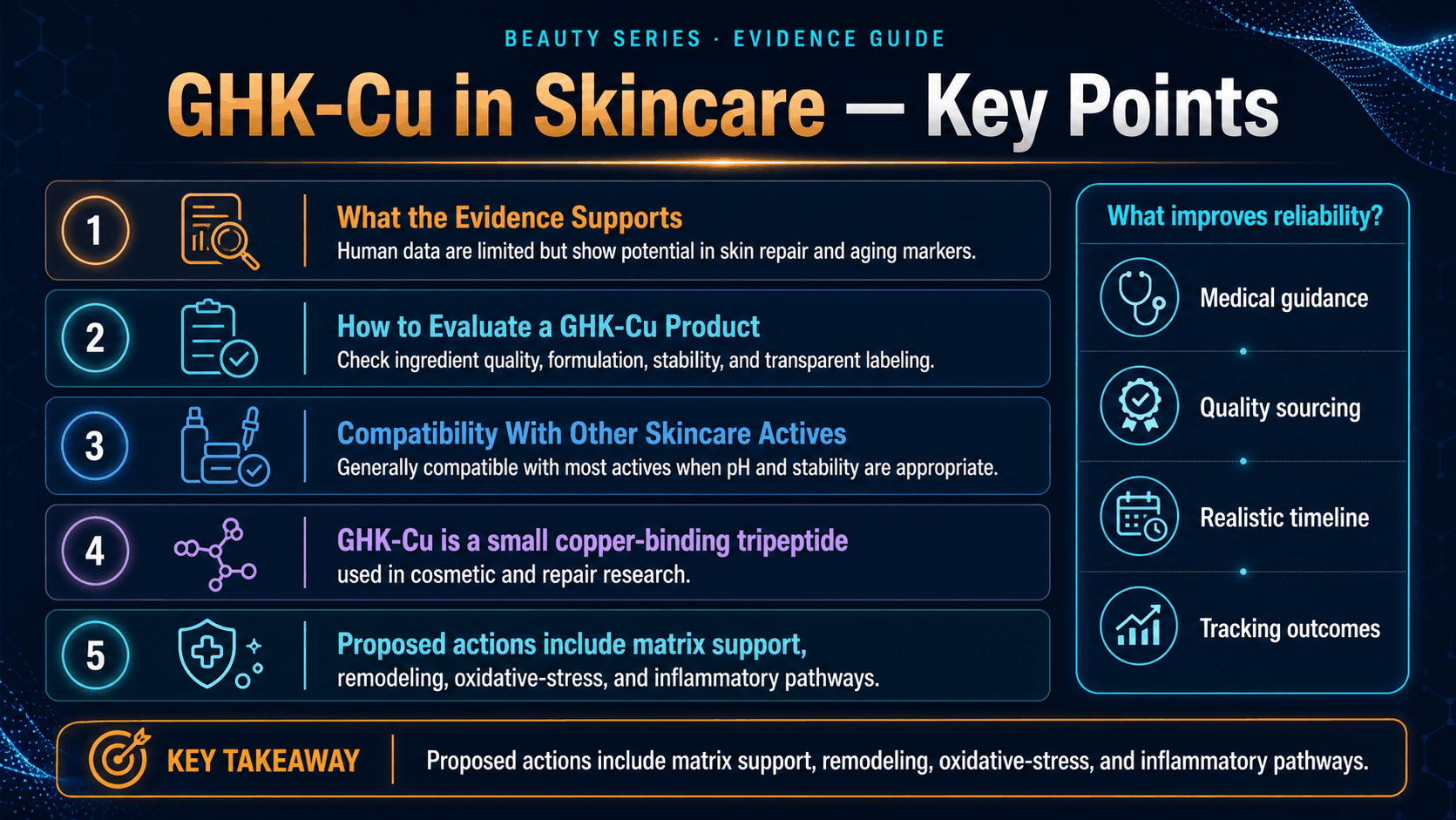
- GHK-Cu is a small copper-binding tripeptide used in cosmetic and repair research.
- Proposed actions include matrix support, remodeling, oxidative-stress, and inflammatory pathways.
- Human cosmetic evidence is promising but smaller than the evidence base for retinoids.
- Product stability, vehicle, packaging, and concentration all matter.
- Higher concentration is not automatically better.
- Niacinamide and hyaluronic acid are often compatible.
- Use caution with low-pH acids, retinoids, and especially microneedling.