
Three Broad Generations of Nootropics
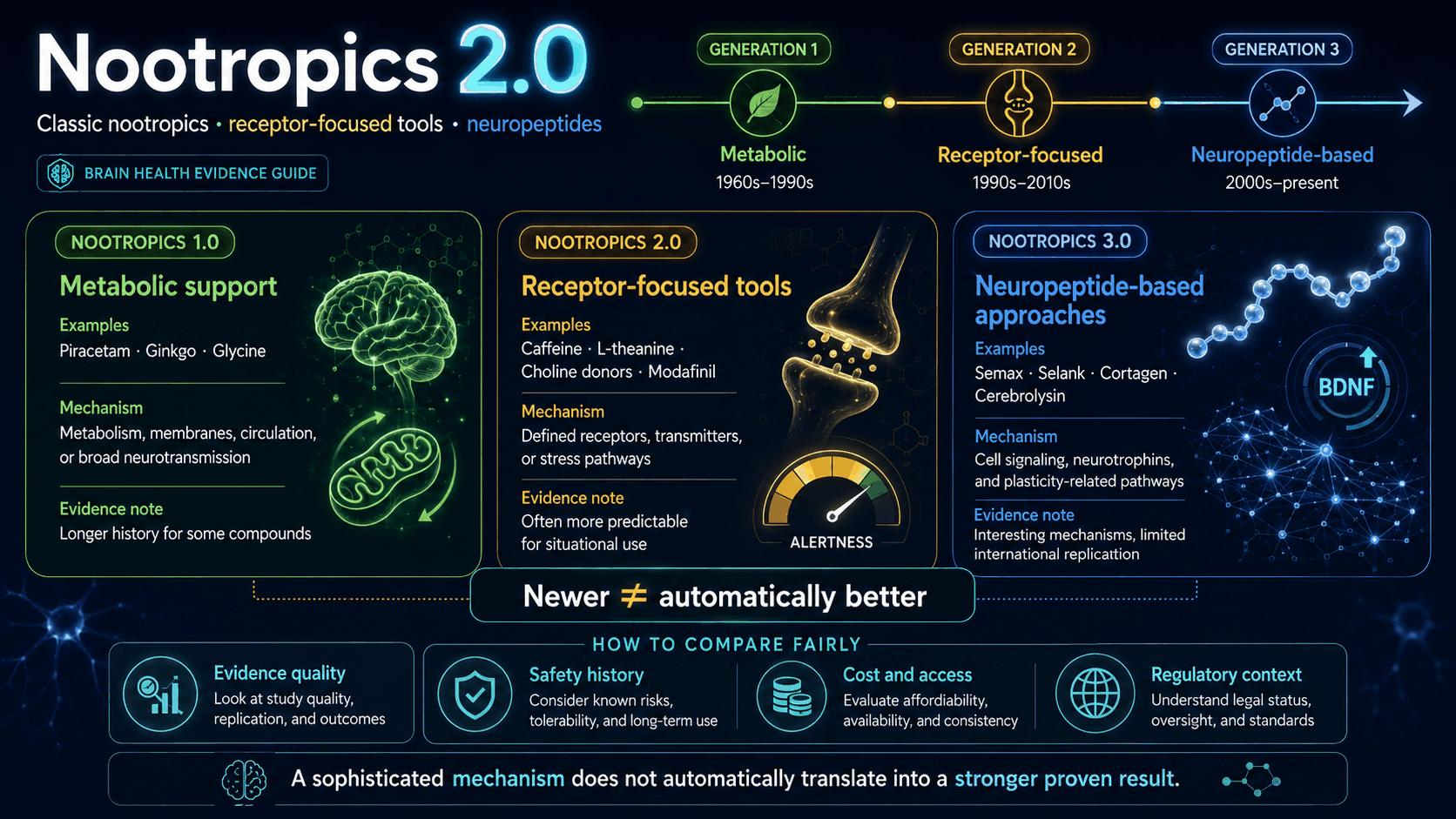
“Newer” does not automatically mean “better.” Each generation targets the brain in a different way.
Generation 1: Metabolic
1960s–1990sPiracetam, aniracetam, ginkgo, glycine, and related compounds. These agents tend to act broadly through metabolism, membranes, circulation, or general neurotransmission.
Generation 2: Receptor-focused
1990s–2010sModafinil, choline donors, caffeine, L-theanine, L-tyrosine, and some adaptogens. These agents often target defined receptors, transmitters, or stress pathways.
Generation 3: Neuropeptide-based
2000s–presentSemax, Selank, Cortagen, Cerebrolysin, and experimental peptide therapies. These are studied for cell signaling, neurotrophins, and plasticity-related pathways.
 Sponsored / AffiliateIntegrative Peptides · Practitioner-oriented peptide and wellness education
What Classic Nootropics Can Actually Do
Piracetam
Has decades of clinical use and has been studied for cognition in selected populations. Evidence for meaningful enhancement in healthy young adults is weak.
Alpha-GPC and Citicoline
Support acetylcholine synthesis and may be most useful when choline intake is inadequate or in selected clinical contexts.
Caffeine + L-Theanine
A practical short-term combination for alertness. Caffeine increases wakefulness, while theanine may reduce some jitteriness.
Three Generations Compared
| Parameter | Metabolic 1.0 | Receptor-focused 2.0 | Neuropeptides 3.0 |
|---|---|---|---|
| Main mechanism | Metabolism and membranes | Receptors and transmitters | Cell signaling and neurotrophin-related pathways |
| Speed of effect | Often days to weeks | Minutes to hours for some agents | May be rapid intranasally, but evidence varies |
| Neuroplasticity | Limited evidence | Moderate and compound-dependent | A major research focus, not uniformly proven clinically |
| BDNF-related effects | Weak or indirect | Possible with selected compounds | Reported mainly in preclinical research |
| Neuroprotection | Moderate in selected contexts | Compound-dependent | Promising in regional and preclinical research |
| Anxiety and stress | Phenibut can work but has dependence risk | Theanine and some adaptogens | Selank is studied, but international evidence is limited |
| Evidence base | Decades of data for some agents | Moderate and mixed | Limited international replication |
| Safety data | Longer history for many compounds | Generally well characterized by compound | Less long-term international data |
| Cost | Usually low | Moderate | Often higher |
| Healthy-person enhancement | Usually modest | Sometimes useful situationally | Frequently claimed, not strongly established |
When Classic Nootropics Are the Better Choice
Fast situational alertness
For a meeting, exam, or study session, caffeine with or without L-theanine is faster, cheaper, and more predictable than an experimental peptide.
Classic optionSelected clinical populations
Some established agents have longer histories in neurological or cognitive disorders than peptide nootropics.
Clinical context mattersLower-cost foundation
Sleep, nutrition, exercise, and evidence-based situational tools are usually more practical than expensive unregulated peptides.
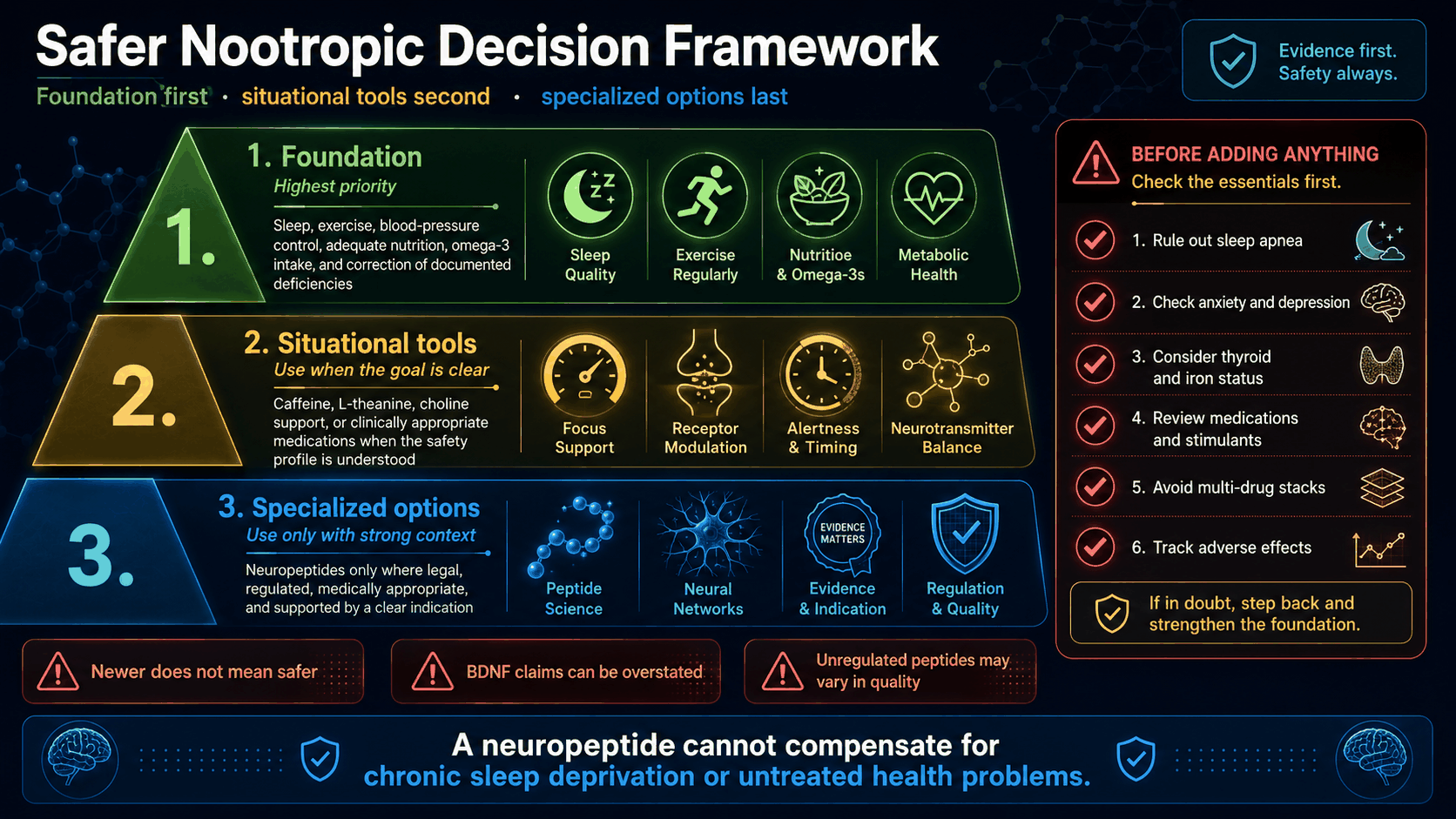
Start with basicsA Safer Three-Layer Decision Framework
 Sponsored / AffiliateDT Peptides · Peptide research products and laboratory-focused resources
How to Start Safely
- Define the actual problem: focus, memory, sleep, anxiety, mood, or fatigue.
- Rule out medical causes before adding nootropics.
- Correct sleep, nutrition, stress, and physical inactivity first.
- Add one evidence-based intervention at a time.
- Track sleep, blood pressure, anxiety, focus, and adverse effects.
- Avoid unregulated peptide products and self-designed multi-drug stacks.
Two Common Myths
Myth: Neuropeptides replace every classic nootropic.
Fact: Different compounds solve different problems. Caffeine provides immediate alertness; choline donors support acetylcholine synthesis; neuropeptides act through other proposed pathways.
Myth: Piracetam is outdated and useless.
Fact: Its value depends on the indication. Evidence is more relevant in selected clinical populations than in healthy young adults seeking enhancement.
Frequently Asked Questions
Are peptide nootropics better than classic nootropics?
Not automatically. Classic agents often have stronger safety histories and more predictable evidence. Peptide mechanisms may be interesting, but clinical proof is limited.
Do neuropeptides increase BDNF?
BDNF-related effects have been reported mainly in preclinical research. That does not guarantee meaningful cognitive improvement in humans.
What is the most practical nootropic for short-term focus?
Caffeine, sometimes combined with L-theanine, is among the most practical options for many healthy adults when used appropriately.
Are choline supplements useful?
They may be more helpful when intake is inadequate or in certain clinical settings than as universal cognitive enhancers.
Should multiple nootropics be started at once?
No. Starting one intervention at a time makes benefits and adverse effects easier to identify.
Key Takeaways
- There are several broad generations of nootropics with different mechanisms.
- Classic agents often have longer safety and evidence histories.
- Neuropeptides offer interesting mechanisms but limited human proof.
- Newer does not automatically mean better.
- Start with sleep, health, and diagnosis.
- Use one intervention at a time.
- Match the tool to the problem and the evidence.