
What Are Semax and Selank?
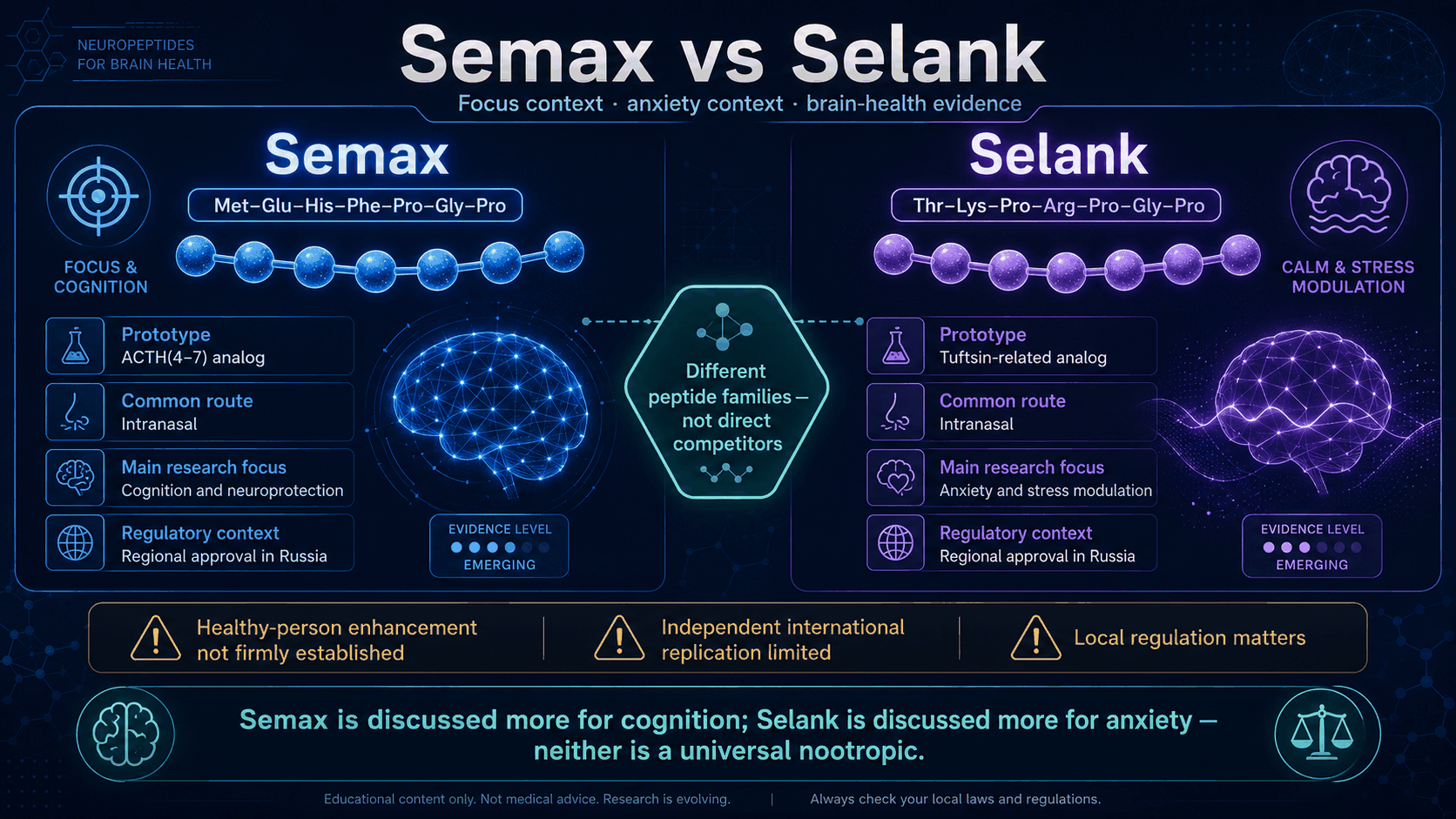
Both are seven-amino-acid peptide drugs developed within Soviet and Russian neuropharmacology, but they come from different peptide families.
Semax
Selank
 Sponsored / AffiliateIntegrative Peptides · Practitioner-oriented peptide and wellness education
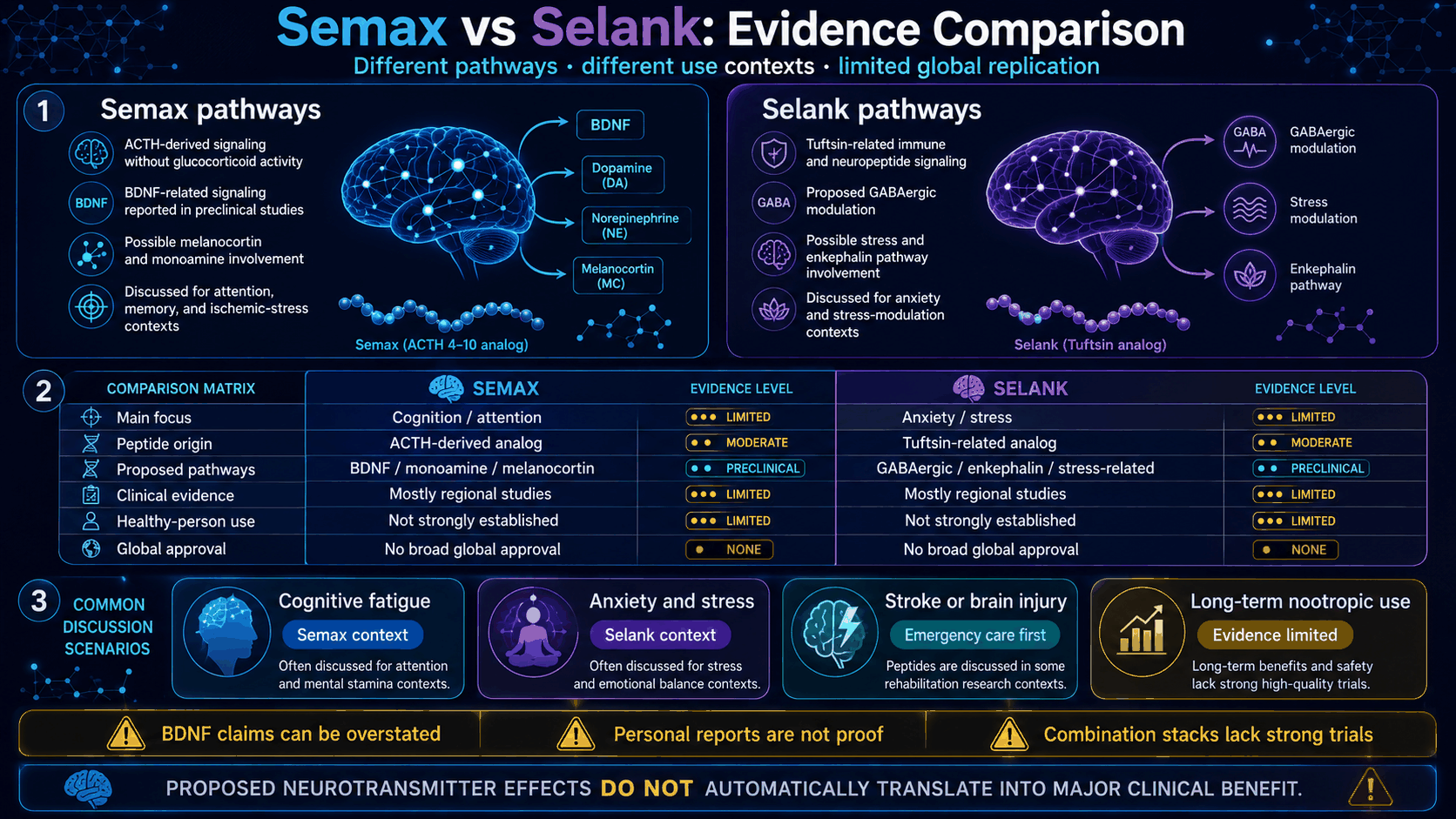
Proposed Neurochemical Pathways
Semax
- ACTH-derived signaling without glucocorticoid activity
- BDNF-related signaling reported in preclinical studies
- Possible melanocortin and monoamine involvement
- Potential effects on attention, memory, and ischemic stress
Selank
- Tuftsin-related immune and neuropeptide signaling
- Proposed GABAergic modulation
- Possible effects on stress and enkephalin pathways
- Potential anxiolysis without strong sedation
Semax vs Selank: Ten-Point Comparison
| Parameter | Semax | Selank |
|---|---|---|
| Main research focus | Cognition, attention, neuroprotection | Anxiety, stress, emotional regulation |
| Peptide origin | ACTH-derived analog | Tuftsin-related analog |
| Proposed pathways | Melanocortin, monoamine, BDNF-related | GABAergic, enkephalin, stress-related |
| Clinical evidence | Mostly Russian-language and regional studies | Mostly Russian-language and regional studies |
| Independent replication | Limited | Limited |
| Sedation | Usually not described as sedating | Often promoted as anxiolytic without heavy sedation |
| Healthy-person performance use | Not strongly established | Not strongly established |
| Stroke / acute neuroprotection | A major area of regional clinical use | Not a primary indication |
| Anxiety disorders | Not a primary use | Main area of interest |
| Global approval | No | No |
 Sponsored / AffiliatePeptide ReGenesis · Peptide education, protocols, and wellness-focused resources
When Each Compound Is Commonly Discussed
Cognitive fatigue or attention problems
Semax is discussed more often in cognitive and neuroprotective settings, but performance enhancement in healthy people remains insufficiently proven.
Semax contextAnxiety and chronic stress
Selank is discussed more often for anxiety symptoms, especially where heavy sedation is undesirable.
Selank contextAnxiety plus concentration difficulty
The anxiety disorder should be assessed first. Combining neuroactive peptides is not automatically evidence-based.
Medical assessment firstStroke or brain injury
Semax has regional clinical use, but emergency neurological care, imaging, and standard stroke treatment come first.
Clinical context onlyStress-related sleep difficulty
Sleep problems require assessment for anxiety, depression, medication effects, and sleep disorders.
Not a universal sleep treatmentLong-term nootropic use
Evidence for sustained enhancement in healthy adults is limited, and long-term safety is not firmly established internationally.
Evidence limitedSafety and Regulatory Context
Semax
- Use only regulated products where legally available
- Do not self-treat stroke, head injury, or severe neurological symptoms
- Monitor sleep, agitation, headache, nasal irritation, and blood pressure
- Healthy-person cognitive enhancement is not firmly established
Selank
- Use only regulated products where legally available
- Do not self-treat panic disorder, severe depression, or suicidal thoughts
- Monitor mood, sleep, nasal irritation, and paradoxical anxiety
- Long-term international safety data remain limited
What Personal Reports Can and Cannot Tell Us
Some users describe Semax as improving mental clarity or reducing cognitive “fog.” Others notice little or report headache, stimulation, or sleep disruption.
Selank users often describe a softer reduction in stress reactivity without heavy sedation. But anxiety symptoms fluctuate naturally, and expectation can influence subjective response.
Two Common Myths
Myth: Semax is a side-effect-free nootropic that makes anyone smarter.
Fact: Evidence for broad enhancement in healthy people is limited, and adverse effects such as nasal irritation, headache, agitation, or sleep disturbance can occur.
Myth: Selank is a natural benzodiazepine with the same proven effect but no risks.
Fact: Selank is not a benzodiazepine and does not share the same evidence base. Its proposed GABAergic modulation is mechanistically different.
Frequently Asked Questions
Are Semax and Selank approved in the United States?
No. They are not broadly approved in the United States.
Which is better for focus?
Semax is discussed more often in cognitive contexts, but healthy-person enhancement remains insufficiently proven.
Which is better for anxiety?
Selank is more closely associated with anxiety research and regional clinical use.
Can they be combined?
There is no strong international evidence that combining them is superior. Medical supervision is appropriate.
Do they increase BDNF?
BDNF-related effects have been reported in preclinical research, but that does not automatically translate into major clinical benefit.
Key Takeaways
- Semax and Selank are peptide drugs with regional clinical histories.
- Semax is associated mainly with cognition and neuroprotection research.
- Selank is associated mainly with anxiety and stress-modulation research.
- Independent international replication is limited.
- Neither is a universal nootropic or anxiety cure.
- Global approval is limited, and local regulation matters.
- Use regulated products and qualified medical guidance.