What Is Epitalon?
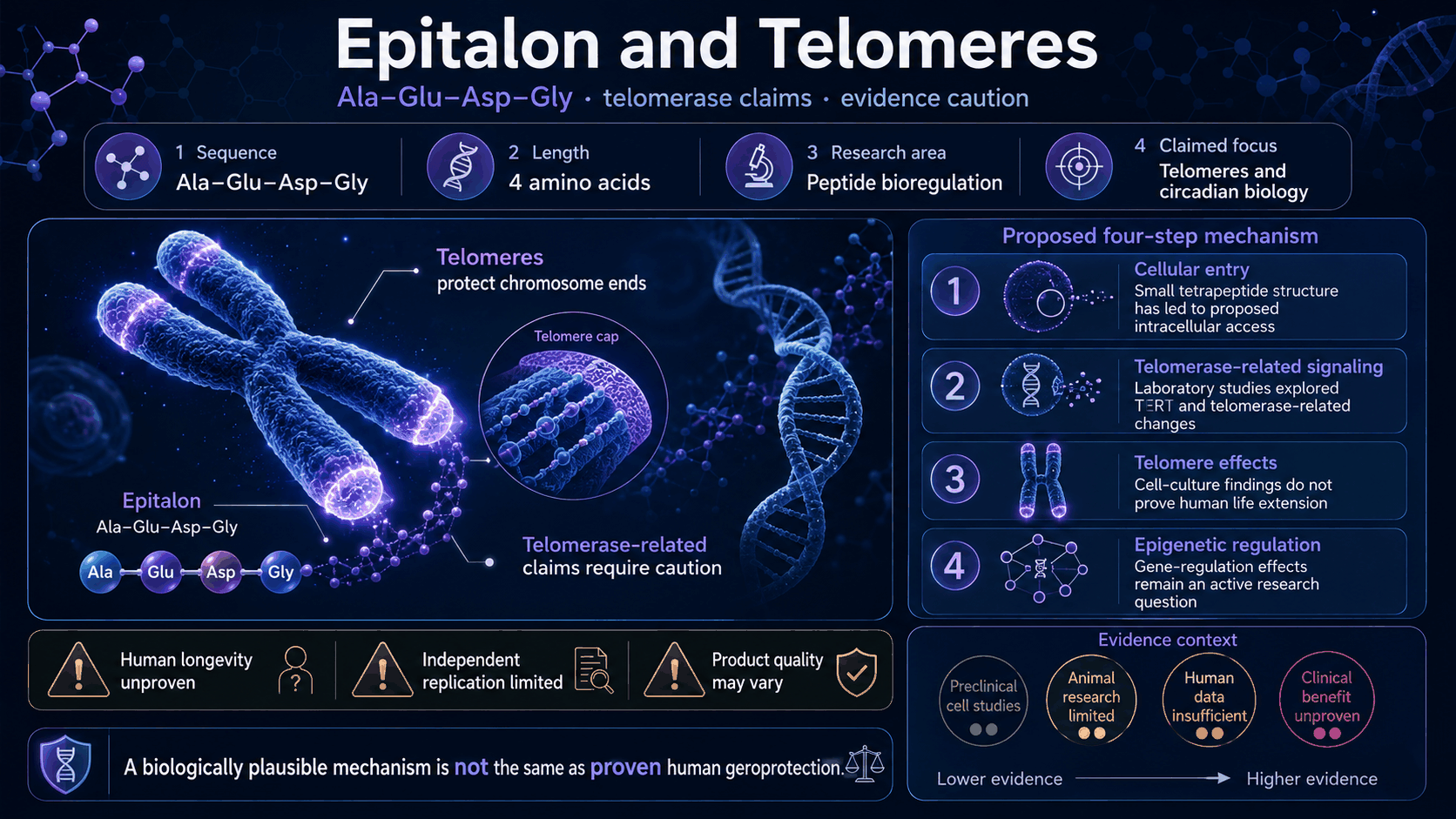
Epitalon is a synthetic tetrapeptide with the sequence Ala–Glu–Asp–Gly.
It is associated with the Russian peptide-bioregulator research tradition led by Vladimir Khavinson. It was developed in connection with earlier work on epithalamin, a peptide extract from the pineal gland.
Reference facts
Why caution is needed
Telomeres and Aging
Telomeres are protective DNA-protein structures at the ends of chromosomes. In many somatic cells, they shorten with repeated division. Critically short telomeres can contribute to cellular senescence or reduced replicative capacity.
Telomerase can extend telomeric DNA. It is active in some stem cells, germ cells, and many cancer cells, but limited in most adult somatic tissues. That dual role is one reason telomerase-related anti-aging claims require caution.
 Sponsored / AffiliateMomentous · Performance nutrition and recovery supplements
The Proposed Four-Step Mechanism
Cellular entry
Its small size has led researchers to propose intracellular access and possible interaction with nuclear targets. Human pharmacology is not fully characterized.
Telomerase-related signaling
Laboratory studies have explored changes related to telomerase activity and TERT expression. Clinical relevance remains uncertain.
Telomere effects
Some cell-culture experiments report telomere-related changes. In-vitro findings do not establish human life extension.
Epigenetic regulation
Effects on gene regulation and chromatin-related processes have been proposed, but this remains an active research question.
How Strong Is the Evidence?
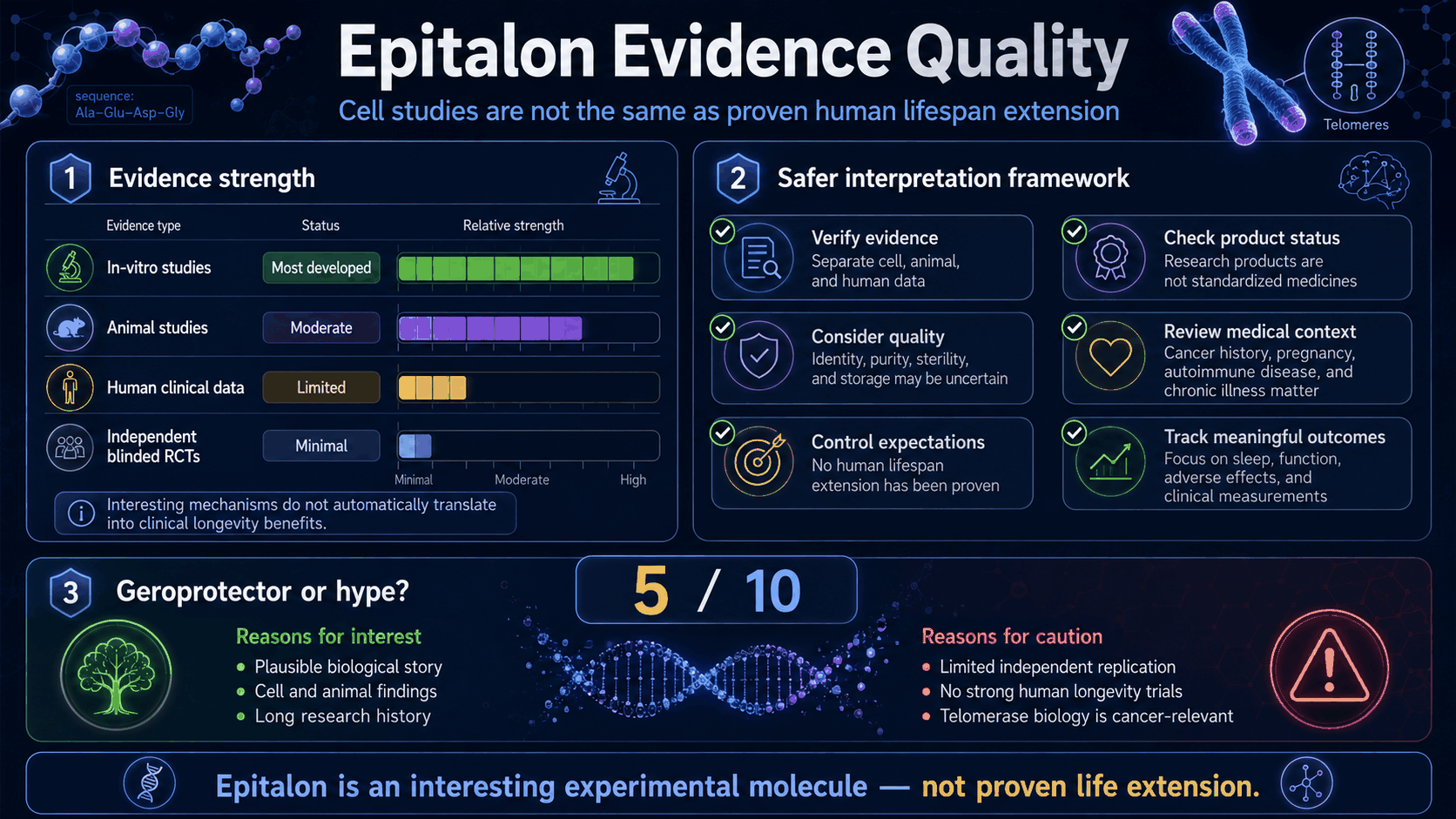
Published work includes cell-culture studies, animal longevity experiments, and smaller human studies involving aging-related outcomes. The most interesting findings involve telomerase-related changes in vitro and lifespan effects in rodents.
 Sponsored / AffiliateQuest Health · Personal lab testing and health marker tracking
A Safer Way to Interpret Epitalon
Verify the evidence
Separate cell, animal, and human data before accepting a claim.
Check product status
Research products are not standardized medicines.
Consider quality
Identity, purity, sterility, and storage conditions may be uncertain.
Review medical context
Cancer history, pregnancy, autoimmune disease, and chronic illness matter.
Control expectations
No human lifespan extension has been proven.
Track meaningful outcomes
Focus on sleep, function, adverse effects, and clinically relevant measurements.
Geroprotector or Hype?
Epitalon · Evidence verdict
Reasons for interest
- Biologically interesting hypothesis involving telomerase and cell aging
- Long research history rather than a recent social-media trend
- Cell and animal findings justify further investigation
- Small molecular structure supports mechanistic research
- Possible circadian relevance remains scientifically interesting
Reasons for caution
- Few independent replications outside the original research network
- No strong human longevity trials demonstrating life extension
- Human telomere benefit remains unproven
- Product quality and legality vary across markets
- Telomerase biology is also relevant to cancer
Balanced conclusion: Epitalon is neither pure hype nor a proven geroprotector. It is an interesting experimental molecule with a plausible biological story and insufficient high-quality human evidence.
Two Common Myths
Myth: Epitalon lengthens telomeres, so it is proven to extend human life.
Fact: Laboratory telomere-related findings and animal lifespan studies do not prove human life extension. Telomere length is one biomarker, not a guaranteed lifespan switch.
Myth: Epitalon is definitely safe because no major cancer signal has been reported.
Fact: Absence of a clear signal is not proof of long-term safety. Telomerase-related interventions require caution, especially with current or previous cancer.
Frequently Asked Questions
What is Epitalon made of?
It is a tetrapeptide composed of Ala–Glu–Asp–Gly.
Does Epitalon activate telomerase?
Laboratory studies have explored telomerase-related effects, but clinically meaningful activation in humans is not established.
Does Epitalon extend human life?
No convincing human evidence currently proves lifespan extension.
Is Epitalon approved as an anti-aging treatment?
Approval status varies by jurisdiction, but it is not established as a standard evidence-based longevity therapy.
Who should be especially cautious?
People with current or previous cancer, pregnancy or breastfeeding, active autoimmune disease, or serious chronic illness should not self-experiment.
Key Takeaways
- Epitalon is a four-amino-acid peptide.
- Telomerase-related effects are mainly laboratory findings.
- Animal results are interesting, but human longevity remains unproven.
- Independent clinical replication is limited.
- No validated self-treatment protocol exists.
- Healthy-aging basics have much stronger evidence.
- The most accurate label is promising research topic, not proven life extension.