The First 24–48 Hours
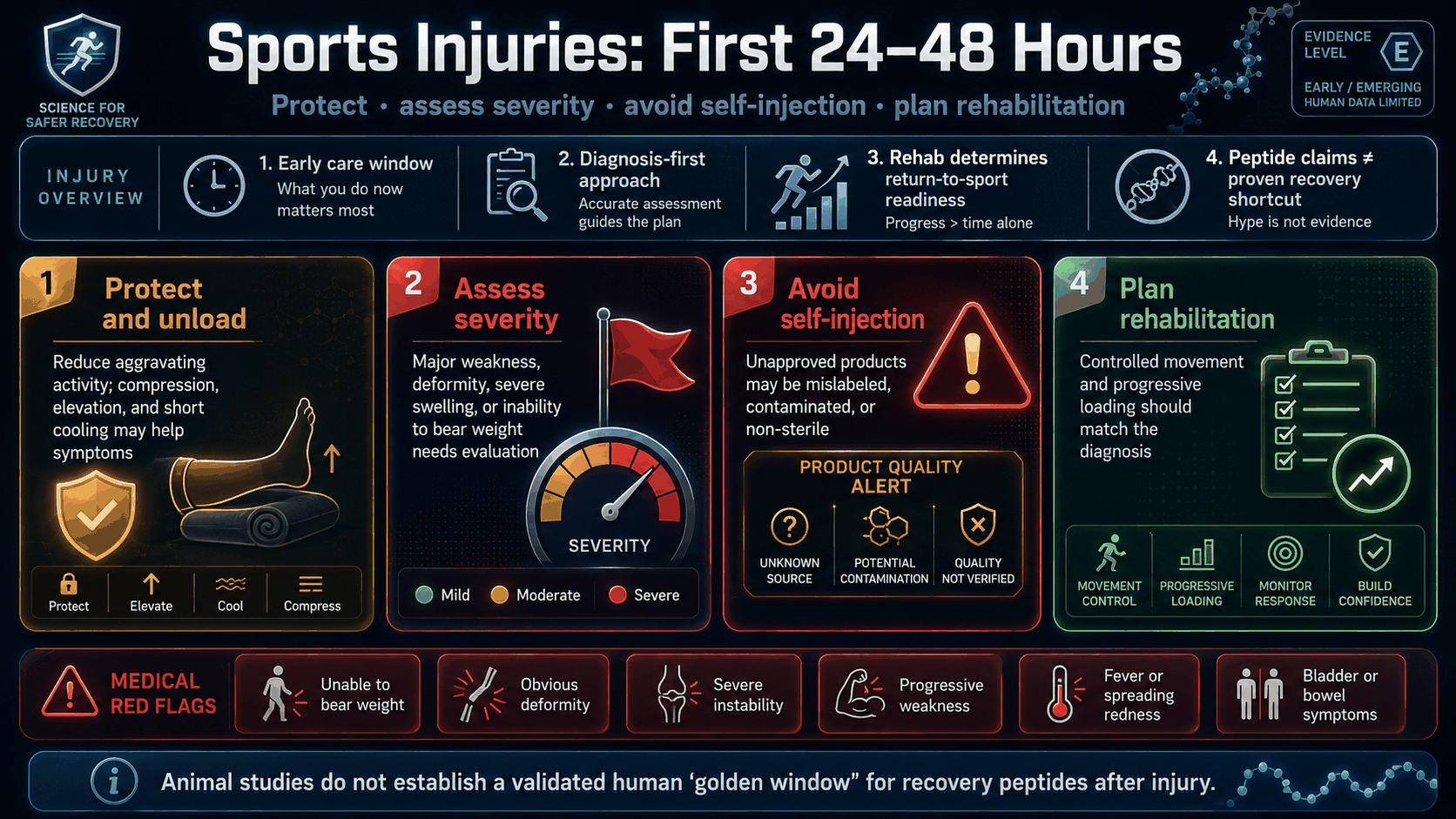
The immediate goal is to protect the injured structure, identify red flags, and begin diagnosis-based care.
Protect and unload
Reduce aggravating activity. Compression, elevation, and short periods of cooling may help symptoms.
Assess severity
Major weakness, deformity, severe swelling, or inability to bear weight require professional evaluation.
Avoid self-injection
Unapproved products may be mislabeled, contaminated, or non-sterile.
Plan rehabilitation
Begin controlled movement and progressive loading when appropriate for the diagnosis.
 Sponsored / AffiliateApollo Peptide Sciences · Research-focused peptide science and molecular data
Five Injury Zones
Knee
Meniscus · ACL · Patellar tendonCommon peptide claims
- BPC-157
- TB-500
- Collagen peptides
- Undenatured type II collagen
Evidence-based priorities
- Accurate diagnosis
- Quadriceps loading
- Neuromuscular control
- Post-operative protocol if required
Interpretation
Peptides cannot replace surgery when indicated. Collagen may support nutrition but does not rebuild a torn ACL or meniscus.
Ankle
Ligament sprain · Partial tearCommon peptide claims
- BPC-157
- TB-500
- Collagen peptides
Evidence-based priorities
- Protection and swelling control
- Mobility when appropriate
- Balance and proprioception
- Progressive running and cutting
Interpretation
Balance and proprioceptive work are among the most important steps for reducing reinjury risk.
Shoulder
Rotator cuff · Impingement · BursitisCommon peptide claims
- BPC-157
- TB-500
- Collagen peptides
- Hyaluronic acid products
Evidence-based priorities
- Identify tendon vs bursa vs joint
- Scapular control
- Rotator-cuff loading
- Technique correction
Interpretation
Movement mechanics and progressive loading are essential. Experimental peptides do not correct impingement mechanics.
Elbow
Tennis elbow · Golfer’s elbowCommon peptide claims
- BPC-157
- TB-500
- Collagen peptides
Evidence-based priorities
- Load modification
- Isometric and eccentric work
- Grip-strength progression
- Technique correction
Interpretation
Epicondylalgia is usually a tendinopathy. Mechanical remodeling requires progressive loading.
Lower Back
Muscle strain · Disc-related pain · Nerve symptomsCommon peptide claims
- BPC-157
- TB-500
- Semax
- Collagen peptides
Evidence-based priorities
- Screen neurological red flags
- Maintain tolerable movement
- Gradual trunk and hip loading
- Reassessment if symptoms persist
Interpretation
Progressive weakness, saddle numbness, or bladder and bowel symptoms require urgent evaluation.
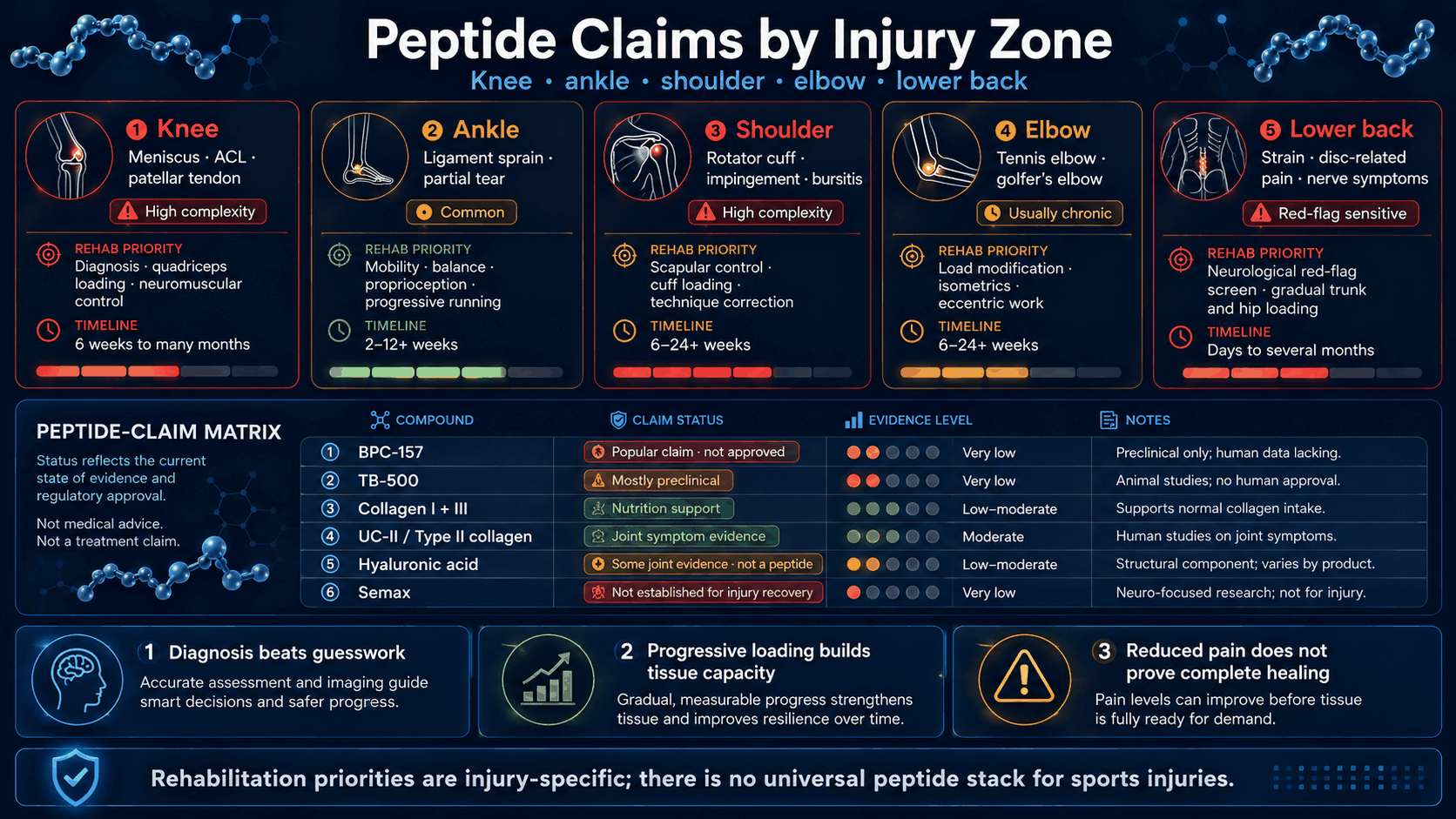
Peptide Claims by Injury Zone
| Compound | Knee | Ankle | Shoulder | Elbow | Lower back |
|---|---|---|---|---|---|
| BPC-157 | Popular claim | Popular claim | Popular claim | Popular claim | Popular claim |
| TB-500 | Preclinical | Preclinical | Preclinical | Preclinical | Preclinical |
| Collagen I + III | Nutrition support | Nutrition support | Nutrition support | Relevant to tendon nutrition | Limited direct role |
| UC-II / Type II collagen | Joint symptom evidence | Limited role | Limited role | Limited role | Limited role |
| Hyaluronic acid | Some joint evidence | Limited role | Some joint use | Limited role | Limited role |
| Semax | Not established | Not established | Not established | Not established | Not established for injury recovery |
 Sponsored / AffiliateQuest Health · Personal lab testing and health marker tracking
Three Critical Mistakes
Pain relief can hide a worsening injury and delay appropriate treatment.
Untrained injection can cause infection, tissue injury, bleeding, or damage to nearby structures.
Strength, coordination, proprioception, and load tolerance come from progressive rehabilitation.
When to Seek Medical Care
Two Common Myths
Myth: If pain decreases, the tissue is healed.
Fact: Pain can improve before strength, collagen organization, and neuromuscular control recover. No pain does not equal no injury.
Myth: Peptides cut every rehabilitation timeline in half.
Fact: There is no strong human evidence that BPC-157 or TB-500 reliably halves recovery time. Collagen remodeling still requires progressive loading over weeks or months.
Frequently Asked Questions
Are BPC-157 and TB-500 approved for sports injuries?
No. They are not approved injury treatments.
Can collagen peptides help recovery?
They may support protein intake and connective-tissue nutrition, but they do not replace rehabilitation or repair a complete tear.
What matters most after an ankle sprain?
Appropriate protection, mobility, strength, balance, proprioception, and a gradual return to running and cutting.
Why can shoulder recovery take so long?
The shoulder depends on several tendons, muscles, the scapula, the joint, and movement mechanics. Multiple factors often need rehabilitation.
When is lower-back pain urgent?
Progressive weakness, saddle numbness, bladder or bowel dysfunction, fever, or major trauma require urgent care.
Key Takeaways
- Diagnose the injured structure before choosing a recovery strategy.
- Protect the area and control aggravating load early.
- Rehabilitation determines strength and return-to-sport readiness.
- Collagen may support nutrition but does not replace rehabilitation.
- BPC-157 and TB-500 remain unapproved and poorly studied in humans.
- Reduced pain does not prove complete healing.