
What Does “Synergy” Actually Mean?
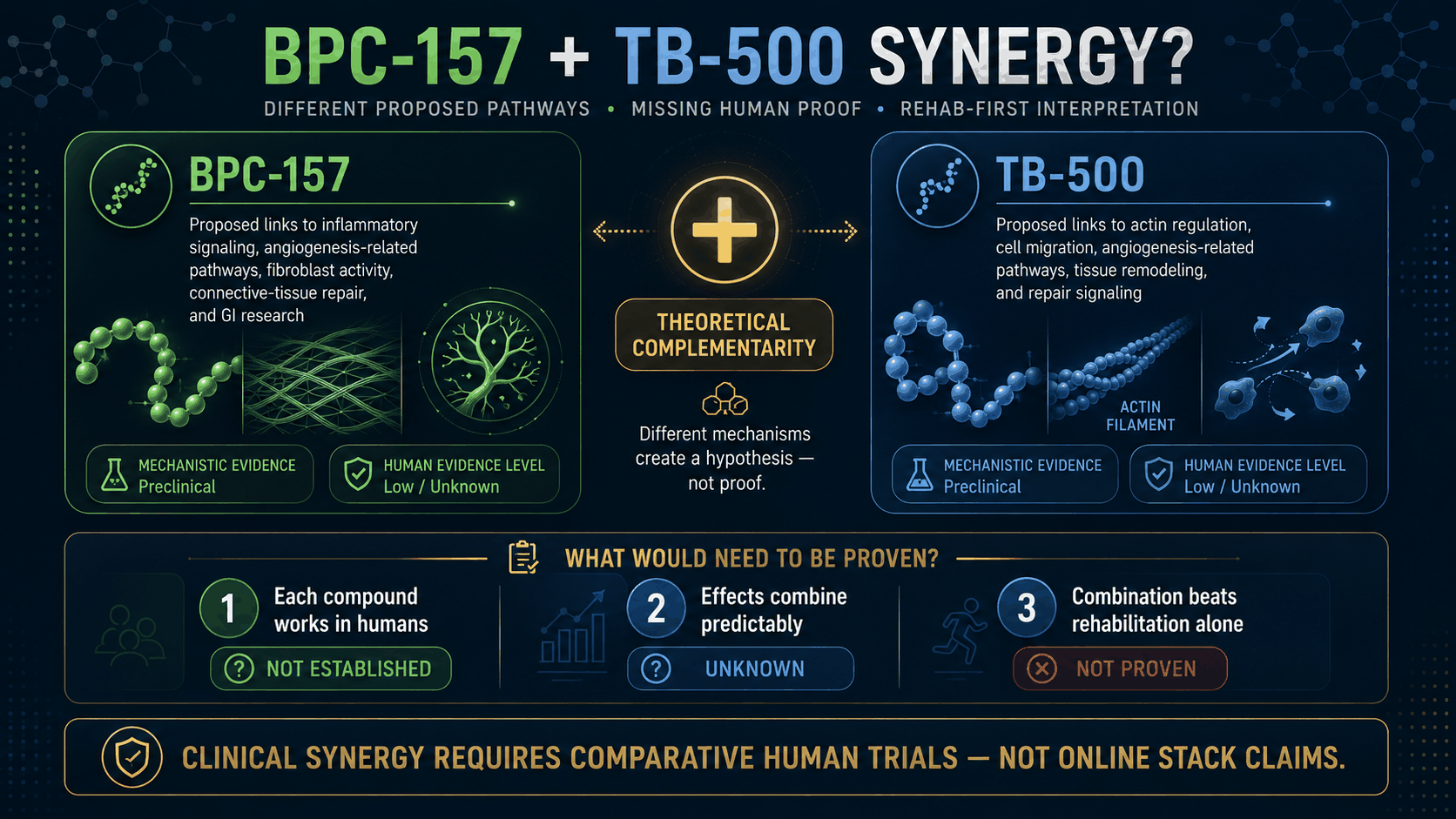
Different mechanisms can create a hypothesis of synergy, but they do not prove that the combination works better in humans.
BPC-157 is often discussed in relation to inflammatory signaling, blood-vessel pathways, connective-tissue repair, and gastrointestinal research. TB-500 is discussed in relation to actin biology, cell migration, tissue remodeling, and repair signaling.
Proposed Complementarity
BPC-157
Proposed links to inflammatory signaling, angiogenesis-related pathways, fibroblast activity, connective-tissue repair, and gastrointestinal research.
TB-500
Proposed links to actin regulation, cell migration, angiogenesis-related pathways, tissue remodeling, and repair signaling.
Theoretical synergy
Broader pathway coverage is biologically plausible, but there is no strong human proof, no validated protocol, and product identity may vary.
 Sponsored / AffiliatePeptide ReGenesis · Peptide education, protocols, and wellness-focused resources
Three Things That Would Need to Be Proven
BPC-157
Human injury-recovery evidence is very limited. Most claims are extrapolated from preclinical research.
TB-500
Human sports-injury evidence is also insufficient, and commercial product identity may not match full-length thymosin β4.
Timing
No validated human timing sequence shows that one should begin before the other.
Interaction
Robust pharmacokinetic, stability, and interaction data are missing.
Benefit
No strong trial demonstrates faster return to sport, stronger tissue, or fewer reinjuries.
Risk
Two unapproved products add more variables, more quality-control uncertainty, and more difficulty identifying adverse effects.
Why There Is No Evidence-Based “Stack Protocol”
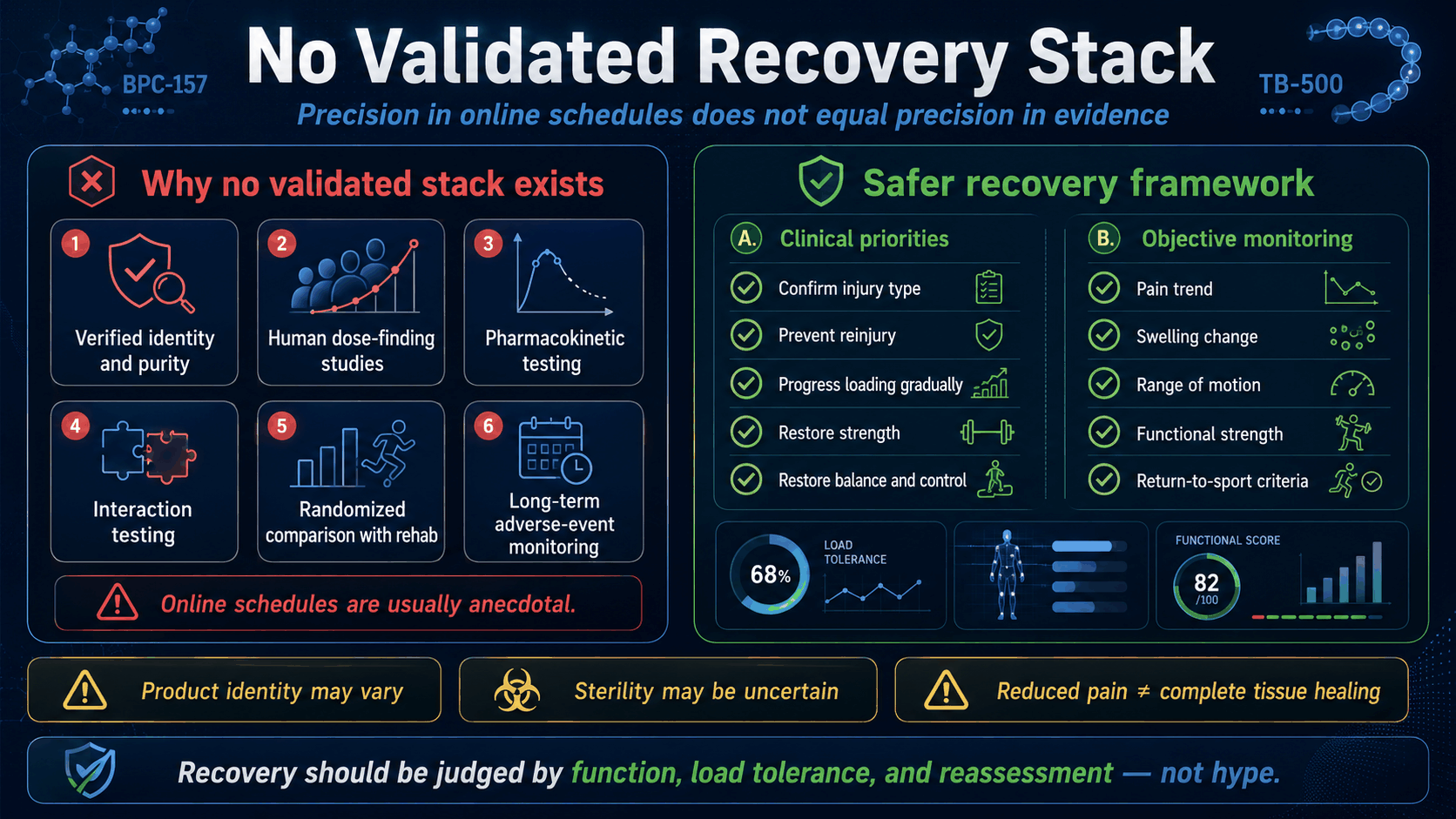
Online schedules often include loading phases, maintenance phases, injection timing, and precise doses. These schedules usually come from forums, vendors, anecdotal reports, or animal-to-human extrapolation—not high-quality clinical trials.
- Verified chemical identity and purity
- Human dose-finding studies
- Pharmacokinetic and interaction testing
- Randomized comparison with rehabilitation alone
- Adverse-event and long-term safety monitoring
- Standardized functional outcomes and imaging
A Safer Recovery Framework
Clinical priorities
- DiagnosisConfirm injury type
- ProtectionPrevent reinjury
- LoadingProgress gradually
- StrengthRestore capacity
- BalanceRestore control
Objective monitoring
- PainTrack the trend
- SwellingMeasure change
- Range of motionCompare sides
- StrengthUse functional tests
- Return to sportPass criteria
 Sponsored / AffiliateDynamic Peptides · Research peptide catalog and product education resources
What the Combination Might Cover—and What It Cannot Prove
| Recovery aspect | BPC-157 claim | TB-500 claim | Evidence-based interpretation |
|---|---|---|---|
| Inflammatory signaling | Preclinical interest | Preclinical interest | Overlap does not prove added benefit |
| Collagen-related repair | Often claimed | Less central claim | Human injury data remain insufficient |
| Angiogenesis-related pathways | Animal and laboratory data | Animal and laboratory data | Parallel pathways are only theoretical synergy |
| Cell migration | Limited claim | Actin-related biology | Mechanism does not equal clinical outcome |
| Muscle recovery | Unproven in humans | Unproven in sports injuries | No validated combination advantage |
| Ligaments and tendons | Popular claim | Popular claim | No strong comparative human trials |
| Nerve-related recovery | Preclinical findings | Preclinical findings | Clinical relevance remains uncertain |
| Gastrointestinal effects | Preclinical research | Not a central claim | Not evidence of injury synergy |
| Protocol convenience | Unapproved product | Unapproved product | More complexity, not more certainty |
How to Tell Whether Recovery Is Progressing
Pain and swelling
Track pain at rest, pain with movement, swelling, bruising, and sleep disruption.
Range of motion
Compare movement with the uninjured side and avoid forcing sharp pain.
Strength and control
Use balance, single-leg control, resistance, and movement-quality tests.
Load tolerance
Track walking, running, jumping, cutting, and the next-day symptom response.
No progress or worsening
Seek reassessment for increasing swelling, weakness, numbness, instability, or severe pain.
Possible infection
Seek care for spreading redness, heat, pus, fever, or rapidly worsening tenderness.
Two Common Myths
Myth: Different mechanisms automatically create proven synergy.
Fact: Different mechanisms create a hypothesis. Clinical synergy requires comparative human trials showing that the combination outperforms each compound alone.
Myth: A popular online schedule must be medically validated.
Fact: Popular schedules are usually anecdotal. Product identity, purity, dose, long-term safety, and interaction data remain uncertain.
Frequently Asked Questions
Is the BPC-157 and TB-500 combination proven?
No. Complementary mechanisms are plausible in theory, but clinical synergy has not been established in humans.
Is there a validated dosing schedule?
No. There is no established clinical stack protocol supported by high-quality human trials.
Can the combination replace rehabilitation?
No. Strength, balance, mobility, and progressive loading remain essential.
Can pain relief prove that tissue has healed?
No. Symptoms may improve before tissue capacity and neuromuscular control are fully restored.
Why are online products risky?
Identity, purity, sterility, concentration, and storage conditions may be uncertain.
Key Takeaways
- BPC-157 and TB-500 have different proposed mechanisms.
- Theoretical complementarity is plausible.
- Human combination trials are lacking.
- No validated dosing or injection protocol exists.
- Product identity, purity, and sterility may vary.
- Rehabilitation remains the foundation of recovery.
- Recovery should be judged by function, not hype.