
What Is TB-500?
The safest scientific description is that TB-500 is a thymosin β4-related research peptide sold for experimental use.
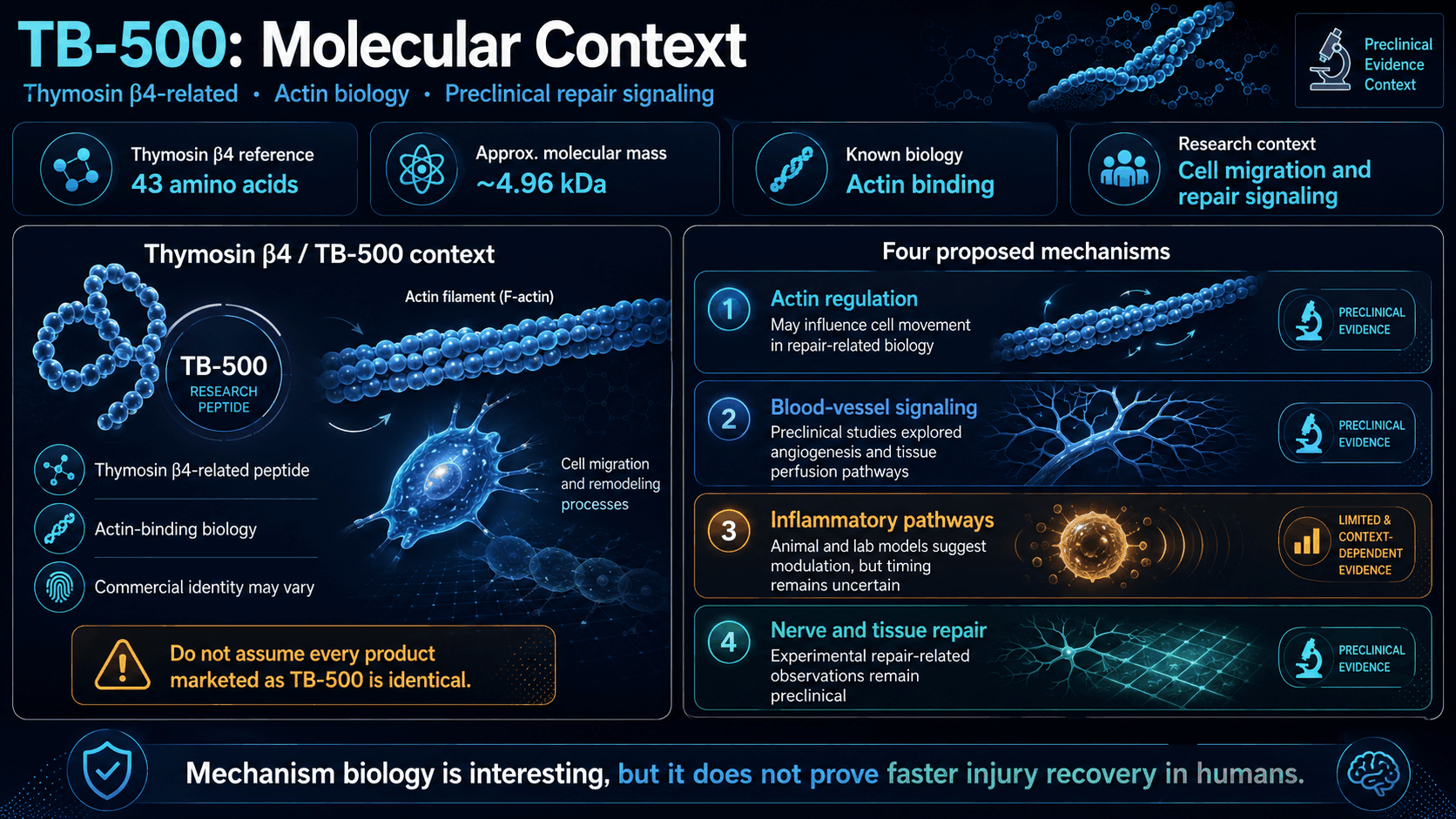
Full-length thymosin β4 is a naturally occurring 43-amino-acid peptide involved in actin binding and cell-migration biology. The term “TB-500” is used inconsistently across online sellers and research discussions, which makes exact identity and purity difficult to assume.
Molecular Context
Thymosin β4 reference facts
TB-500 caution points
 Sponsored / AffiliateApollo Peptide Sciences · Research-focused peptide science and molecular data
Four Proposed Mechanisms
These mechanisms are biologically interesting, but they remain mostly preclinical in the context of sports injuries.
Actin regulation
Thymosin β4 binds monomeric actin and may influence cell movement. Cell migration is important in repair, but this does not prove faster healing in humans.
Blood-vessel signaling
Preclinical studies have explored angiogenesis and tissue-perfusion pathways. The clinical effect in injured people remains uncertain.
Inflammatory pathways
Laboratory and animal models suggest modulation of inflammatory signaling, but timing and human relevance are not established.
Nerve and tissue repair
Experimental studies report repair-related and cell-survival effects, but human sports-injury evidence remains insufficient.
TB-500 vs BPC-157
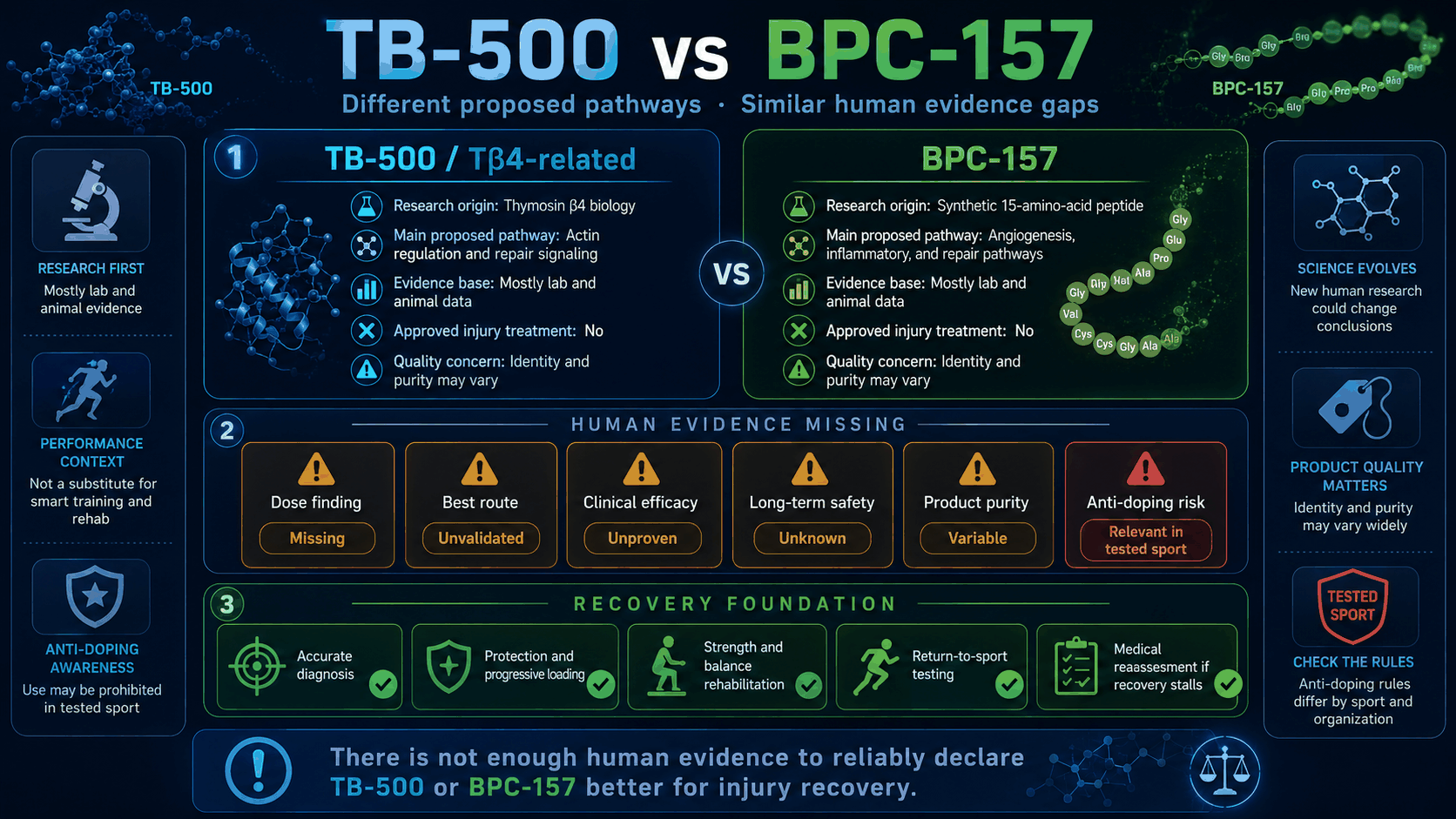
| Parameter | TB-500 / Tβ4-related | BPC-157 |
|---|---|---|
| Research origin | Thymosin β4 biology | Synthetic 15-amino-acid peptide |
| Main proposed pathway | Actin regulation and repair signaling | Angiogenesis, inflammatory, and repair pathways |
| Evidence base | Mostly laboratory and animal data | Mostly laboratory and animal data |
| Human sports-injury trials | Insufficient | Insufficient |
| Approved injury treatment | No | No |
| Product-quality concern | Identity and purity may vary | Identity and purity may vary |
| Anti-doping relevance | Relevant in tested sport | Relevant in tested sport |
What Human Evidence Is Missing?
A real treatment requires reproducible manufacturing, dose-finding studies, route comparisons, controlled trials, adverse-event monitoring, and long-term follow-up. TB-500 does not yet have that clinical evidence base for injury recovery.
TB-500 + BPC-157: Is the Combination Proven?
The combination is popular because the two compounds are believed to affect different repair pathways. That makes the idea theoretically attractive, but theoretical complementarity is not proof of clinical synergy.
Different pathways can be complementary in theory.
There are no robust human studies showing that the combination outperforms rehabilitation or either compound alone.
Using two unapproved products makes adverse effects and contamination harder to interpret.
Strength, balance, mobility, and return-to-sport testing can be tracked objectively.
Risks, Contraindications, and Anti-Doping Concerns
What is evidence-based
- Accurate diagnosis
- Protection and progressive loading
- Strength and balance rehabilitation
- Return-to-sport testing
- Medical reassessment if recovery stalls
Why caution is necessary
- Unapproved product
- Uncertain identity, purity, and sterility
- Injection-related infection risk
- Unknown long-term effects
- Theoretical angiogenesis concerns
- Anti-doping consequences
Two Common Myths
Myth: TB-500 and thymosin β4 are always exactly the same.
Fact: Full-length thymosin β4 is a defined 43-amino-acid peptide. Commercial TB-500 labeling may refer to fragments or related materials, so exact identity should be verified rather than assumed.
Myth: Athlete use proves that TB-500 works.
Fact: Popularity in sports communities does not establish effectiveness or safety. Tested athletes must also consider current anti-doping rules.
Frequently Asked Questions
Is TB-500 approved for injury recovery?
No. It is not an approved medication for muscle, tendon, or ligament injuries.
Does animal research prove that it works in humans?
No. Animal findings can suggest mechanisms, but they do not establish human effectiveness or safety.
Is TB-500 better than BPC-157?
There is not enough comparative human evidence to rank them reliably.
Is the TB-500 and BPC-157 combination proven?
No. The combination is popular, but there is no established clinical “stack” protocol supported by strong human trials.
Can TB-500 replace rehabilitation?
No. Rehabilitation is necessary for strength, balance, mobility, and safe return to activity.
 Sponsored / AffiliatePeptide ReGenesis · Peptide education, protocols, and wellness-focused resources
Key Takeaways
- TB-500 is best described as a thymosin β4-related research peptide.
- Most injury-recovery evidence is preclinical.
- Human effectiveness remains unproven.
- TB-500 and BPC-157 do not have proven clinical synergy.
- Product identity, purity, and sterility may vary.
- Rehabilitation remains the foundation of recovery.
- Drug-tested athletes must verify current anti-doping rules.