
What Happened
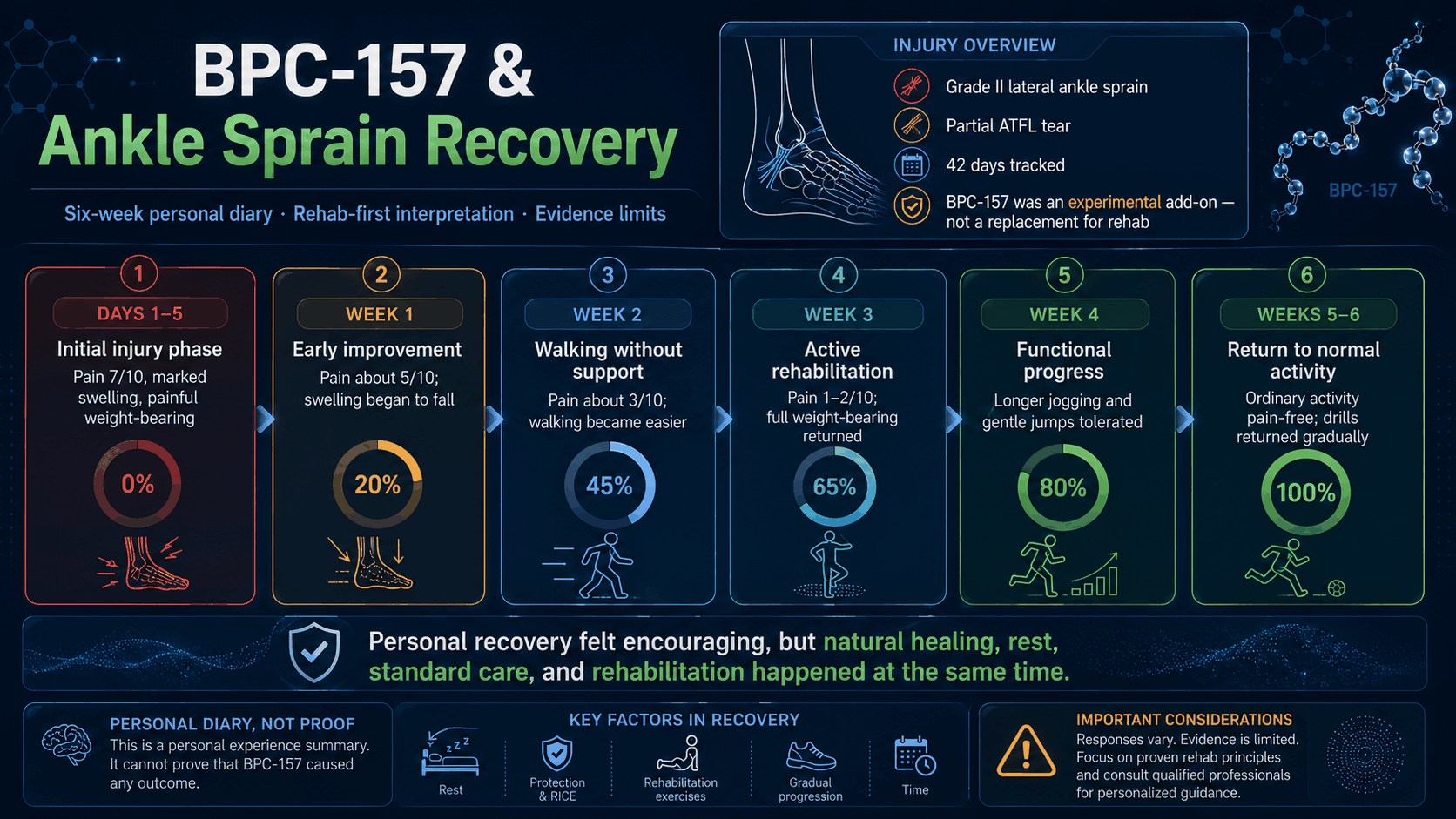
The injury was a Grade II lateral ankle sprain involving a partial tear of the anterior talofibular ligament.
The ankle rolled inward after landing from a jump. Pain, swelling, and limited mobility followed. Standard care included protection, relative rest, compression, elevation, medical assessment, and a progressive rehabilitation plan.
Diagnosis
Partial ligament tear rather than a complete rupture.
Early care
Protection, compression, elevation, and pain control when needed.
Rehabilitation
Mobility, balance, controlled loading, and a gradual return to running.
What Is BPC-157?
BPC-157 is a synthetic 15-amino-acid peptide sequence derived from a fragment studied in gastric-juice research. It is often discussed online for soft-tissue recovery, but it is not an approved human injury medication.
Most of the scientific interest comes from animal and laboratory studies exploring possible effects on blood-vessel signaling, fibroblast activity, inflammatory pathways, and tissue repair.
What Was Tracked
Rather than treating the experience as proof, the recovery was documented as a personal observation.
 Sponsored / AffiliatePeptide ReGenesis · Peptide education, protocols, and wellness-focused resources
Six-Week Recovery Diary
Pain was about 7/10, swelling was marked, and weight-bearing was painful. Medical assessment confirmed a partial tear.
Pain decreased to about 5/10 by the end of the week. Swelling began to fall, and heel loading became easier.
Pain reached about 3/10. Swelling was much lower and walking without support became possible. Several factors were changing at once, so causation could not be assigned.
Pain was 1–2/10 with sudden movements. Full weight-bearing returned, and light jogging was introduced after professional approval.
Longer jogging sessions and gentle jumps were tolerated. High-intensity cutting and jumping were still limited.
Ordinary activity was pain-free. Running and change-of-direction drills returned gradually. Recovery at six weeks remained within the expected range for many Grade II ankle sprains.
Proposed Mechanisms
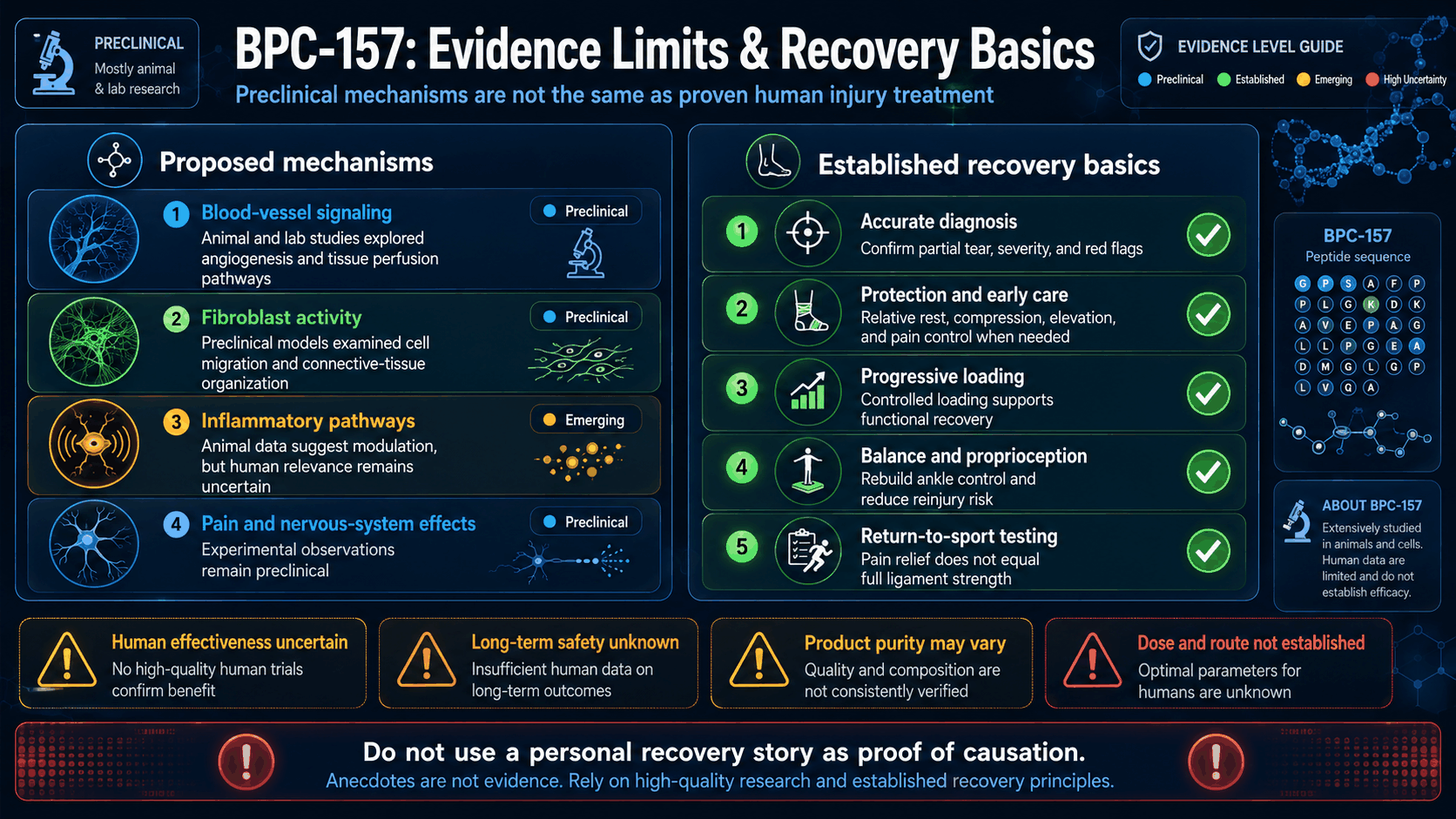
These mechanisms come mainly from preclinical research and should not be described as proven human effects.
Animal and laboratory studies have explored pathways related to angiogenesis and tissue perfusion.
Preclinical models have examined cell migration and connective-tissue organization.
Animal data suggest modulation of inflammatory pathways, but human relevance remains uncertain.
Preclinical research has reported pain-related and neuroprotective observations that remain experimental.
What Is Known and What Remains Unknown
What is established
- Grade II ankle sprains often improve over several weeks
- Progressive rehabilitation reduces reinjury risk
- Controlled loading supports recovery
- Pain relief does not equal full ligament strength
What remains uncertain
- Whether BPC-157 accelerates healing in humans
- What dose or route would be safe or effective
- Long-term safety and purity of unapproved products
- Which injuries, if any, would benefit
Two Common Myths
Myth: BPC-157 can replace physical therapy.
Fact: No peptide restores balance, proprioception, joint control, or muscle strength by itself. Rehabilitation remains essential.
Myth: BPC-157 is proven in humans.
Fact: Animal data are much more extensive than human data. High-quality clinical trials are lacking, and long-term safety is uncertain.
Frequently Asked Questions
Is BPC-157 approved for ankle sprains?
No. It is not approved as a treatment for ligament or tendon healing.
Does animal research prove that it works in people?
No. Animal findings can suggest mechanisms, but they do not establish human effectiveness or safety.
Can a personal recovery story prove causation?
No. Natural healing, rehabilitation, rest, training history, and other variables can all influence recovery.
What matters most after a Grade II ankle sprain?
Accurate diagnosis, protection, progressive loading, balance work, range-of-motion exercises, and a gradual return to sport.
 Sponsored / AffiliateApollo Peptide Sciences · Research-focused peptide science and molecular data
Key Takeaways
- BPC-157 is a synthetic 15-amino-acid peptide.
- Most evidence is preclinical rather than human clinical evidence.
- The six-week recovery was personally encouraging but not proof of effectiveness.
- Rehabilitation remained the foundation of recovery.
- Long-term safety, purity, dose, and route remain uncertain.
- Unapproved peptides should never replace diagnosis or evidence-based treatment.