
Why Age Changes the Conversation
There is no single “best age” for every peptide-related goal.
In your twenties, the body is usually close to its biological peak, so the conversation is mostly about prevention, recovery, and avoiding unnecessary intervention. In your forties and fifties, visible aging, slower recovery, hormonal changes, and immune resilience become more relevant. After sixty, medical supervision and quality of life become the priority.
The important point is not that one decade is “right” and another is “wrong.” The goal, risk profile, and expected response simply change.
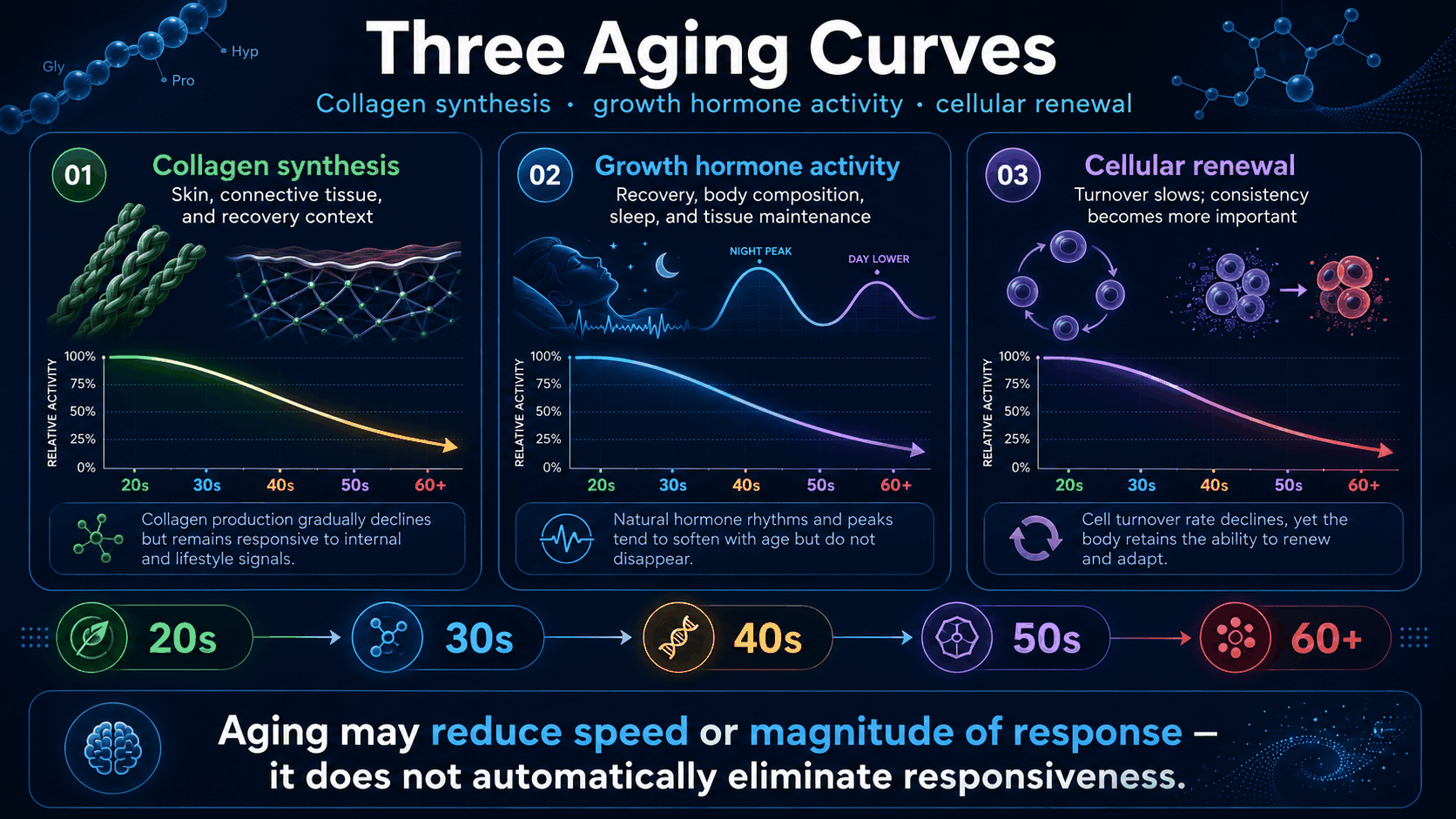
Three Biological Curves That Change With Age
1. Collagen synthesis
Collagen production is highest in early adulthood and gradually declines, affecting skin, connective tissue, and recovery.
2. Growth hormone activity
Growth-hormone secretion declines across adulthood, influencing recovery, body composition, sleep, and tissue maintenance.
3. Cellular renewal
Cell turnover generally slows with age, which can make visible results take longer and increase the need for consistency.
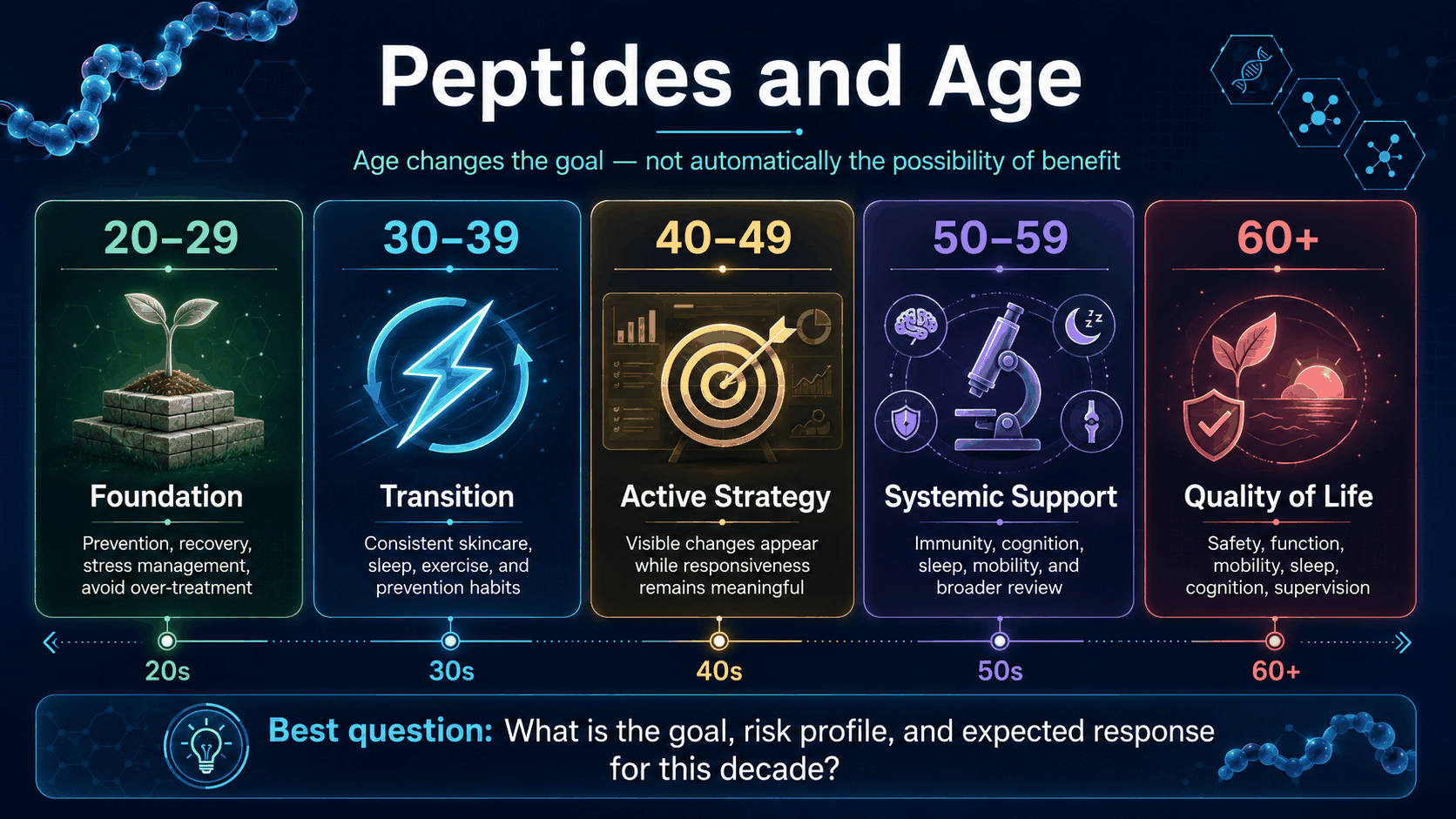
Five Age Windows
🌱 Ages 20–29 — Foundation
Most systems are functioning close to peak capacity. Priorities are usually prevention, athletic recovery, stress management, and avoiding over-treatment.
⚡ Ages 30–39 — Transition
Fine lines, slower recovery, and the first noticeable changes often appear. This is a practical decade for consistent skincare, sleep, exercise, and prevention.
🎯 Ages 40–49 — Active Strategy
This decade is often called the “golden window” because changes are noticeable while biological responsiveness remains meaningful. A systematic plan matters more than isolated interventions.
🔬 Ages 50–59 — Systemic Support
Hormonal transitions, immune resilience, cognition, bone health, sleep, and gastrointestinal health may become more important than purely cosmetic goals.
🌿 Ages 60+ — Quality of Life
Responses may be slower and medication interactions matter more. The focus should be safety, function, mobility, sleep, cognition, and physician-guided decision-making.
 Sponsored / AffiliatePeptide ReGenesis · Peptide education, protocols, and wellness-focused resources
The Benefit Curve
Many people notice the greatest visible return in the mid-thirties through mid-forties because age-related changes have begun, while recovery and receptor responsiveness are still relatively strong.
Quick-Reference Table
| Peptide / group | 20–29 | 30–39 | 40–49 | 50–59 | 60+ |
|---|---|---|---|---|---|
| Oral collagen | Prevention | Consider starting | Daily routine | Consistent use | Ongoing support |
| GHK-Cu | Optional | Topical use often discussed | Common priority | Relevant | Use with supervision |
| Epitalon | Usually unnecessary | Early prevention discussion | Commonly discussed | Higher-priority discussion | Medical supervision |
| BPC-157 | Sports / injury context | Recovery context | Joints | GI + joints | GI + mobility |
| Thymosin Alpha-1 / Thymalin | Low priority | Prevention discussion | Immune focus | Higher priority | Physician-guided |
| Semax / Selank | Stress / study | Productivity | Goal-dependent | Cognition | Neuro support |
| GH secretagogues | Advanced sports context | Sports context | Recovery discussion | Caution | Medical consultation |
| DSIP | Rarely needed | When indicated | When indicated | Sleep focus | Potentially relevant |
This table is an educational planning framework, not a treatment recommendation.
Common Myths
Myth: Starting at 40 is already too late.
Fact: The forties can be a highly responsive period because visible changes are present while biological responsiveness remains meaningful.
Myth: Peptides are automatically inappropriate in your twenties.
Fact: The risk-benefit profile depends on the product and goal. Recovery, collagen, cognition, and aggressive anti-aging protocols are not the same conversation.
Myth: After 60, receptors no longer respond.
Fact: Responsiveness may decline, but it does not disappear. Safety screening and medical supervision become much more important.
 Sponsored / AffiliatePeptide University · Peptide learning resources and educational programs
Key Takeaways
- Your twenties are mainly about prevention and recovery.
- Your thirties are a strong time to build consistent habits.
- Your forties often provide the clearest visible return.
- Your fifties require a broader, more systemic strategy.
- After sixty, quality of life and medical supervision come first.
- Age changes the goal; it does not automatically remove the possibility of benefit.