
Why Peptide Myths Spread So Easily
Peptides sit at the intersection of medicine, skincare, sports, supplements, and online marketing.
That makes them especially vulnerable to two extremes: exaggerated promises and exaggerated fear. Some claims turn every peptide into a miracle. Others treat every peptide as illegal or dangerous. Both approaches ignore the fact that peptides are a broad category, not one single product.
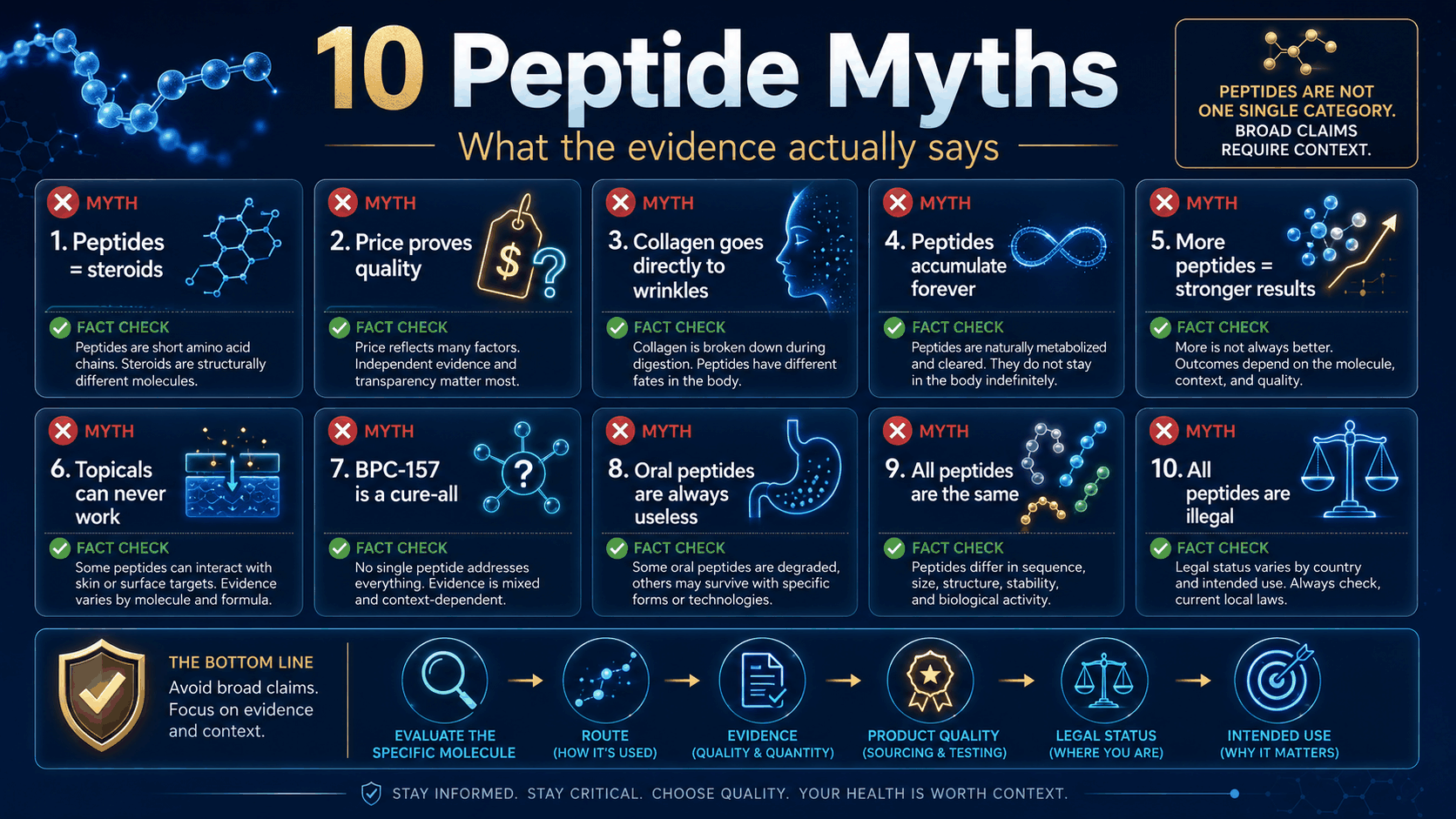
Peptides and steroids are fundamentally different classes of molecules. Steroids are cholesterol-derived compounds, while peptides are chains of amino acids. Some peptides influence hormone release, but that does not make them identical to steroids or administered hormones.
Price does not directly reveal peptide concentration or formulation quality. Branding, packaging, and marketing can drive price. The ingredient list, delivery system, stability, and clinical evidence matter more.
Collagen is digested into amino acids and short peptides. Some fragments may act as building blocks or biological signals, but intact collagen does not travel directly to wrinkles and fill them.
Many peptides are broken down by peptidases into smaller fragments and amino acids. Half-life varies widely by molecule and formulation, but long-term accumulation is not a universal property of peptides.
More is not automatically better. Receptors can saturate, side effects may increase, and combining several products makes it harder to identify what helped or caused a reaction.
 Sponsored / AffiliateDynamic Peptides · Research peptide catalog and product education resources
Large hydrophilic peptides penetrate poorly, but cosmetic peptides can be modified or formulated to improve delivery. Their effects are generally subtler than injectable delivery, but “no effect at all” is too broad.
BPC-157 has been studied in tissue repair, gastrointestinal, and neurological models, but much of the evidence is preclinical. Human clinical data remain limited. It is a research peptide, not a universal cure.
Many peptides are degraded in digestion, but some short peptides can be absorbed through peptide transporters. Oral bioavailability is often lower, but not always zero.
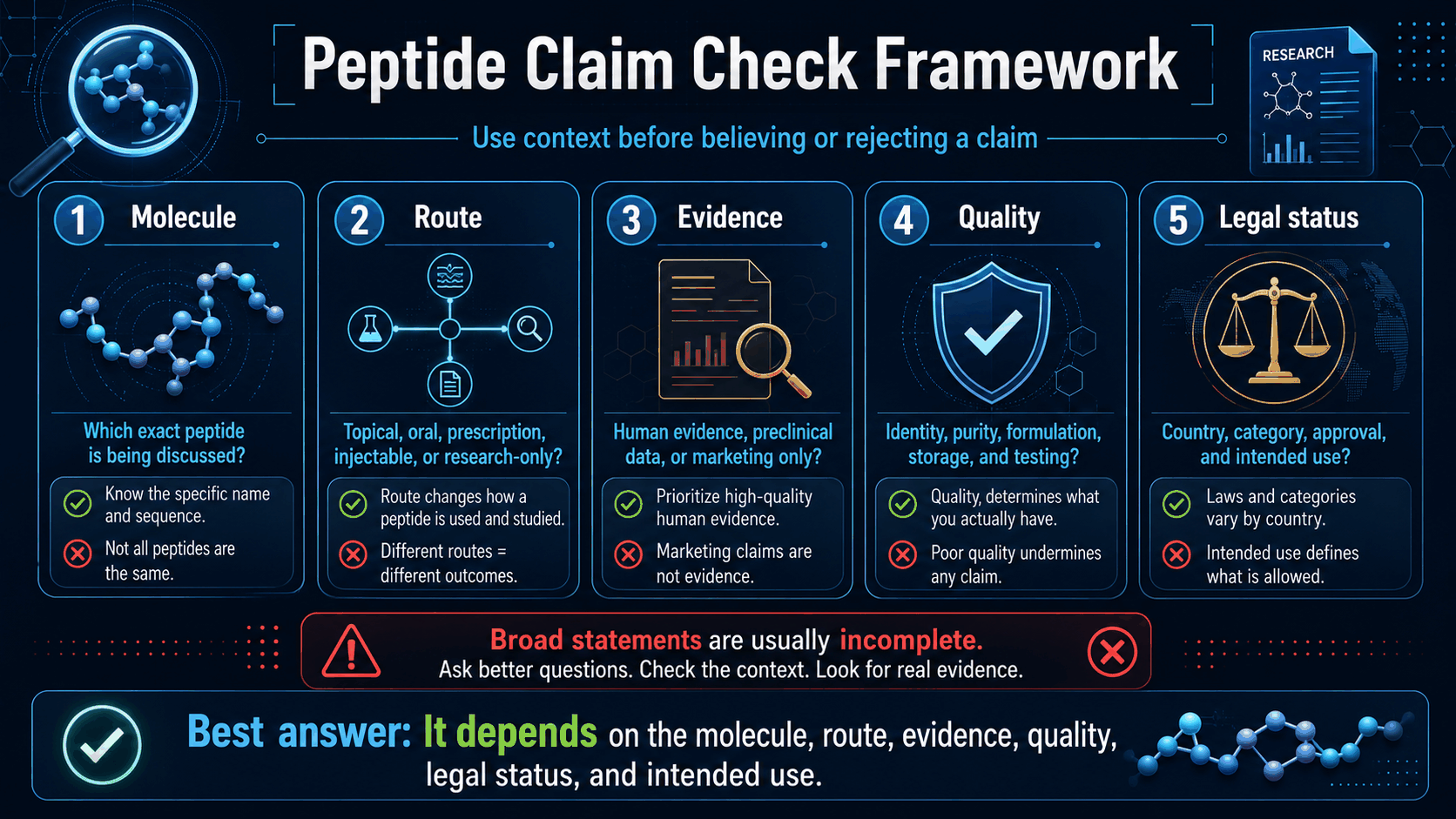
The amino-acid sequence determines structure, receptor binding, and function. BPC-157, Epitalon, Matrixyl, and Argireline are not interchangeable.
Legal status depends on the specific peptide, country, product category, and intended use. Collagen peptides, cosmetic peptides, prescription peptide drugs, and research-only compounds are regulated differently.
Ten oversimplified claims, none of them accurate without context.
Frequently Asked Questions
Are peptides automatically safe because they are made of amino acids?
No. Molecular origin does not guarantee safety. Dose, purity, route, contamination, interactions, and approval status all matter.
Are cosmetic peptides the same as injectable peptides?
No. They differ in formulation, delivery, depth of action, regulation, and risk.
Can online marketing be trusted?
Marketing can be useful for discovery, but claims should be checked against official labels, regulatory status, and credible research.
 Sponsored / AffiliatePeptide ReGenesis · Peptide education, protocols, and wellness-focused resources
Key Takeaways
- Peptides are not one single category of product.
- Price does not prove quality or concentration.
- Collagen works through digestion and signaling, not direct delivery to wrinkles.
- Topical, oral, injectable, prescription, and research peptides are different conversations.
- BPC-157 has promising preclinical data but limited human evidence.
- Legal status and safety depend on the specific product and use.