
Why Timing May Matter
The body is not a static system. It changes with daylight, sleep, temperature, physical activity, hormone rhythms, and nutritional status.
That does not prove that every peptide becomes stronger in one season and weaker in another. It does mean that the biological environment surrounding a protocol can change. For example, vitamin D status often shifts across the year, sleep patterns can change with daylight length, and peripheral circulation may vary with temperature.
The practical goal is not to create rigid rules. It is to understand context, set realistic expectations, and discuss timing with a clinician when timing could matter.
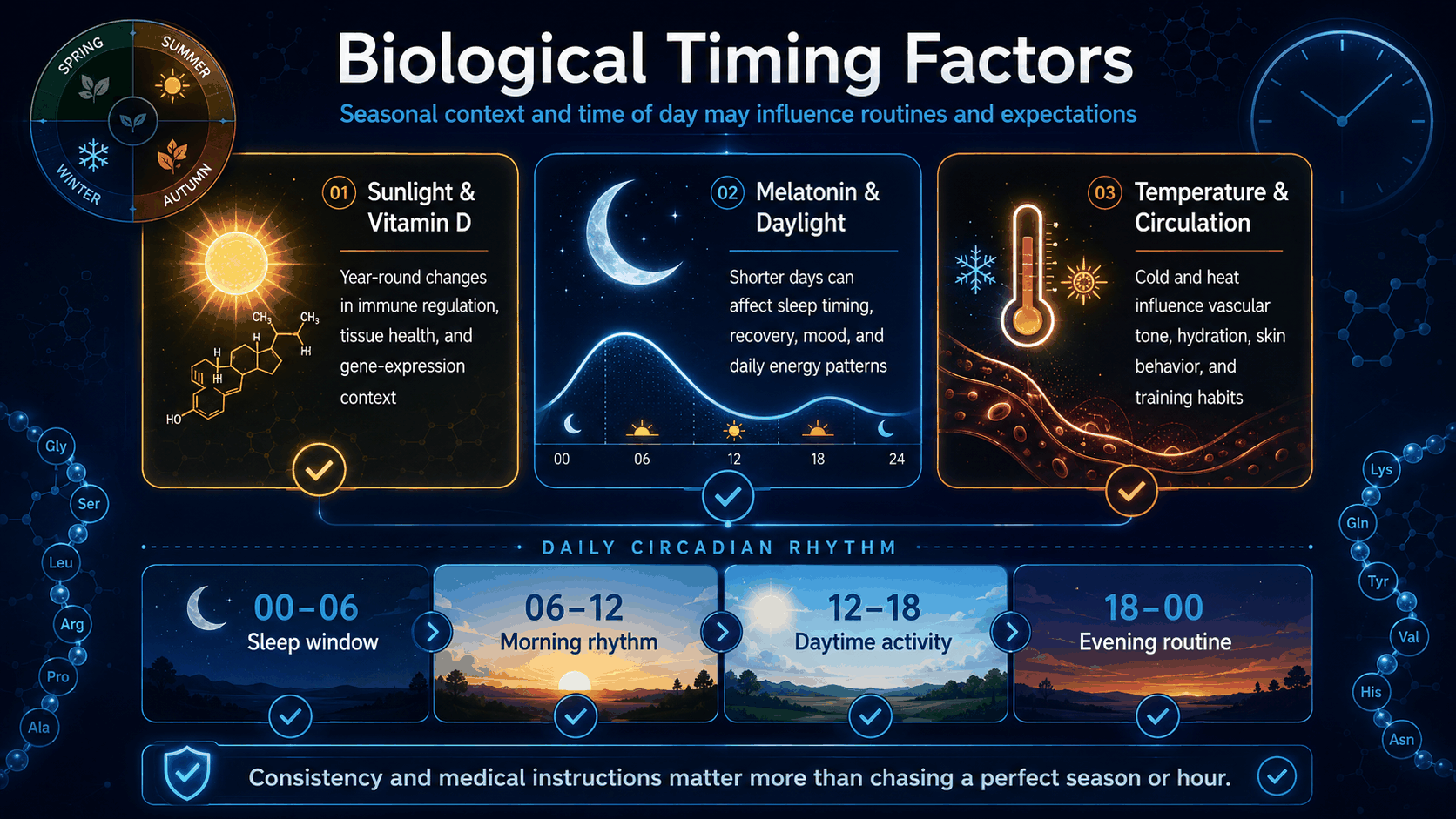
Three Biological Factors Behind Seasonal Change
1. Sunlight and vitamin D
Vitamin D status can change across the year and is involved in immune regulation, tissue health, and many gene-expression pathways.
2. Melatonin and daylight length
Shorter days can alter sleep timing and melatonin exposure, indirectly affecting recovery, hormone rhythms, and daily energy patterns.
3. Temperature and circulation
Cold and heat affect vascular tone, skin behavior, hydration, exercise patterns, and sometimes the comfort of topical or injectable routines.
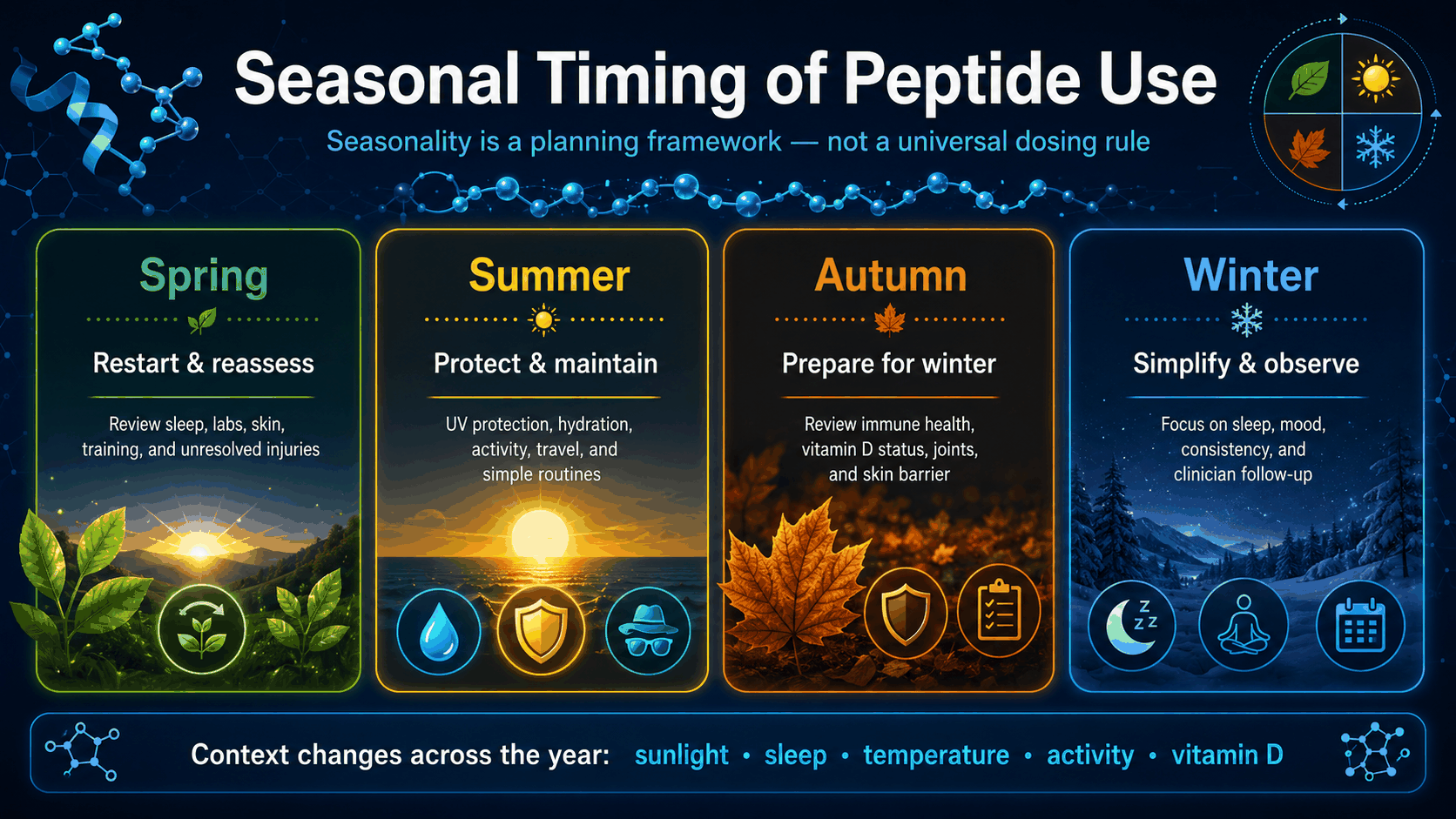
A Season-by-Season Framework
🌿 Spring — Restart and reassess
Spring is a practical time to review winter habits, sleep, training, skin condition, and laboratory results. Some people use it as a reset point for clinician-supervised regenerative or skincare protocols.
☀ Summer — Skin, activity, and UV awareness
Warmer weather often means more exercise, better circulation, more sun exposure, and greater attention to topical skincare. UV protection remains essential because UV radiation accelerates collagen breakdown.
🍂 Autumn — Preparation and maintenance
Autumn is a logical period to review immune health, vitamin D status, joint discomfort, and changes in skin-barrier needs before winter.
❄ Winter — Sleep, mood, and consistency
Shorter days may shift sleep, mood, training, and activity. Winter can be a useful time to focus on adherence, recovery, and clinician-guided evaluation rather than aggressive experimentation.
 Sponsored / AffiliateTeleWellnessMD · Telehealth wellness consultations and health optimization support
Time of Day: The Circadian Layer
Daily hormone rhythms may be more relevant than the season itself for some protocols. Timing should depend on the specific product, route of administration, evidence base, and clinician instructions.
Nighttime is associated with sleep and major growth-hormone pulses.
Morning brings a cortisol rise and is often chosen for stimulating or cognition-focused routines.
Daytime usually offers stable activity, food intake, and movement patterns.
Evening is commonly used for sleep-oriented routines and nighttime skincare.
Seasonal Quick-Reference Table
| Peptide / group | Spring | Summer | Autumn | Winter | Common timing discussion |
|---|---|---|---|---|---|
| Epitalon | Commonly discussed | Possible | Possible | Often discussed | Evening / bedtime |
| GHK-Cu | Popular period | Popular period | Possible | May be less convenient | Morning / daytime |
| BPC-157 | Frequently discussed | Frequently discussed | Frequently discussed | Still discussed | Protocol-dependent |
| Thymosin Alpha-1 / Thymalin | Possible | Possible | Often emphasized | Possible | Morning |
| Semax / Selank | Possible | Possible | Possible | Often emphasized | Morning / daytime |
| DSIP | Possible | May be less relevant | Possible | Often emphasized | Before sleep |
| GH secretagogues | Commonly discussed | Commonly discussed | Possible | Possible | Usually evening / fasting context |
| Topical cosmetic peptides | Popular | Popular with UV protection | Useful | Useful for barrier care | Often evening |
| Oral collagen peptides | Year-round | Year-round | Year-round | Year-round | Any consistent time |
This table is a content-planning framework, not a dosing guide or treatment recommendation.
A Practical Annual Planning Framework
- Spring: review and restart.
Reassess goals, labs, skin condition, training load, and unresolved injuries. - Summer: protect and maintain.
Prioritize UV protection, hydration, exercise recovery, and simple routines that are easy to follow while traveling. - Autumn: prepare for winter.
Review immune health, sleep, vitamin D status, joint symptoms, and skin-barrier needs. - Winter: simplify and observe.
Focus on sleep, mood, consistency, clinician follow-up, and avoiding unnecessary protocol changes.
Common Myths
Myth: Peptides should never be used in winter.
Seasonality is not a prohibition. A medically indicated treatment should not be delayed simply because of the calendar.
Myth: Seasonal timing is fully proven for every peptide.
It is not. Chronobiology and seasonal physiology are real fields, but peptide-specific evidence is uneven and often limited.
Myth: A seasonal chart can replace medical advice.
It cannot. Product quality, diagnosis, route, dose, interactions, approval status, and individual risk matter far more than a seasonal label.
 Sponsored / AffiliateApollo Peptide Sciences · Research-focused peptide science and molecular data
Key Takeaways
- Season can change the biological context around a peptide protocol.
- Time of day may matter for sleep-, cognition-, or hormone-related routines.
- Consistency and medical supervision matter more than chasing a perfect season.
- Seasonality should be treated as a planning framework, not a dosing rule.